
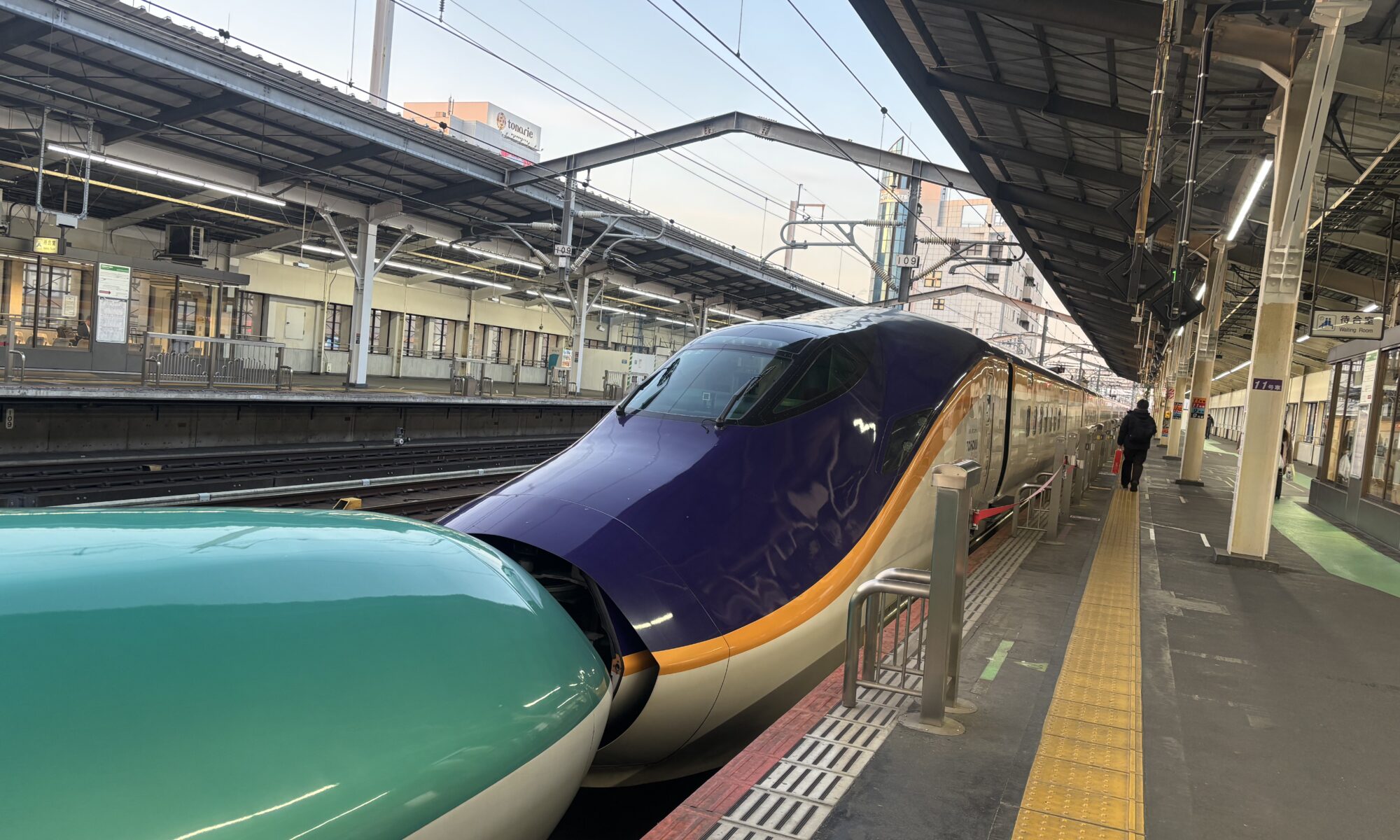
A rare business trip to Utsunomiya, and an unexpected encounter on the way home. Along with a good deal of regret.
Heading Home After Work
When we book the Shinkansen home from a business trip, we almost always choose whatever leaves soonest after the work finishes. Meetings can overrun, or wrap up early, so the priority is simply “the first train we can catch.”
This trip was no different. We gave no thought at all to which train it would be.
Our usual line is the Tokaido Shinkansen; we rarely have reason to use the Tohoku Shinkansen. It had been a long time since we’d even been to Utsunomiya.
A Streak of Purple on the Platform
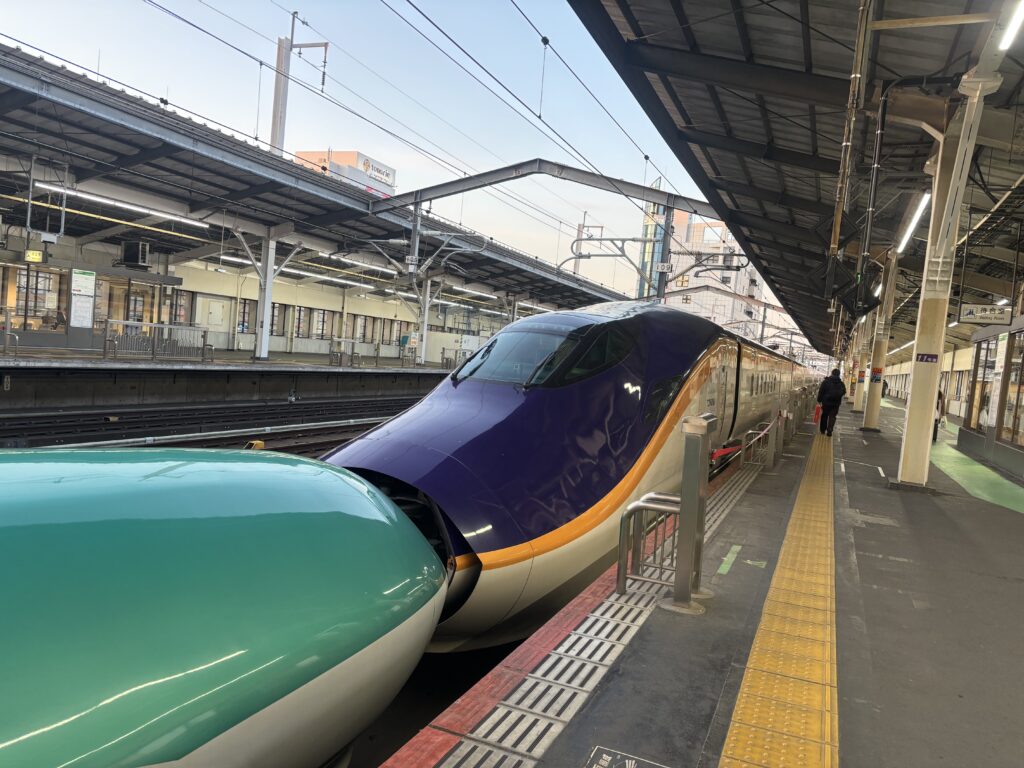
Glancing idly at a phone on the platform, we caught an unfamiliar colour sliding in at the edge of our vision, and looked up.
Sliding quietly in was an E8 Series Shinkansen “Tsubasa” in deep purple. The body colour is called Oshidori Purple, set against the white of Zao Bianco and a band of Benibana Yellow that reads almost as gold. A restrained combination, and yet it dominates the platform.
The sharp nose of the lead car against that glossy purple is a genuinely striking combination. Other passengers on the platform were reaching for their cameras too. We shot away, thoroughly taken with it.
We were determined to film it while it was moving, and remember concentrating hard on doing exactly that.
The E8 Series entered service in 2024 on the Yamagata Shinkansen. Its three colours – Oshidori Purple, Zao Bianco and Benibana Yellow – are all inherited from the E3 Series it replaced. The safflower, Yamagata’s prefectural flower, gives its name to the yellow band rather than to the body. The design was overseen by Ken Okuyama, an industrial designer from Yamagata. Between Tokyo and Fukushima it runs coupled to a Tohoku Shinkansen “Yamabiko,” separating at Fukushima to continue toward Yamagata. Utsunomiya lies within the coupled section.
And Our Train Was the Next One
Here is the part that still stings.
The Tsubasa arrived as the service immediately before the one we had booked.
That purple ran past us. We got the shots we wanted. What we didn’t get was a ride. Had we booked one train earlier, we would have been on it.
Watching it pull away from the platform, the regret set in slowly.
We Should Have Researched a Line We Never Use
Thinking about it calmly, the cause is obvious.
We had forgotten that a new train, the E8 Series, was running there at all.
Because we so rarely take the Tohoku Shinkansen, we had never looked into what runs on it. We booked purely on “the first train after work finishes,” and the question of rolling stock never entered our heads.
Which is faintly absurd. On the Tokaido Shinkansen we’re particular enough to specify seat E in order to see Mount Fuji. On a line we know, we care about the seat number. On a line we don’t, we checked nothing whatsoever.
If you’re planning to take the Tohoku or Yamagata Shinkansen When you book, take a moment to check which type of train operates that particular service. JR East’s site and the Ekinet booking service both show the rolling stock for individual trains. Shifting your booking by one service can change what you get to ride. The less familiar the line, the more this small step is worth.
Looking It Up Afterwards: You Can Still Board a Full Train
Smarting from the whole thing, we went and read up on the Tsubasa when we got home. Which is how we learned something we hadn’t known.
The Tsubasa is entirely reserved-seating, year round. There are no unreserved cars. However, when the reserved seats sell out, a “standing limited express ticket” (立席特急券 / tachiseki tokkyūken) is released.
- It costs ¥330–¥930 less than an ordinary reserved seat
- You are, in principle, expected to stand — the ticket itself states that it does not entitle you to a seat
- In practice, if a seat happens to be free, sitting in it is not a problem
The catch is how you buy it. These tickets are not sold through Ekinet. You have to buy one at a reserved-seat ticket machine in a station, on the day of travel or the day before. If you’re searching online from overseas you simply won’t find it, so plan on doing this at a station.
Standing all the way home after a day’s work isn’t much of a plan. But knowing there’s an option other than giving up when everything is sold out felt like something worth having. For a leisure trip, we’d take it.
Please note: this is information we looked up after the fact rather than something we’ve used ourselves. Check JR East’s official guidance for the current terms.
For everyday travel, “whatever gets me home fastest” is a perfectly reasonable rule. But on a line you’ll only ride once in a long while, it’s worth spending a few minutes before you book — a lesson this trip delivered rather firmly.
In Summary: We Saw It, and We Missed It
Those few minutes on the platform at Utsunomiya were genuinely memorable. Precisely because we weren’t expecting it, the shock of that purple appearing in front of us was considerable.
Honestly, though, the frustration of not riding it has stayed with us more strongly.
Next time we head north, we’ll check the timetable and the rolling stock before booking. Booking the Tsubasa on purpose — that’s the homework now.
The trip home from a business trip pulls you toward “whichever train leaves first.” There’s nothing wrong with that. But apply it on a line you’ll rarely see again and this is the sort of thing you’re left with. Next time, we’ll be a little greedier.
A note added later: when we first wrote this, we were convinced the train we had seen was the one known as the “Kabuki Color.” Looking it up afterwards, we found that the name belonged to the livery carried by the E3 Series 2000 subseries from December 2008, and that it disappeared when the exterior design was revised from April 2014 onwards. The E3 Series “Tsubasa” itself ended regular service in December 2025. In other words, we had been looking for a livery that had been gone for more than a decade – which lands us right back at the point of this article: we should have checked first. The relevant passages have been corrected.
How particular the same writer gets on a line they do know well is covered here.
→ Riding the Tokaido Shinkansen N700S for Work | How to See Mount Fuji from Your Seat