Hello, this is mascots! This time, I’m sharing a special rail journey to celebrate my birthday. Our destination: Amanohashidate, one of Japan’s three most scenic views. The weather turned out rainy, but thanks to some wonderful sightseeing trains, it became an unforgettable day. 🚃
From Shin-Osaka to Fukuchiyama on the Limited Express “Kounotori”
Our journey began at Shin-Osaka Station, where we boarded the limited express “Kounotori.”
Connecting Shin-Osaka with Fukuchiyama, this train is an essential gateway to the Kita-Kinki region. Watching the scenery gradually shift from cityscape to lush countryside through the window, our excitement for the trip steadily grew.
What is the Limited Express “Kounotori”? Operated by JR West, it connects Shin-Osaka/Osaka with Fukuchiyama, Toyooka, and Kinosaki Onsen. It’s a key means of access to the Kita-Kinki area.
Changing to the “Tango Relay No. 3” at Fukuchiyama
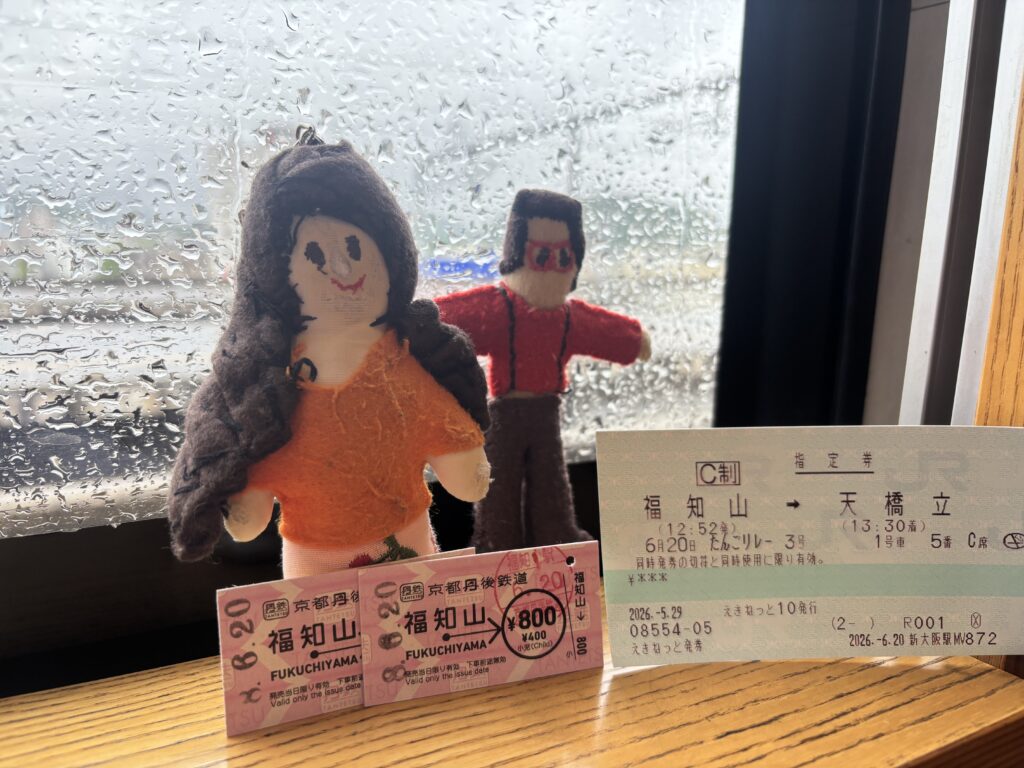
At Fukuchiyama Station, we transferred to the Kyoto Tango Railway’s “Tango Relay No. 3” to continue toward Amanohashidate.
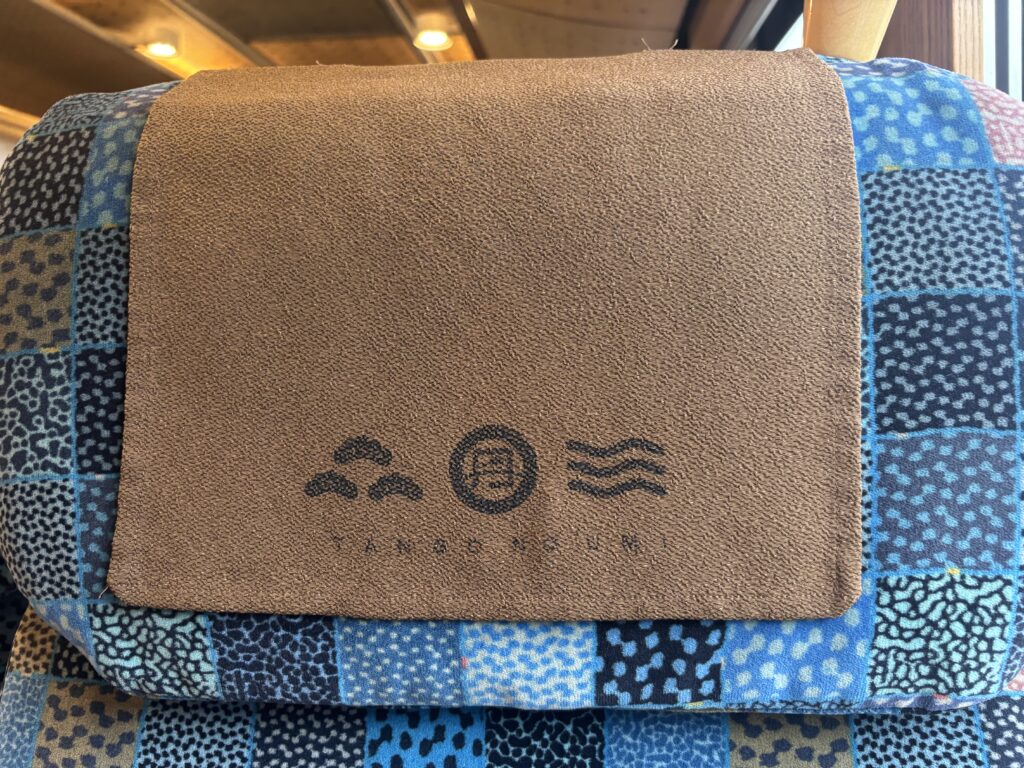
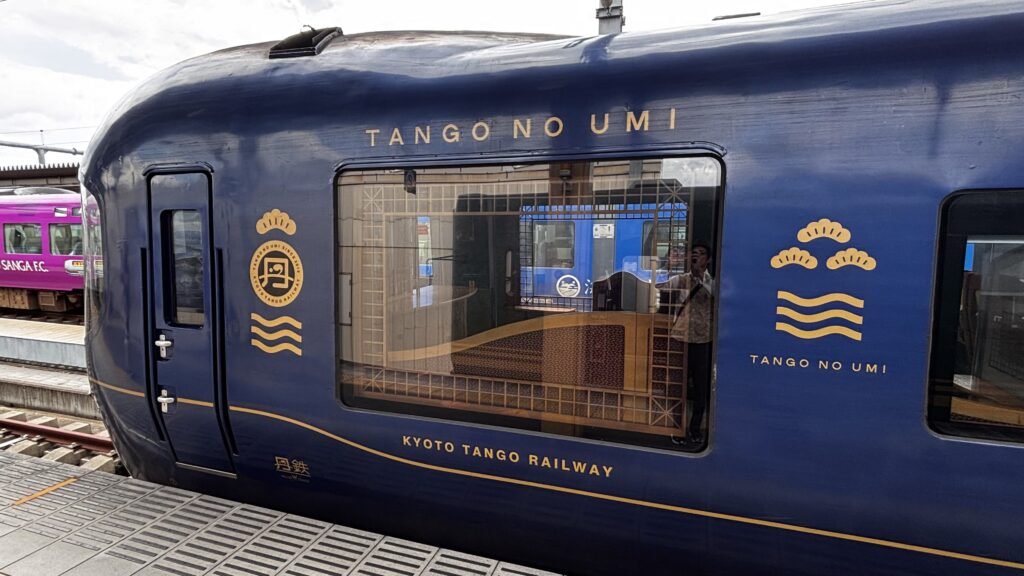
And what luck — the train we boarded was the popular “Tango no Umi” (Sea of Tango)! Designed by Eiji Mitooka, this beautiful train wears a deep indigo color known as “Tango Blue.” The elegant interior, generously finished with wood, feels almost like a moving drawing room. The slightly gloomy mood from the rain instantly lifted the moment we stepped aboard. ☂️✨
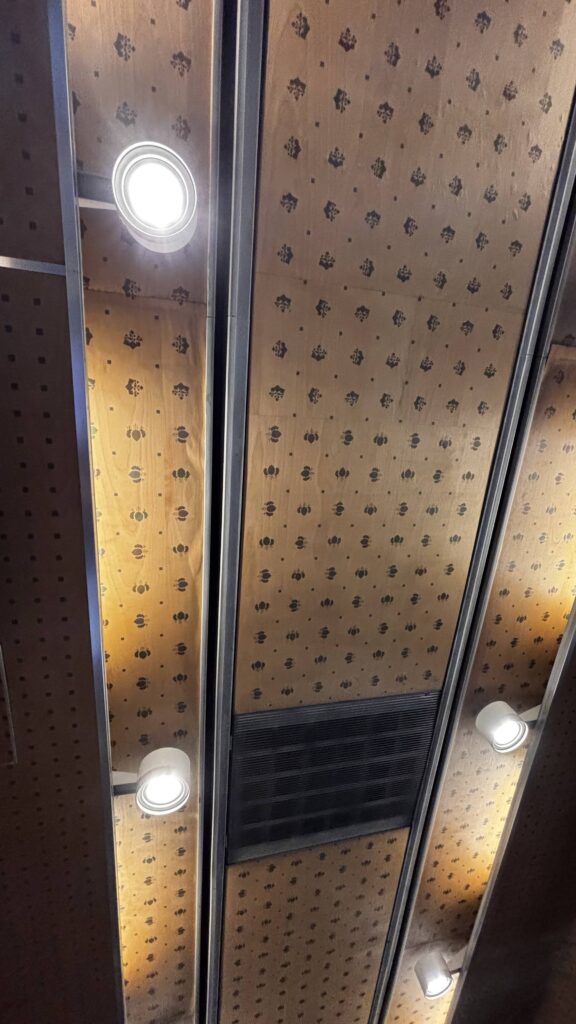
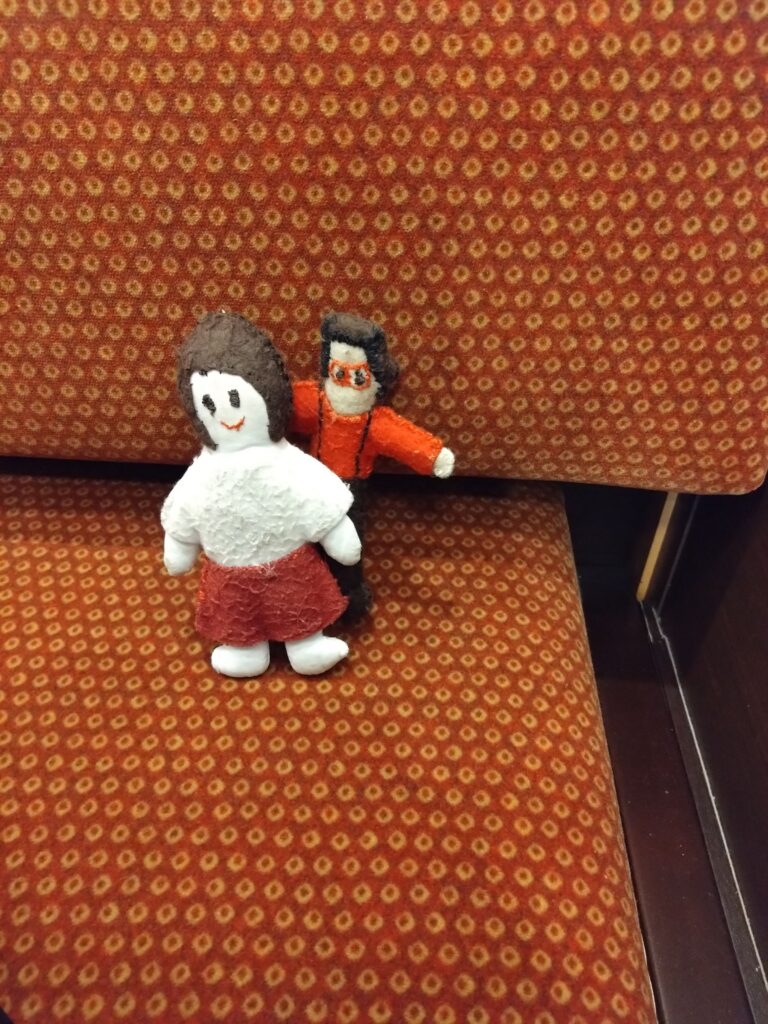
Glancing up, I noticed the mascots all frozen in place, staring at the ceiling. “What’s wrong?” I wondered, following their gaze upward — and there it was: a stunning ceiling design that drew me right in.
The refined decoration highlighting the wood grain, combined with carefully arranged geometric patterns. We usually only look down at our feet or out the window, so it’s easy to miss — but sightseeing trains are crafted with care right up to the ceiling. Thanks to the mascots’ “Look up!” discovery, I was able to appreciate a whole new charm of the train.
What is “Tango no Umi”? A sightseeing train of the Kyoto Tango Railway. Known for its calm indigo exterior and warm, wood-filled interior, it runs as the limited express “Hashidate” and as relay services.
Amanohashidate in the Rain — A Scenic 6-Minute Chairlift Ride
When we arrived at Amanohashidate, the rain was still falling. But giving up isn’t the mascots’ style (laughs).
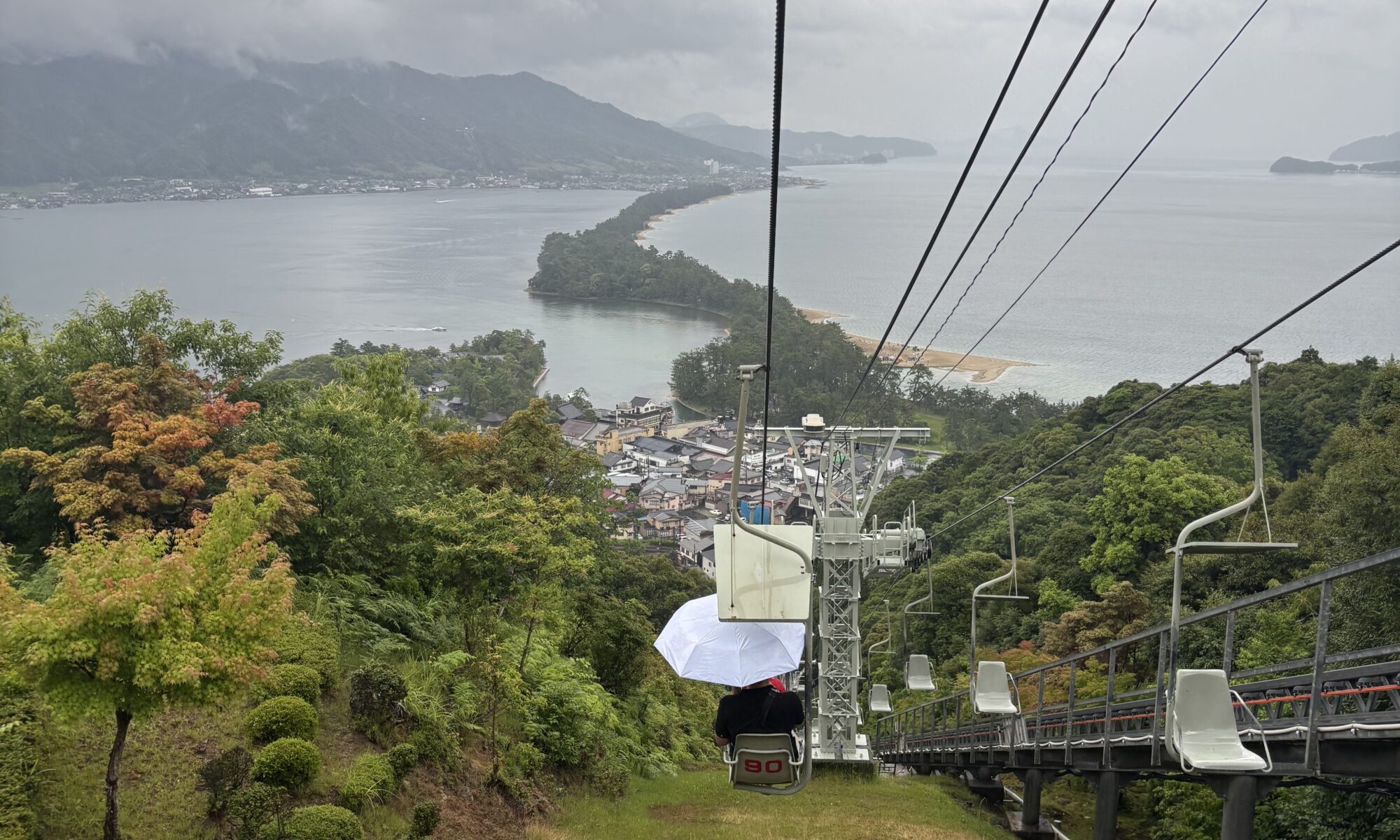
Umbrellas in hand, we took on the chairlift overlooking Amanohashidate! The roughly 6-minute aerial ride was thrilling even in the rain. Looking down at the pine-covered sandbar and the dreamy, mist-shrouded scenery, the mascots were absolutely thrilled. Experiencing a serene beauty different from a sunny day may well be a privilege unique to rainy weather. 🌧️
💡 Travel Tip: Coin Lockers Are a Lifesaver! Amanohashidate has coin lockers where you can store suitcases. They require ¥100, but it’s the type that returns your coin when you retrieve your bag — so it’s effectively free. Being able to drop off heavy luggage and explore hands-free is wonderful, and we especially appreciated it on a rainy day. 😊
The Highlight! The “Bar” Journey on the Tango Kuromatsu Train
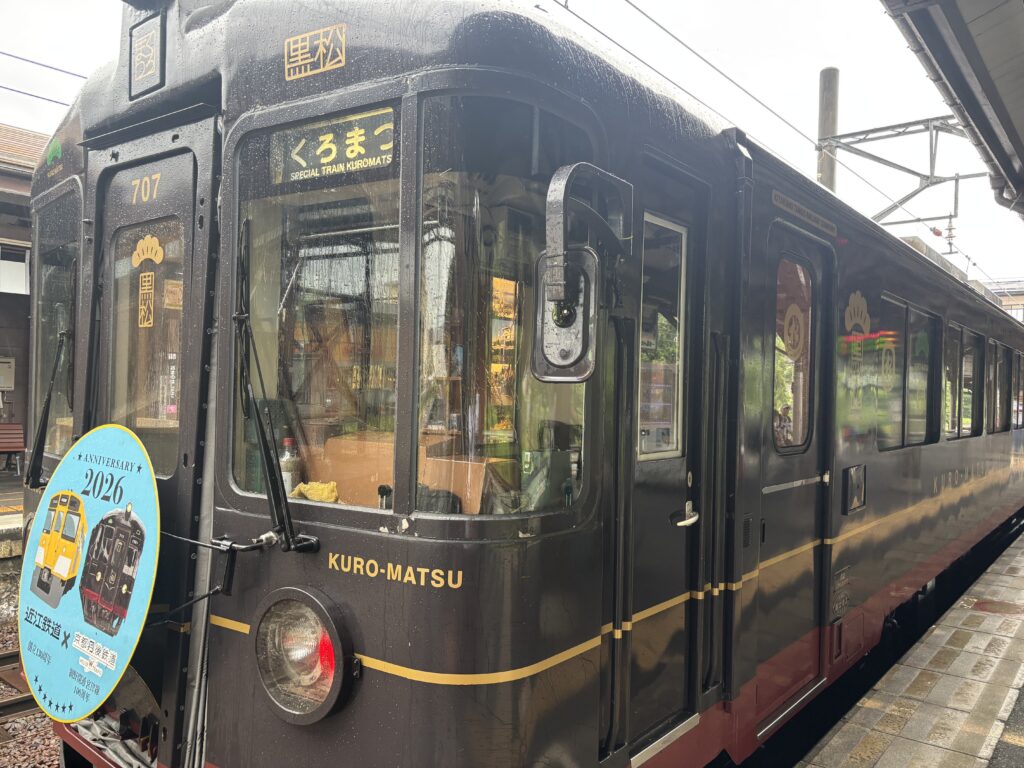
And now, the main goal of this trip — riding the sightseeing train “Tango Kuromatsu“!
We joined the evening “Bar” plan, savoring special dishes served aboard the moving train. The chic, dignified black carriage and the high-quality interior packed with attention to detail made the time feel truly extraordinary.
What impressed me most was how brilliantly the service makes use of the Kyoto Tango Railway’s “one train per hour” schedule. The relaxed timetable typical of a local line is instead elevated into “special time” — a clever approach that left me deeply impressed.
What is the Tango Kuromatsu Train? A restaurant train operated by the Kyoto Tango Railway. Of the three siblings — “Kuromatsu,” “Akamatsu,” and “Aomatsu” — it’s the top-tier, fully reservation-based carriage. Its meal-inclusive plans let you enjoy dishes made with seasonal local ingredients.
The Key to Success: Book Early for Sightseeing Trains
The reason we were able to fully enjoy the meal aboard the Kuromatsu was that we booked a month and a half in advance.
Popular sightseeing trains — especially meal-inclusive plans on weekends — sell out quickly. I was reminded once again that the moment you think “I want to ride this,” the most important thing is to check the reservation status right away.
Meal-inclusive plans are especially competitive
Check operating days and availability early on the official website
Book as soon as your travel dates are set
Summary: A Birthday Rail Trip That Was Wonderful Even in the Rain
Leg
Train
Shin-Osaka → Fukuchiyama
Limited Express “Kounotori”
Fukuchiyama → Amanohashidate
Tango Relay No. 3 “Tango no Umi”
Amanohashidate
Sightseeing (chairlift, coin lockers)
Departing Amanohashidate
Tango Kuromatsu Train “Bar”
It started with unexpected rain, but it became the best birthday trip — full of beautiful sightseeing trains, the dreamy scenery of Amanohashidate, and heartfelt cuisine.
Above all, it became a journey that made me genuinely think, “I want to keep booking and riding sightseeing trains all across Japan.” Which train should we ride next? I can hardly contain my excitement already. 🚃✨
If you’ve been hesitating about traveling on a rainy day, please find the courage to head out. A special memory — different from a sunny day — is surely waiting for you. 😊
We paid a visit to Aman Ruins Park (Aman Iseki Koen) in Takatsuki City, Osaka Prefecture — a park with the JR Kyoto Line running along one edge and the Hankyu Kyoto Line along the other, which makes it close to ideal if you like trains. We went on 23 May 2026, arriving around 2pm, and stayed about an hour. Even in that short window we saw a remarkable number of trains.
Watching JR and Hankyu at the Same Time
The appeal of this park is its position. The Hankyu Kyoto Line runs along the southern edge and the JR Kyoto Line along the northern edge, so both are visible from inside the park.
What surprised us most was how frequently the Hankyu trains come through — roughly one every five minutes, without pause. There’s no sense of waiting at all. You look up and the next one is already arriving.
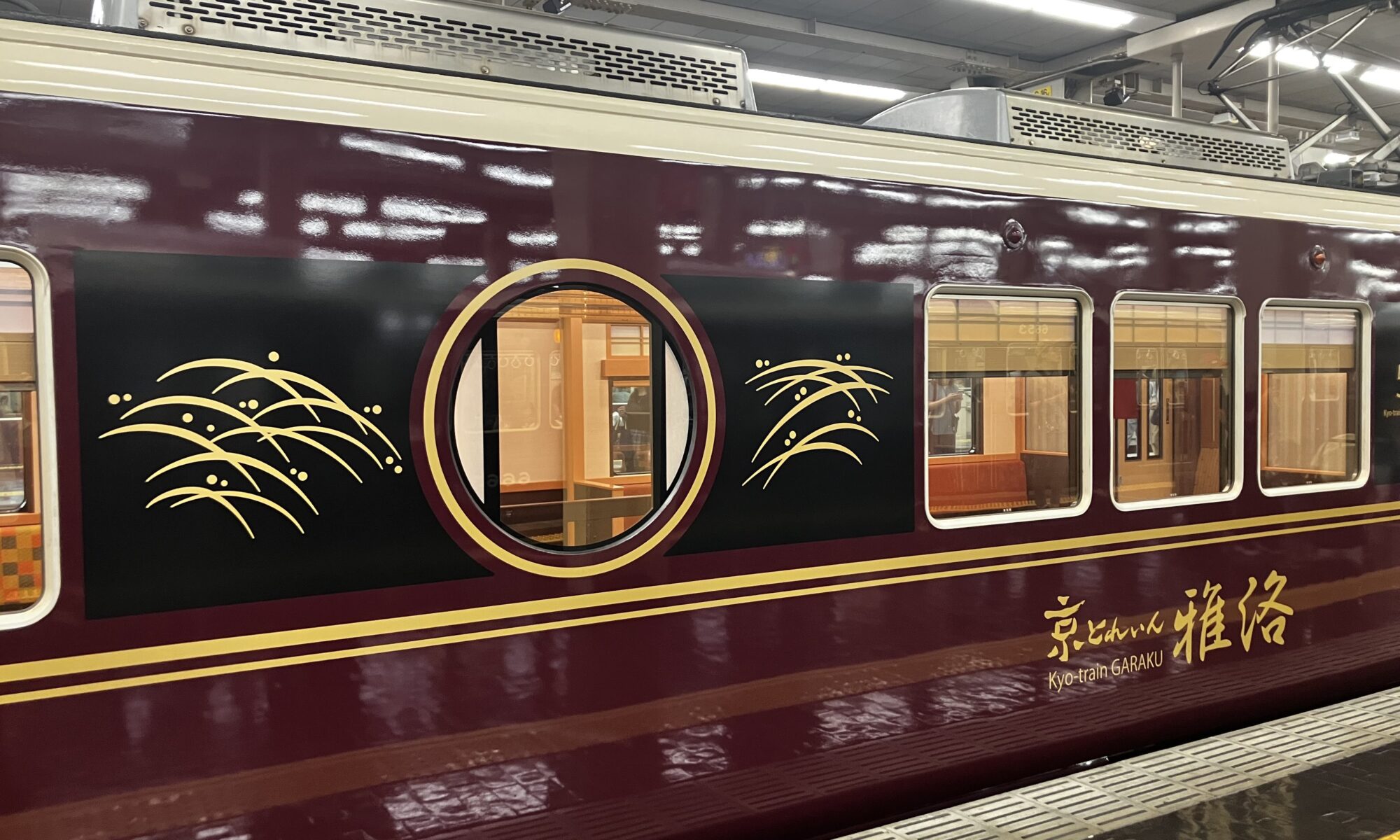
The JR side sits a little further off, across the park. The distance takes some of the impact away, but the variety makes up for it: Limited Express Thunderbird, Limited Express Haruka and the Special Rapid Service all pass this way. On the Hankyu side we also caught the sightseeing train Kyo-train Garaku.
And there is one more star attraction here, which we’ll come to shortly.
Stretching out on the wide lawn and watching trains against an open sky is a pleasure in itself. Bringing a packed lunch would work nicely.
The Starbucks Terrace — The Best Seat in the House
There’s a Starbucks inside the park, and its terrace is the best seat on the Hankyu side. You can sit with a coffee while trains run past directly in front of you. At one every five minutes, you’ll see a good few before your cup is empty.
By the time we arrived, around 2pm, the seats were already filling up. If you’d like to settle in properly, a slightly earlier visit would be safer. The interior is spacious and easy to get into with a stroller.
We gather that in the evening you can watch train silhouettes against an orange sky, but ours was an early-afternoon visit, so we can’t vouch for that ourselves. Something to save for next time.
The Real Thrill Is Beside the JR Tracks
After our break at Starbucks, we walked across the park to the edge of the JR line. This turned out to be the highlight of the day.
The JR Kyoto Line that had looked so distant from the terrace is suddenly right beside you. The Special Rapid Services and limited expresses are impressive enough on their own — but what genuinely stopped us was JR Freight.
A long freight train came through with a sound like the ground shifting, rolling past just a few metres away, on and on and on. A photograph cannot convey it. It is a completely different experience from watching quietly from the café terrace.
We’d read beforehand that freight runs on this stretch, so we went looking for it deliberately — and seeing it from that close exceeded anything we’d pictured. If you have a child who loves trains, this is the spot to bring them.
Play Facilities — You Could Spend All Day Here
There’s more to the park than train-watching. Alongside the large play equipment there’s Bornelund Playville, a play space produced by Bornelund (paid entry).
There’s also an exhibition centre covering the Yayoi-period Aman ruins the park is named after, which was free to visit.
There is parking, though it’s paid, and it apparently fills up at weekends. Both JR Takatsuki and Hankyu Takatsukishi stations are within walking distance, so coming by train, watching trains, and going home by train is perhaps the most fitting way to do this park.
Basic Information
Item
Details
Location
Hatchonawate-cho, Takatsuki, Osaka
Opening hours
Open at all times (individual facilities vary)
Admission
Free
Access
About 15 min on foot from JR Takatsuki Station / about 10 min from Hankyu Takatsukishi Station
Parking
Available (paid)
Date visited
23 May 2026
Where to Watch the Trains
The Starbucks terrace Hankyu trains pass right by. At one every five minutes you’ll see them continuously without moving from your seat. Best before the terrace fills up.
Beside the JR tracks We’d call this the real draw of the park. Special Rapid Services, limited expresses and freight all pass close enough to feel, and the impact is on another level.
The lawn Lie back and take in the sky and the trains together. Good for a slower afternoon.
A note on timing We were there for about an hour in the early afternoon and still saw more than enough. This is a park where you never have to wait. Weekdays are apparently quieter.
About the Aman Ruins
The Aman ruins that give the park its name are the remains of a large Yayoi-period settlement. The exhibition centre inside the park introduces excavated pottery and what daily life looked like at the time.
Trains to watch, playgrounds to run around, and history to take in — there aren’t many parks that manage all three.
Why Families with Young Children Will Love It
From what we saw walking the grounds ourselves, this is an easy place to bring children.
Nursing room and nappy-changing facilities (we checked these on site)
The lawn gives plenty of room to run
Bornelund Playville is paid entry but well equipped
Strollers are fine inside Starbucks
With a train every five minutes, children don’t get bored
It would make a good choice for a child’s first go at train-watching — and the freight trains on the JR side are the sort of thing you don’t forget in a hurry.
Watching a freight train pass right beside you at the fence is something this park does better than anywhere else I know. There is also an event built entirely around freight trains, which I wrote up separately.
An hour at Shin-Osaka before your next train? Here is what someone who lives nearby actually does with it: when to buy 551 Horai’s pork buns without queueing, which shops the current renovation has closed, and what is worth skipping.
What this article covers:
・Whether you actually need to spend that hour waiting at all
・When you can buy 551 Horai’s pork buns without queueing
・Which shops the current renovation has closed, and which remain (as of August 2026)
・What locals actually buy as souvenirs, and what I hesitate to recommend
Do You Really Have to Wait That Hour?
Let me start with something unhelpful: if you are changing between Shinkansen trains, you often do not need to wait an hour at all.
With a non-reserved seat you simply board the next train that comes. A reserved seat can usually be changed. A great deal of the time, an hour that has “opened up” can be closed again at the ticket counter. If you are travelling on a rail pass, ask at the ticket office before you resign yourself to waiting.
Still, real one-hour gaps do happen. You may be connecting to a local line where the next train is a while away. You may be waiting for someone, as I once did here for an hour when a friend came to visit. Or you may have a reserved seat that you have good reason not to give up.
This article is for people who genuinely have that hour. I live near Shin-Osaka and use this station regularly, so what follows is simply what I do.
Shin-Osaka Is Under Renovation Right Now
One thing to know before you plan anything: the shopping area on the local line side of the station is being renovated, and a number of shops are currently gone. This is the situation as of August 2026, and no completion date has been announced.
Many guides online still list shops that no longer exist. As you will see below, some of the places I used to rely on have disappeared too.
551 Horai Pork Buns: When You Can Actually Buy Them
Butaman, steamed pork buns, from 551 Horai are the classic Osaka souvenir. Whether you queue or not comes down entirely to timing.
I buy them about once a month, and this is my experience. On weekdays after 7:30pm the line gets dramatically shorter, and that is the window to aim for. At weekends the queue is intimidating, and if you only have an hour I would give up on it rather than gamble.
Here is something that surprises a lot of people: you can buy a single bun. Most visitors assume they only come in boxes and rule them out entirely, but the shop will happily sell you just one. Grabbing one for yourself between trains is a perfectly normal thing to do.
If you buy the chilled type rather than the hot one, it travels fine on the Shinkansen.
Takomasa’s Akashiyaki (2nd Floor)
I like this place and eat here now and then. Akashiyaki is a softer, egg-rich relative of takoyaki: octopus dumplings that you dip into dashi broth rather than coat in sauce.
I will be honest, though. It gets busier than you would expect.
Some guides say fifteen minutes is enough. Depending on the queue, that is optimistic. If you have one hour and try to fit in both a meal and souvenir shopping, you will end up rushing one of them.
If you are going to eat, give up on the shopping. That is the realistic trade-off.
Souvenirs: Honestly, This Is the One
Takopatie (2nd floor, 3rd floor, and convenience stores)
Takopatie is regularly voted the most popular souvenir at Shin-Osaka. There is a saying in Japan that famous local specialities are never actually good. This one is the exception. It is genuinely delicious.
There are three reasons I keep buying it. It is light, so it does not weigh down your bag even if you buy it at the very end of a trip. The twelve-piece box is the right size and the right count for handing out. And you can buy it almost anywhere in the station: the souvenir shops on the second and third floors, and even the convenience stores.
That last point is what matters when you only have an hour. You do not have to queue at a speciality counter, because you can pick it up at a convenience store.
Tenten’s Bite-Sized Gyoza: Not for Everyone, Honestly
This one gets recommended constantly, but I do not push it.
I have bought it as a gift. The problem is that it is difficult to cook. The dumplings are small and thin, so if you get the heat wrong they do not turn out well. As a present for someone who enjoys cooking, it is a fine choice. As a souvenir that anyone will be pleased with, I think the bar is a little high.
Kiyasu Sohonpo’s Mitarashi Dango: No More Fresh Off the Grill
I used to come here often, because you could buy the dango grilled to order in the local line shopping area. Skewers with a fragrant char, handed over the same day, made an excellent gift.
The renovation has taken that shop away. You can still buy the dango at the souvenir section near the Shinkansen gates, but buying them fresh off the grill is not something you can do at the moment.
Rikuro’s: It Has Moved
Rikuro’s is known for its freshly baked cheesecake. Its shop in Ekimarche, on the local line side, is also gone during the renovation.
There are still counters on the third floor by the Shinkansen gates and in the third-floor souvenir shop, so if you are waiting for a Shinkansen you can pick one up on your way through.
The Steam Locomotive Driving Wheels on the 1st Floor
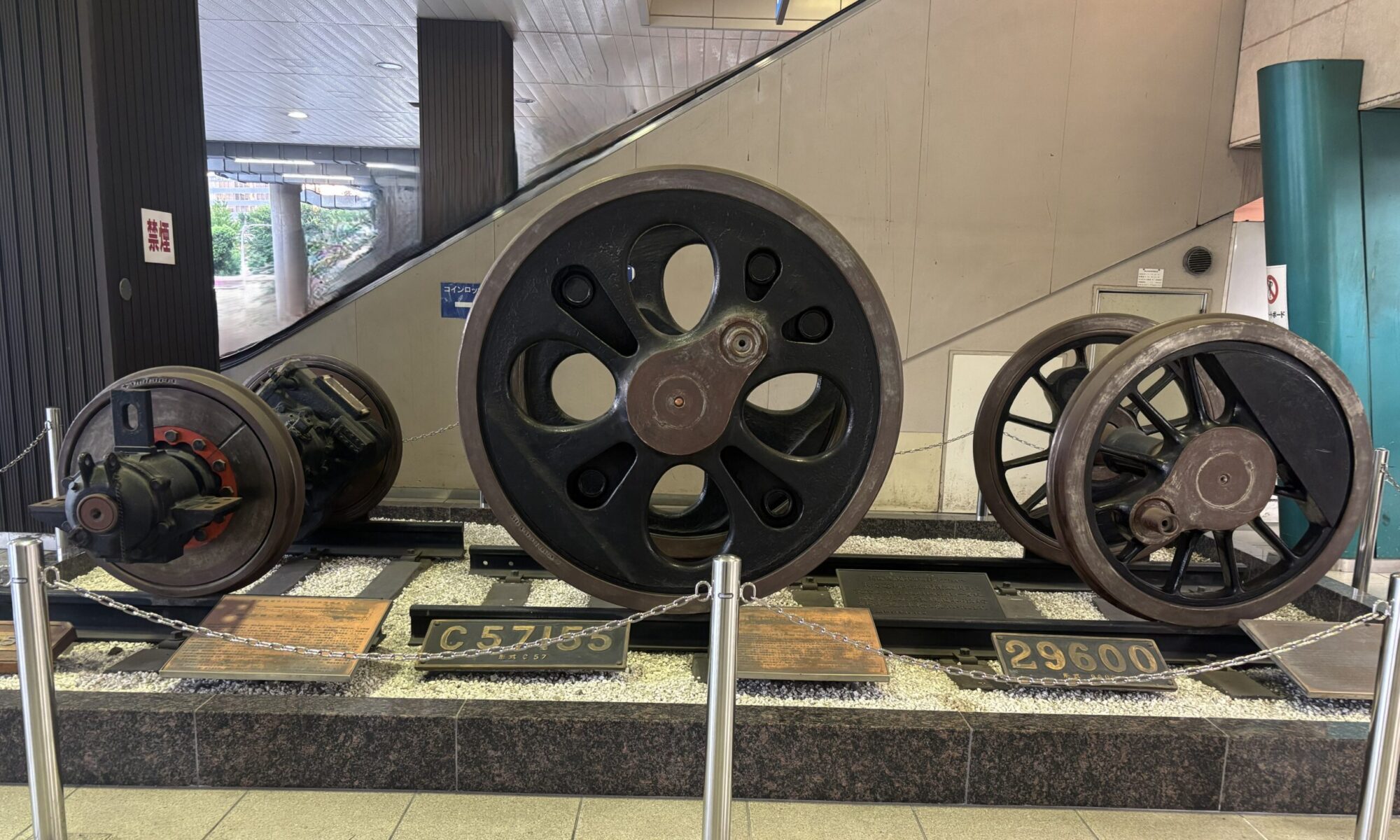
If you like trains, go down to the first floor when you get the chance. Three wheelsets are displayed beside the escalator.
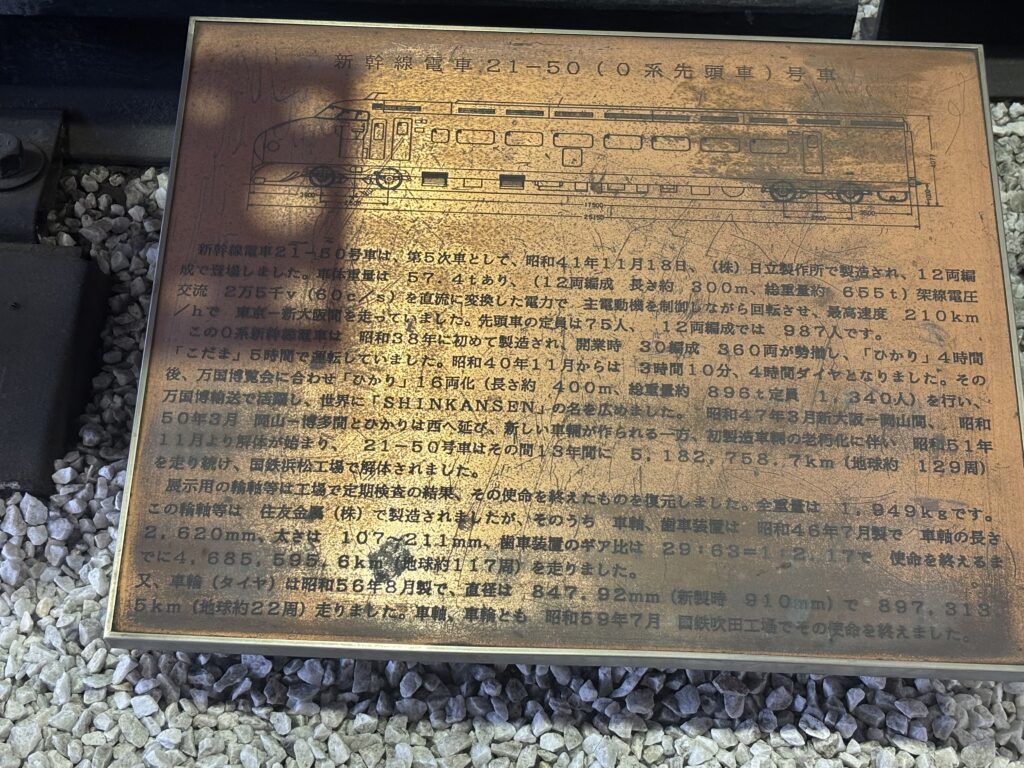
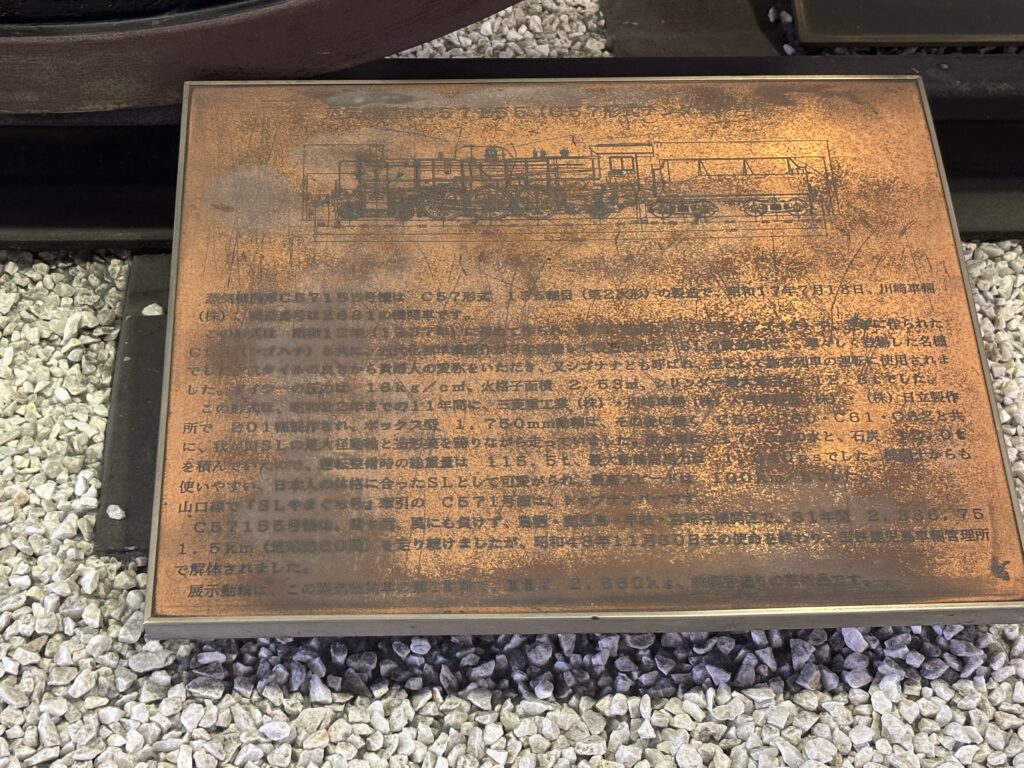
From left to right: a wheelset from car 21-50 of a 0 Series Shinkansen, a driving wheel from the C57 155 locomotive, and a driving wheel from the 29600. Each has its own brass plate, and the plates are worth stopping to read.
The 0 Series plate records that this wheelset covered 5,182,758.7 km over thirteen years, roughly 129 times around the Earth. The wheel began life 910 mm in diameter and had worn down to 847.92 mm by the time it was retired.
C57 155 was built by Kawasaki Sharyo in 1942 and ran for thirty-one years. What is on display is its second driving wheel, 1,750 mm across and weighing 2,880 kg.
I stop and look every time I have a reason to be on the first floor. It is inside the station, so a few minutes is all you need.
Nakajima Soja Shrine: Five Minutes on Foot
If you have a little room in your schedule, Nakajima Soja is about a five-minute walk from the station.
It is a shrine with more than 1,300 years of history and almost no tourists. Locals simply call it the Nakajima shrine. I go there myself at New Year.
Allow fifteen minutes for the walk there and back plus the visit itself. If you only have an hour, you will have to cut something else to make room.
The Roof Garden at Arde Shin-Osaka
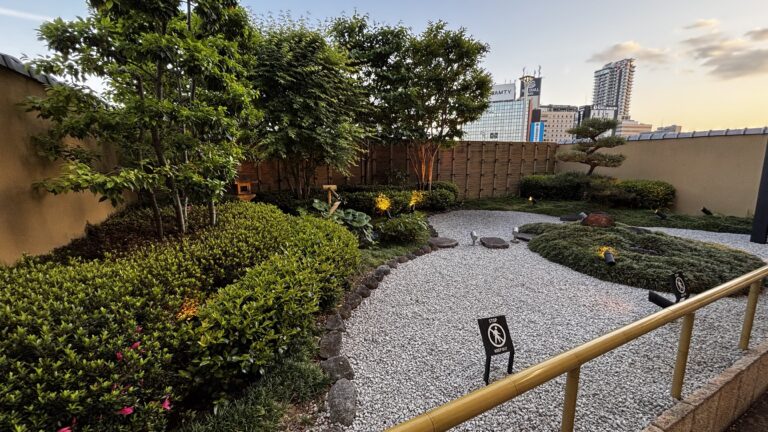
Arde Shin-Osaka, the shopping complex connected to the station, has a roof garden.
The appeal is the surprise of it: a garden, at Shin-Osaka. There are benches, so it works perfectly well as a place to sit down for a while.
One honest warning. You cannot see the Shinkansen from here. It is sometimes described as a hidden train-watching spot. It is not one. Come for the novelty of finding greenery at the station, not for the trains.
In Summary: With One Hour, Don’t Try to Do Everything
What you want to do | Realistic time | Notes
What you want to do
Realistic time
Notes
Akashiyaki at Takomasa
Depends on the queue
Do this and skip everything else
551 Horai pork buns
Minutes on a weekday evening, long queue at weekends
You can buy a single bun
Takopatie
Minutes, convenience stores included
If in doubt, this one
Steam locomotive wheels (1F)
A few minutes
Inside the station
Nakajima Soja Shrine
15 minutes there and back
Outside the station
Arde roof garden
10 minutes
No Shinkansen view
You cannot fit all of it into an hour. Choosing between a meal and shopping is the realistic approach.
And to repeat the point I opened with: if you are travelling by Shinkansen, changing your train time is also an option.
Gion Festival Has More to Offer Than the Main Boulevard!
Gion Festival is one of Kyoto’s most iconic summer traditions. This time, instead of sticking to the main street, we discovered a whole new way to enjoy the festival — wandering through Kyoto’s narrow back alleys to find the floats and mountain floats tucked away in quieter corners of the city.
Arare Tenjin-yama: A Place That Brought Back Student Memories
Our first stop was Arare Tenjin-yama.
This float is famous for its protective power against fire, and it also happened to be a place I visited during my student days. Revisiting it brought a wave of nostalgia — and yet, looking at it with fresh eyes, I noticed new details I’d never seen before. It reminded me just how deep the history of Gion Festival really runs.
About Arare Tenjinyama: One of the iconic floats of Gion Matsuri, this float is said to have protected the city from a devastating fire in 1582 (the 10th year of the Tensho era). Its chimaki (sacred rice dumplings) are popular as fire-prevention charms and sell out quickly each year.
A New Way to Enjoy Gion Festival — Why the Back Alleys Are Worth Exploring
Here’s what makes wandering the side streets such a special experience:
Fewer crowds than the main boulevard — you can take your time and look properly
A warmer, more intimate atmosphere with locals nearby
Each float and mountain float has its own unique history and story to discover
The contrast between the traditional Kyoto townhouses and the floats makes for stunning photos
The back alleys of Gion Festival are a hidden gem — and one we’d highly recommend adding to your itinerary.
Kikusui-hoko: Another Highlight Along the Way
Next, we stopped by Kikusui-hoko. Unlike the famous floats lining the main street, the floats and mountain floats tucked into the side streets have a quietly different atmosphere.
Walking these narrow lanes, you can feel the living culture of the festival — lovingly preserved and carried forward by the local community, generation after generation.
Kikusui-hoko is one of the floats in the Gion Festival’s Sakimatsuri (front festival). It takes its name from the Noh play “Kiku Jido” and is said to grant the blessing of longevity. Original Kikusui-hoko tea and sweets are also sold on the float itself.
Things to Know Before Visiting Gion Festival
Gion Festival runs throughout the entire month of July, from the 1st to the 31st. The highlight events are the Sakimatsuri yamahoko procession on July 17th and the Atomatsuri procession on July 24th — but the Yoiyama evenings (the nights before the processions) are also incredibly lively, with food stalls and float displays filling the streets.
Tips for your visit:
Wearing a yukata (summer kimono) adds to the atmosphere and is highly recommended
If you want to avoid the biggest crowds, weekday mornings are your best bet
Some floats offer paid boarding experiences — well worth trying if you get the chance
Chimaki (protective rice dumpling charms) sold at each float make wonderful souvenirs
On the Way Home — A Chance Encounter with the Kyototrain Garaku!
After finishing our stroll, we were heading home when we stumbled upon the Kyototrain Garaku — and somehow managed to get on board!
This was a train I’d always wanted to ride. The beautiful Japanese-inspired interior design, evoking the changing seasons throughout the carriages, was everything I’d hoped for. Even the Mascots were unusually quiet, clearly soaking in the atmosphere (laughs).
Each carriage features a different interpretation of traditional Japanese aesthetics — from a karesansui dry garden space to wooden bench seating reminiscent of a traditional engawa veranda. The BGM playing softly through the carriages was equally Japanese in feel, making the whole journey feel like an extension of Kyoto itself.
Stumbling onto the Kyototrain at exactly the right moment felt like the perfect reward to round off the day. With the lingering warmth of Gion Festival still in our hearts, we made our way gently back to Osaka. Next time, I’d love to plan the trip around the train schedule so we can enjoy the full experience from start to finish.
The Kyototrain is a sightseeing train operated by Hankyu Railway. Themed around traditional Japanese aesthetics, each carriage features a different seasonal landscape. It runs mainly on weekends and public holidays between Osaka-Umeda and Kyoto-Kawaramachi. Check the schedule in advance before your visit.
Recommended Itinerary: Gion Festival + Kyototrain
Time
Activity
Morning
Arrive in Kyoto, begin back-alley festival stroll
Late morning
Visit Arare Tenjin-yama, Kikusui-hoko and more
Midday
Lunch at a Kyoto restaurant
Afternoon
Continue exploring the side-street floats
Evening
Board the Kyototrain from Hankyu and head back to Osaka
Summary: Gion Festival Back Alleys + Kyototrain — The Perfect Kyoto Summer Combination
Highlight
What Made It Special
Arare Tenjin-yama
Fire-protection charm, nostalgic memories from student days
Kikusui-hoko
Longevity blessing, quiet side-street atmosphere
Kyoto back alleys
A hidden, unhurried way to experience Gion Festival
Kyototrain
Japanese-inspired interior, soaking in the Kyoto afterglow
Gion Festival takes place every July. The Yoiyama evenings and yamahoko processions are especially crowded, so book your accommodation well in advance!
At the start of 2026 we set ourselves a goal: to spend the year experiencing things that are real rather than reproduced. It came out of a single film we watched over the New Year.
What followed was three months of chasing one story — from a shrine in Osaka to a theatre in Kyoto.
3 January | A Film Called Kokuho, and a Goal
Kokuho (National Treasure) was widely talked about in 2025. We finally watched it over the New Year period, and it moved us considerably.
The goal we set afterwards was the one above: spend the year touching the real thing, not a copy or a description of it.
And the work featured in the film was “The Love Suicides at Sonezaki” (Sonezaki Shinjū), the classic tragedy by Chikamatsu Monzaemon. We wanted to see it performed live. That was where these three months began.
14 February | First, the Shrine Where the Story Is Set
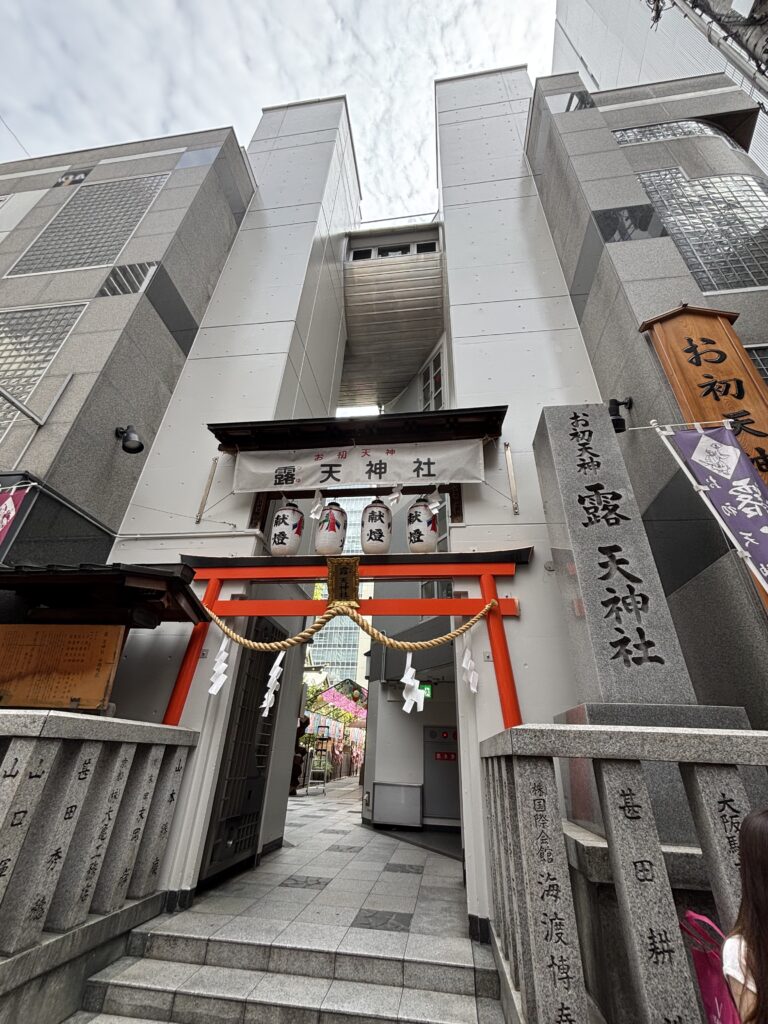
Before the performance, we decided to visit the place the story is set in. That meant Ohatsu Tenjin, a short walk from Higashi-Umeda Station in Osaka.
Its formal name is Tsuyunoten-jinja, a shrine with around 1,300 years of history. It is known as the setting of Chikamatsu’s jōruri play “The Love Suicides at Sonezaki,” and is also popular as a shrine for matchmaking and romance.
In the grounds stands a statue of Ohatsu and Tokubei, the two lovers of the story, side by side to greet visitors.
It’s a quiet space that appears out of nowhere in the middle of a business district — an oddly separate place that lets you forget the city around it. Seeing the setting first genuinely changed how we received the performance in March.
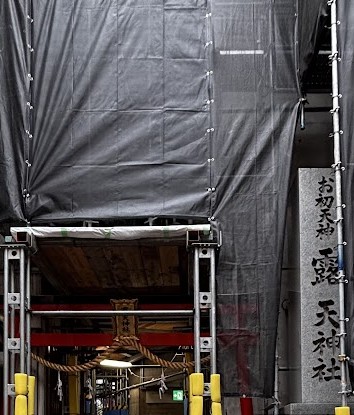
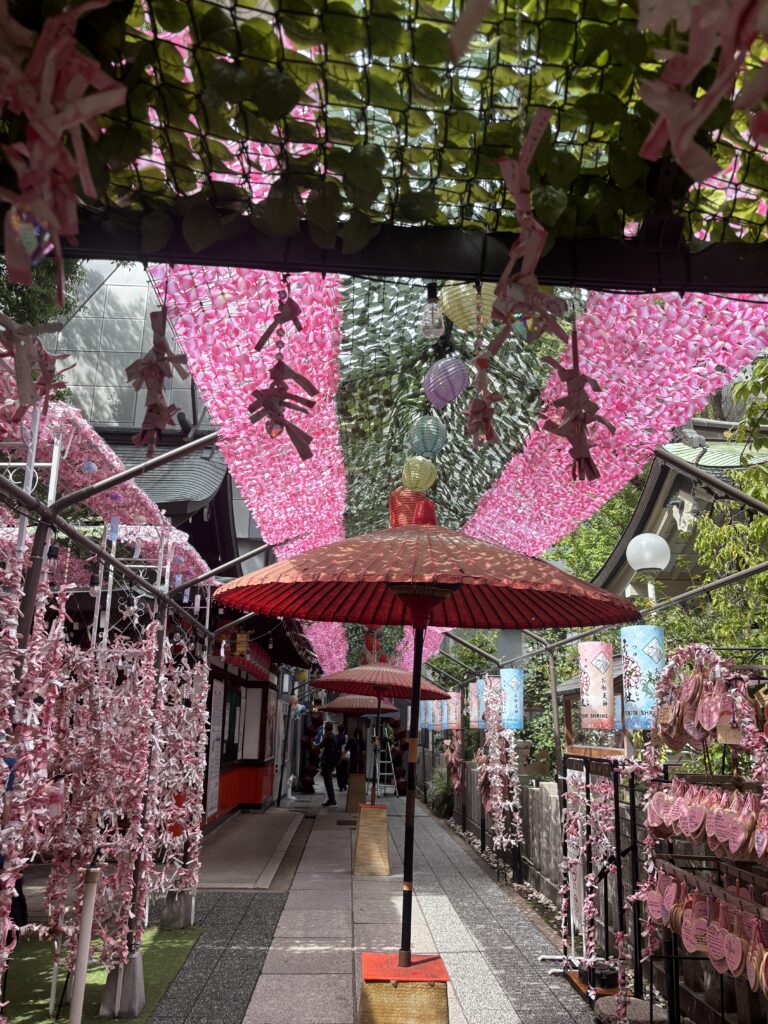
When we visited in February the shrine was mid-renovation, the hall hidden behind sheeting. We went back in September and the work was done: the torii and the approach were clear again, the path hung with pink decorations and heart-shaped ema — very much a shrine for matchmaking.
Ohatsu Tenjin — the basics
Formal name
Tsuyunoten-jinja
Location
Sonezaki 2-chome, Kita-ku, Osaka
Access
About 5 minutes on foot from Higashi-Umeda Station
Known for
Matchmaking and romance
Date visited
14 February 2026
21 March | “The Love Suicides at Sonezaki” at Minami-za
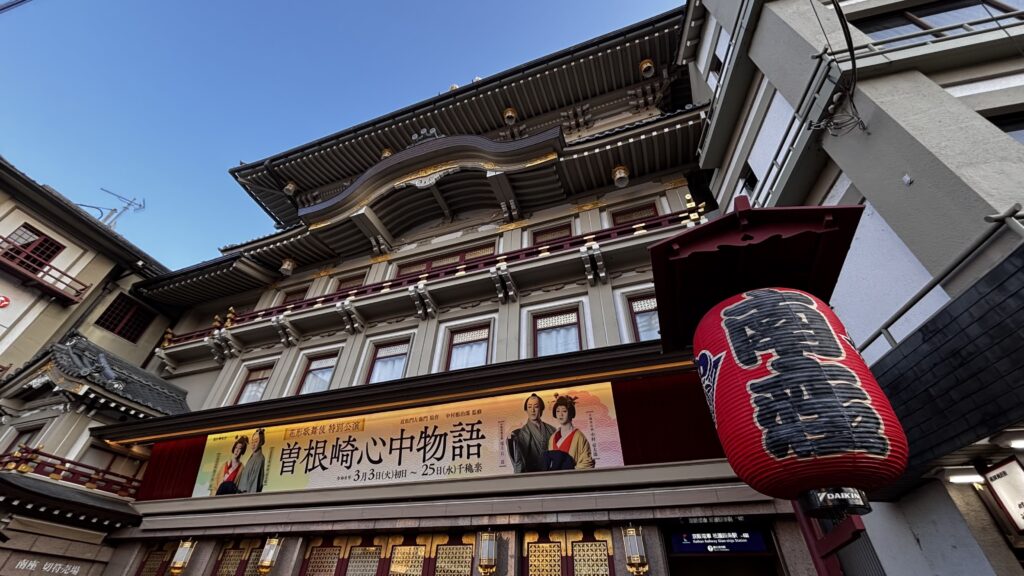
Then the main event. We found a listing at Minami-za in Kyoto and booked immediately. We attended the evening performance on 21 March.
What the tickets cost Second floor, left side, row 1, seats 11 and 12 ¥12,000 per person (¥24,000 for two) As of March 2026
It had been ten years since we last saw kabuki — the New Year performances at Asakusa in Tokyo. This was our first time seeing kabuki in the Kansai region.
We Skipped the Earphone Guide and Prepared with a Film Instead
Kabuki performances offer an earphone guide with commentary in modern Japanese. This time, we deliberately didn’t use one.
Instead, we prepared by watching a two-hour black-and-white film version of “The Love Suicides at Sonezaki” beforehand. With the plot already in our heads, we could follow the performance without any guide at all.
If you’d rather not have your ears covered — if you want to hear the stage as it is — we’d recommend this approach. Preparation takes time, but nothing competes for your attention on the day.
A note for visitors from overseas: guide options vary by performance, so it’s worth checking what’s offered for the show you’re booking.
Shijo-Kawaramachi, Where Couples Sit at Even Intervals
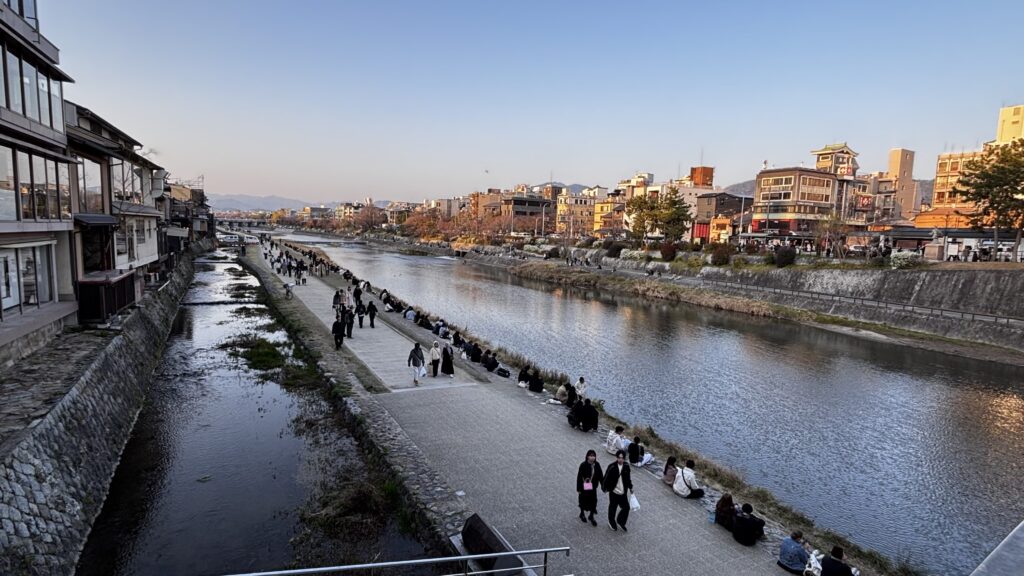
Walking to Minami-za, we passed the famous sight along the Kamo River: couples sitting at almost perfectly even intervals along the bank.
Watching present-day couples on the way to a play about a double suicide made for a strange sort of contrast.
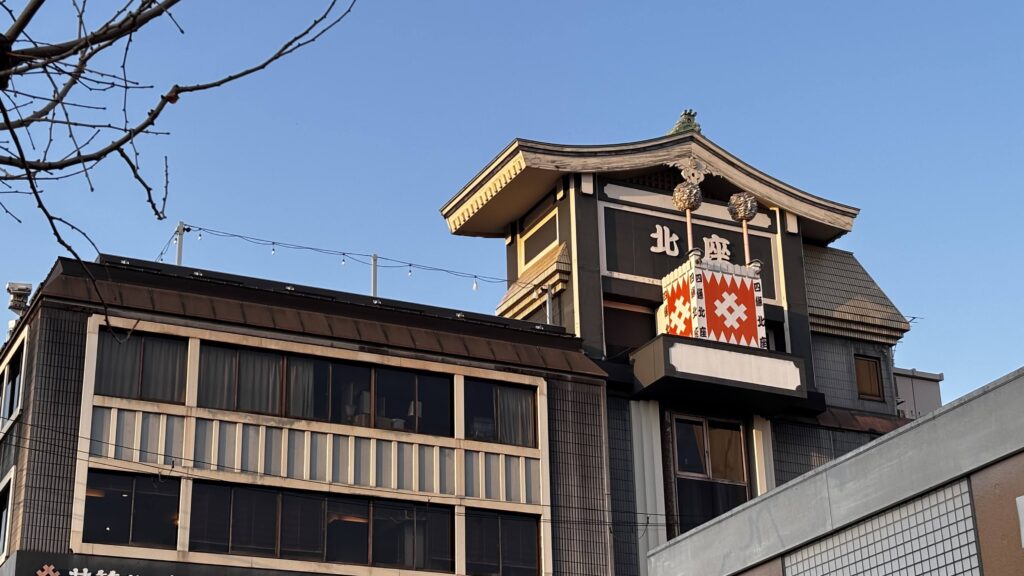
Incidentally, across from Minami-za stands a building called Kita-za. This area once held a number of theatres, and the names are what remains of that.
Arriving at Minami-za — Worth Exploring Before the Curtain
A Surprise: Minami-za Is a Western-Style Building
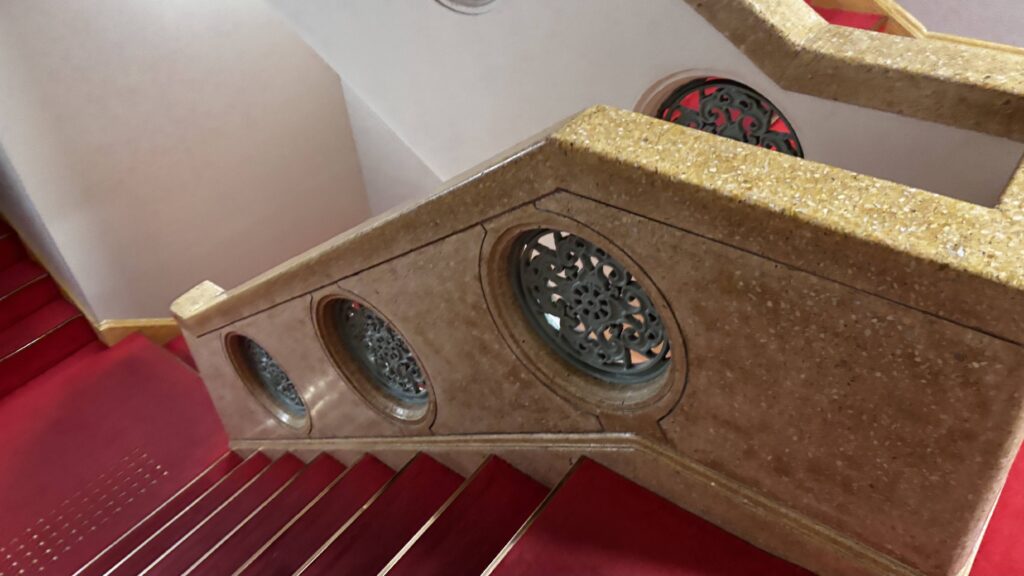
We had pictured something with tatami and traditional Japanese interiors. In fact Minami-za carries Western architectural features throughout.
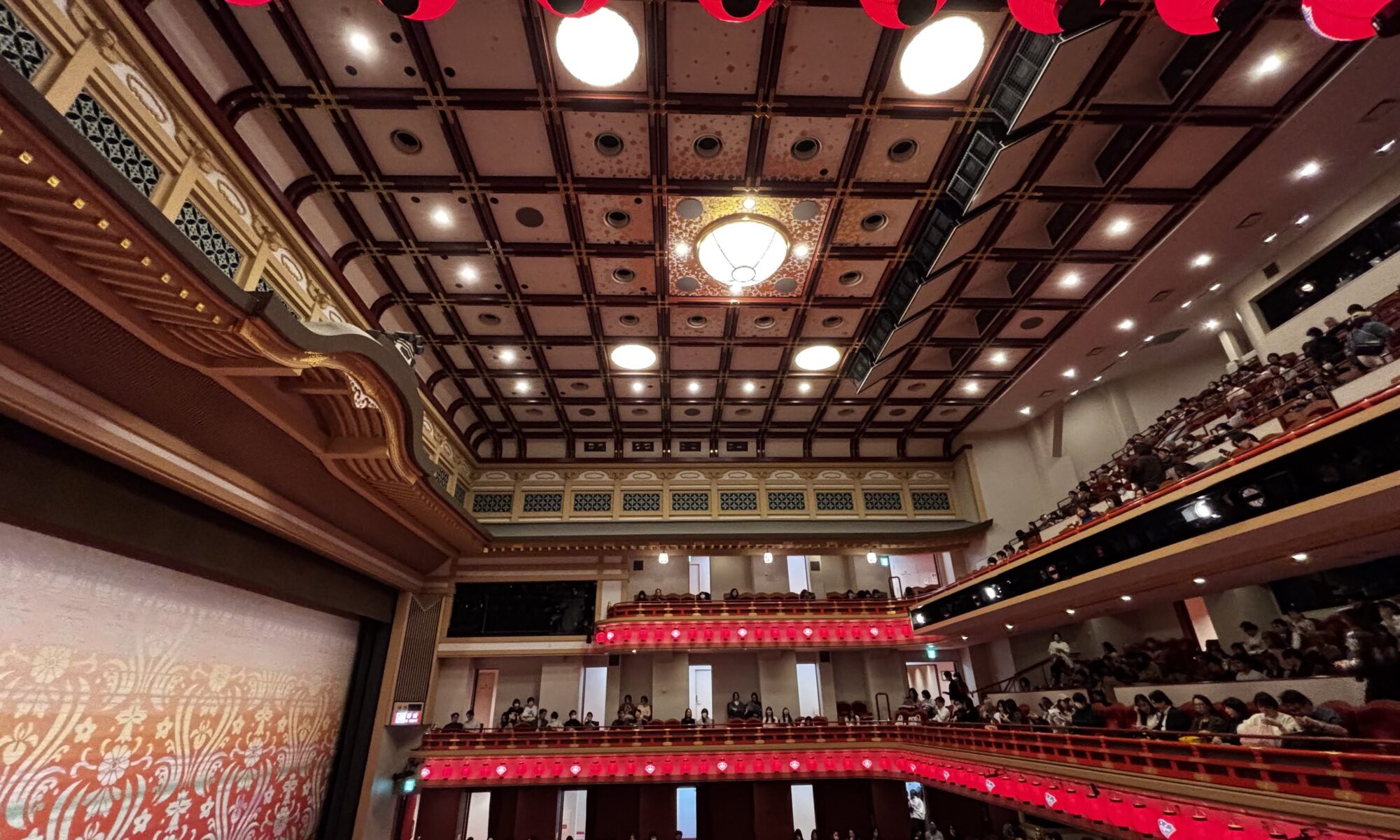
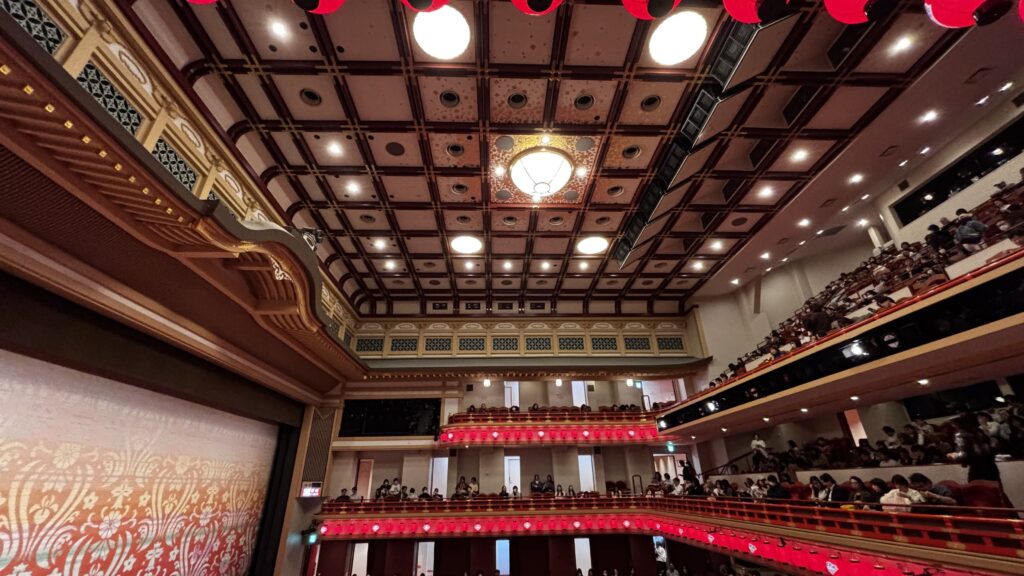
The building is a nationally Registered Tangible Cultural Property (registered in 1996), and both the exterior and interior reward attention. Simply walking around inside before the performance was enjoyable in itself.
Chairs with Cushions — Comfortable Even Over a Long Performance
All the seating is proper chairs, and cushions are provided. There’s clear thought given to keeping people comfortable through a long sitting, which makes it an easy environment for a first-time kabuki audience.
Two Parts: an Hour of Drama, Then a Discussion
This was the biggest surprise of the day. The performance came in two parts.
Part one was “The Love Suicides at Sonezaki” itself, running about an hour. Kabuki has a reputation for length, but at this duration a newcomer can settle in without difficulty.
Part two was a discussion among the performers about the play and about the film Kokuho.
So the film that had started all of this came back to us, from the stage we had come to see. January’s film, February’s shrine, March’s performance — the three months closed neatly on themselves.
It struck us as an unusually accessible piece of kabuki for a younger audience. An hour of drama followed by a discussion that explains it — as a first experience, it would be hard to improve on.
Home on the Hankyu Kyoto Line
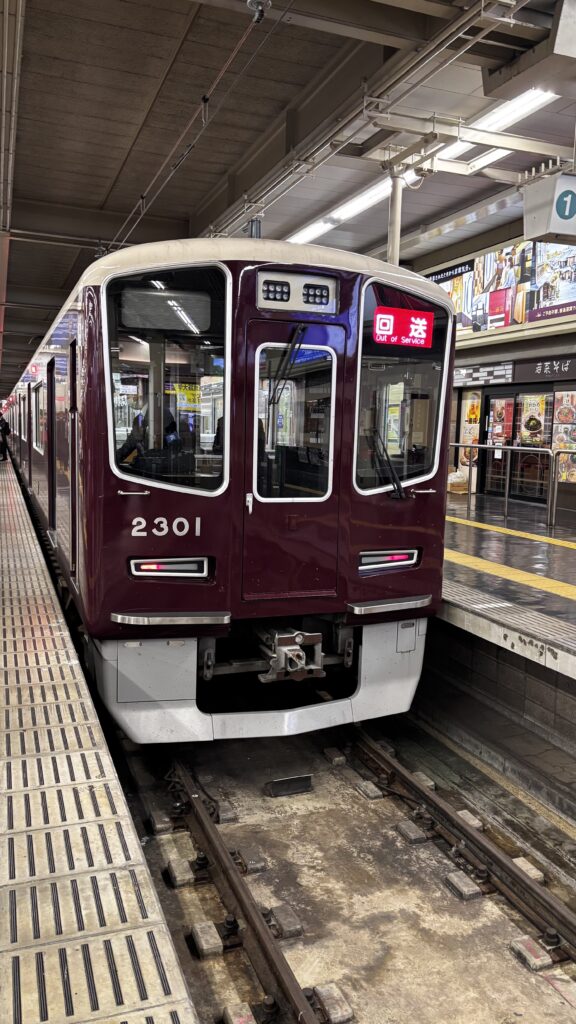
This being a railway blog, we did of course travel by train. The journey home was the Hankyu Kyoto Line from Kyoto-Kawaramachi to Osaka-Umeda.
Watching Kyoto’s streets go past from the window as we headed back to Osaka, the elegant maroon livery of the Hankyu carriages made a fitting end to the day.
The Hankyu Kyoto Line connects Osaka-Umeda and Kyoto-Kawaramachi, taking about 43 minutes by limited express. The maroon colour is Hankyu’s signature.
Summary | Three Months Spent Following One Story
Date
What happened
Cost
3 January
Watched Kokuho — the goal takes shape
—
14 February
Ohatsu Tenjin (Tsuyunoten-jinja), Osaka
Free
21 March
“The Love Suicides at Sonezaki,” evening performance, Minami-za, Kyoto
¥12,000 per person (second floor)
If you’re thinking about seeing kabuki
Prepare in advance and you can follow it without an earphone guide
Seating is chairs with cushions — comfortable over a long sitting
The building itself is worth seeing, so arrive early
A programme with a drama plus a discussion is a good way in for a first-timer
Letting a film decide where you travel is one of the better ways to plan a trip. Visit the setting, then go and see the real thing. It took some effort, and it was worth it. The year of experiencing real things continues.
We rode Gran Class from Morioka to Tokyo on the Hayabusa No. 26: 27,080 yen each for 2 hours 15 minutes, and everything served, in the order it arrived.
What this article covers
What Gran Class actually costs (our real fare, Morioka to Tokyo)
What you’re given, and what’s done for you, across a 2 hr 15 min ride
What you can and can’t fit into an 89-minute connection at Morioka
A useful thing to pick up while changing trains at Tokyo Station
Kakunodate to Morioka: 51 Minutes on the Komachi
The final leg of the trip began at Kakunodate, boarding the Komachi for Morioka. Watching the Tohoku summer landscape slide past the window, our thoughts were already on Morioka’s jajamen noodles.
Our journey Komachi No. 20, Kakunodate 12:57 → Morioka 13:48 (51 min) Seats: Car 12, seats 2A and 2B (reserved) ¥6,060 for two adults = ¥3,030 per person (fare included, as of August 2025)
Kakunodate is a beautifully preserved castle town, often called “the Little Kyoto of Michinoku.” From the Komachi’s windows the view is green hills and rice fields — the sort of scenery that makes you forget the city for a while.
An 89-Minute Connection at Morioka — and No Jajamen
Eighty-nine minutes between trains. That looks generous on paper. In practice it was an awkward length.
Morioka is famous for jajamen, thick wheat noodles served with a rich miso-based sauce. Pushed along by the mascots, we made straight for a well-known shop — and found a very long queue. An hour and a half isn’t enough to queue, eat, and get back to the platform with any margin.
If jajamen is the goal, allow yourself more than two hours in Morioka.
Next Door to the Queue: Tsukemen Kazu
Still, boarding a Shinkansen having eaten nothing seemed a waste. What caught our eye was Tsukemen Kazu, sitting immediately next door to the shop everyone was queueing for.
The menu board outside carried several award badges, which was encouraging.
Tsukemen Kazu — menu (August 2025)
Plain tsukemen (regular, 200 g): ¥1,100
Tsukemen (regular): ¥1,250
Special tsukemen (regular): ¥1,500 — the most popular choice Small, medium and large portions are available at similar prices.
Tsukemen is a style where the noodles and the broth arrive separately, and you dip the noodles as you eat. It turned out to be exactly the right decision. There was an excellent restaurant with no wait, directly beside the one with the queue. When your connection time is tight, it pays to look one door further along.
As for the jajamen itself — we bought a take-home set at the station, which lets you recreate the trip at your own kitchen table.
Riding Gran Class on the Hayabusa No. 26
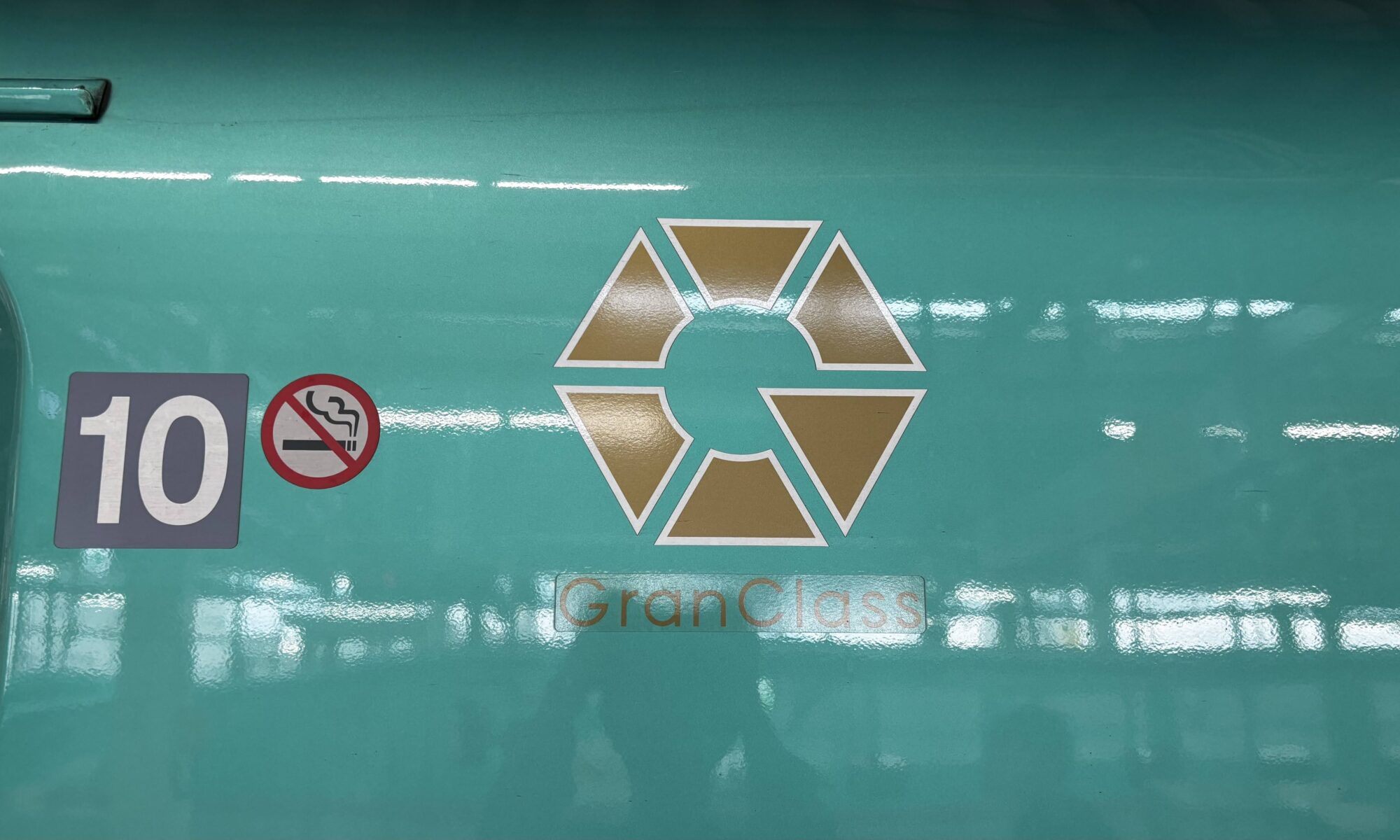
And now the main event: Gran Class, the highest class of seating on the Shinkansen. The previous year we’d ridden Gran Class for the first time, on the Hakutaka No. 560 — but only for the 22 minutes from Kanazawa to Toyama, and on a service configured as seat-only, with no food or drink. We learned what the seat was like and nothing else. This time it was two hours and fifteen minutes, with the full service.
Our journey Hayabusa No. 26, Morioka 15:17 → Tokyo 17:32 (2 hr 15 min) Seats: Car 10, seats 5B and 5C (Gran Class) ¥54,160 for two adults = ¥27,080 per person (fare included, as of August 2025)
For comparison, the ordinary reserved seat from Kakunodate to Morioka earlier the same day cost ¥3,030. What follows is what the difference buys you.
The Seat
The powered recliner goes back close to flat, and the spacing between seats is generous — the effect is much like a first-class airline cabin. There’s plenty of storage around the seat, so you can spread out and organise your luggage without difficulty.
Ten Minutes After Departure, It Begins
Service started roughly ten minutes after we pulled out, with a hot towel. The attendant then brought the menu round for us to choose a drink from.
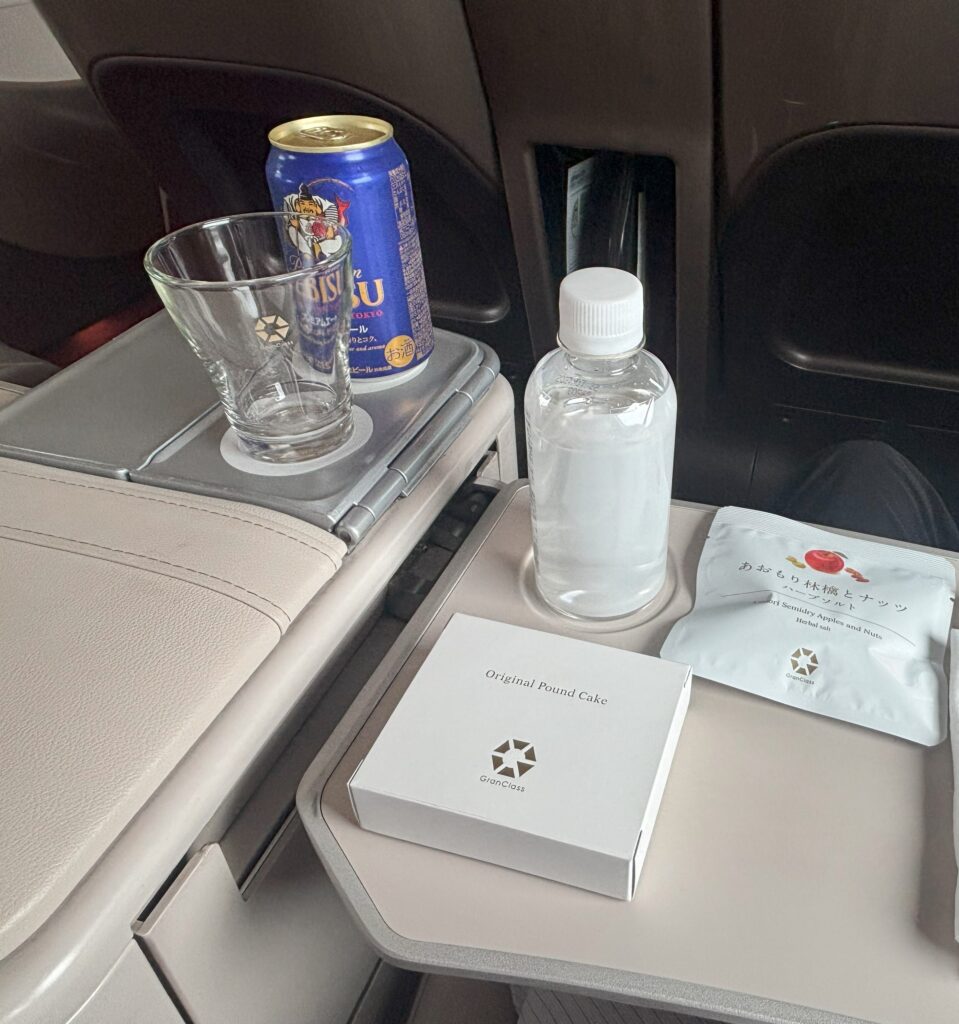
We chose sparkling wine and a Yebisu beer — one each. Being able to order different things is part of the pleasure.
The glassware carries the Gran Class emblem. A small thing, but details like that are what the price is made of.
What Came With the Drinks
Alongside the drinks came Aomori apple and nuts. The pairing worked far better than we expected — the sharpness of the apple and the salt of the nuts carry both the sparkling wine and the beer along nicely.
Inside the small white box was a pound cake. We couldn’t manage it on board, and were able to take it home with us.
An Honest Regret: We Should Have Arrived Hungry
A confession. We had just eaten a full bowl of tsukemen in Morioka.
Because it was a mid-afternoon departure, we’d assumed the service would amount to a light snack. In fact there was considerably more than that. We rather wish we’d turned up hungry.
So, advice for anyone about to do this: keep the meal before your Gran Class ride light. What’s waiting on board is more substantial than you’d guess.
A 30-Minute Delay at Tokyo — and Toyoken’s Black Curry Bread
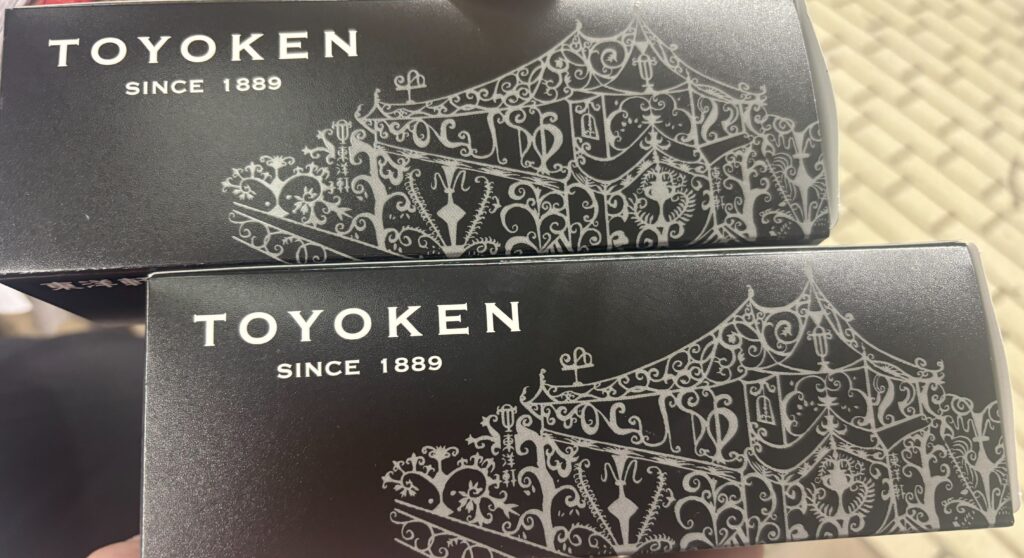
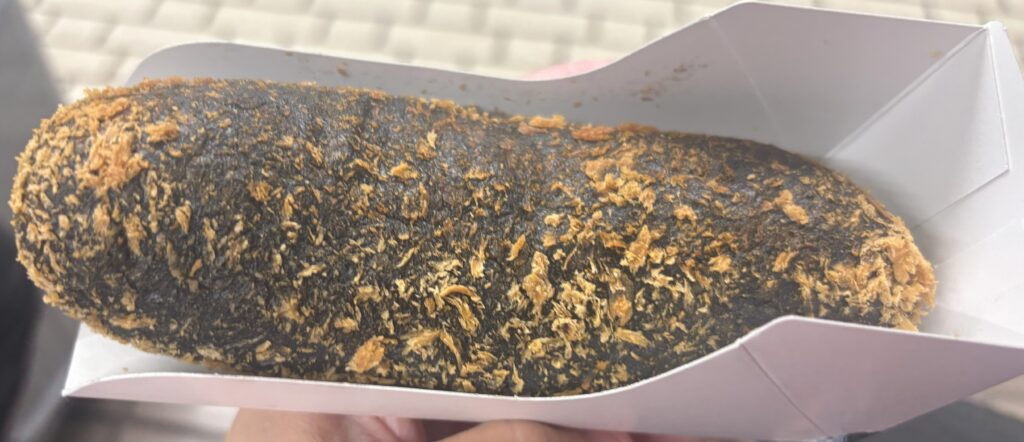
Heavy rain caused a delay of over thirty minutes. As it turned out, this worked in our favour: it gave us time to hunt down Toyoken’s Black Curry Bread, something of a Tokyo Station speciality.
Crisp bread around a spiced black curry filling — an excellent travelling companion for the Tokaido Shinkansen leg.
Toyoken Black Curry Bread is sold at GRANSTA inside Tokyo Station. It does sell out, so it’s best attempted when you have time in hand.
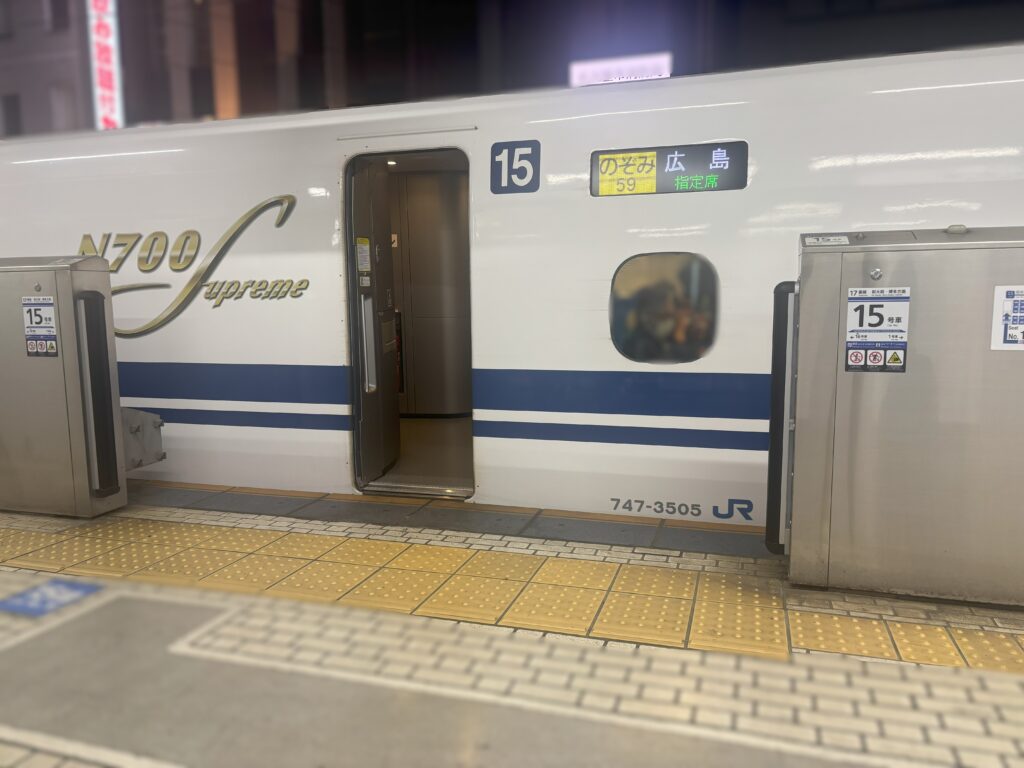
Finishing on the Tokaido Shinkansen N700S
Once aboard the Tokaido Shinkansen, the mascots were asleep almost immediately — the satisfaction of the trip written across their faces. The drinks on the previous leg may have helped.
The final train, incidentally, was a JR West N700S set. Ending the journey on the newest generation of Shinkansen was a small bonus for the railway fans among us.
Summary | What ¥27,080 Buys
Section
Train / class
Times
Per person (fare included)
Kakunodate → Morioka
Komachi No. 20, reserved
12:57 → 13:48 (51 min)
¥3,030
Morioka → Tokyo
Hayabusa No. 26, Gran Class
15:17 → 17:32 (2 hr 15 min)
¥27,080
What Gran Class included
A hot towel about ten minutes after departure, followed by the drinks menu
Drinks — sparkling wine and Yebisu beer, chosen individually
Glassware carrying the Gran Class emblem
Aomori apple and nuts
A pound cake, which you may take away with you
A powered seat reclining close to flat
Gran Class has a reputation for being an indulgence too far. But on a journey of two hours or more you receive the service in full, and on the way home at the end of a trip, when you’re genuinely tired, we thought it earned its price.
Parts ① and ② of this trip are covered in separate articles.