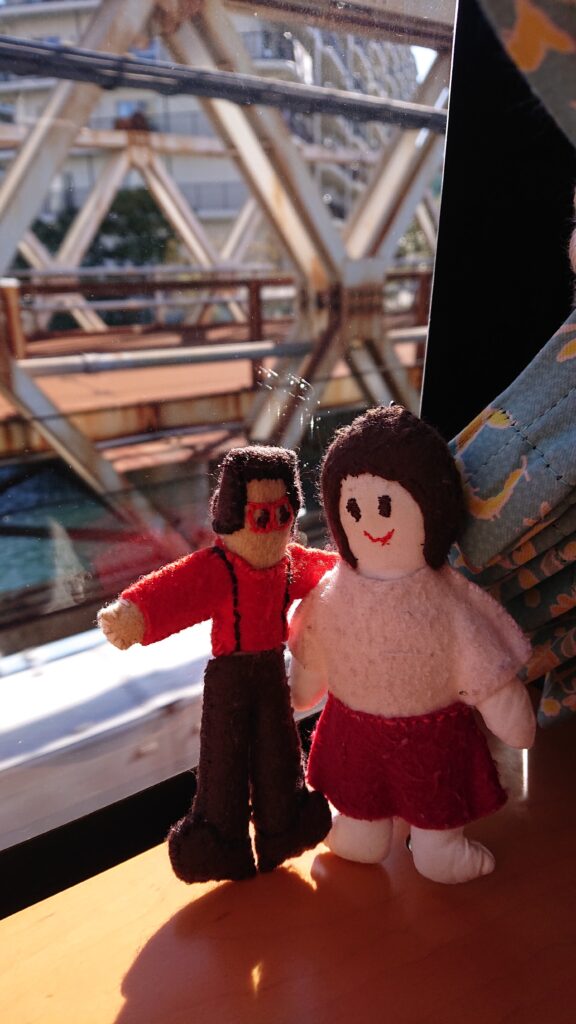
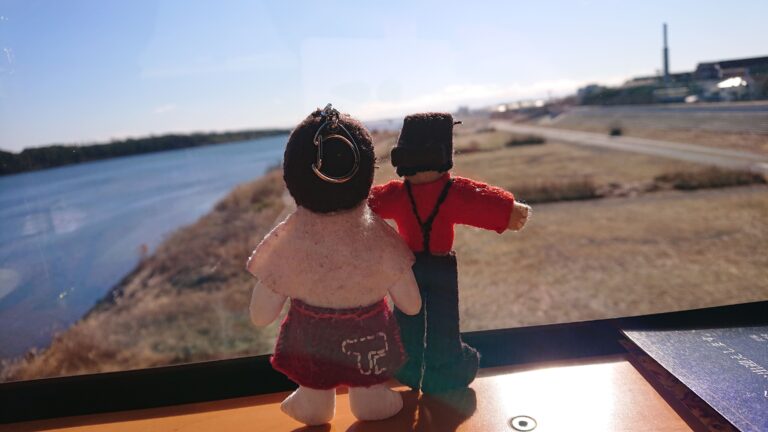
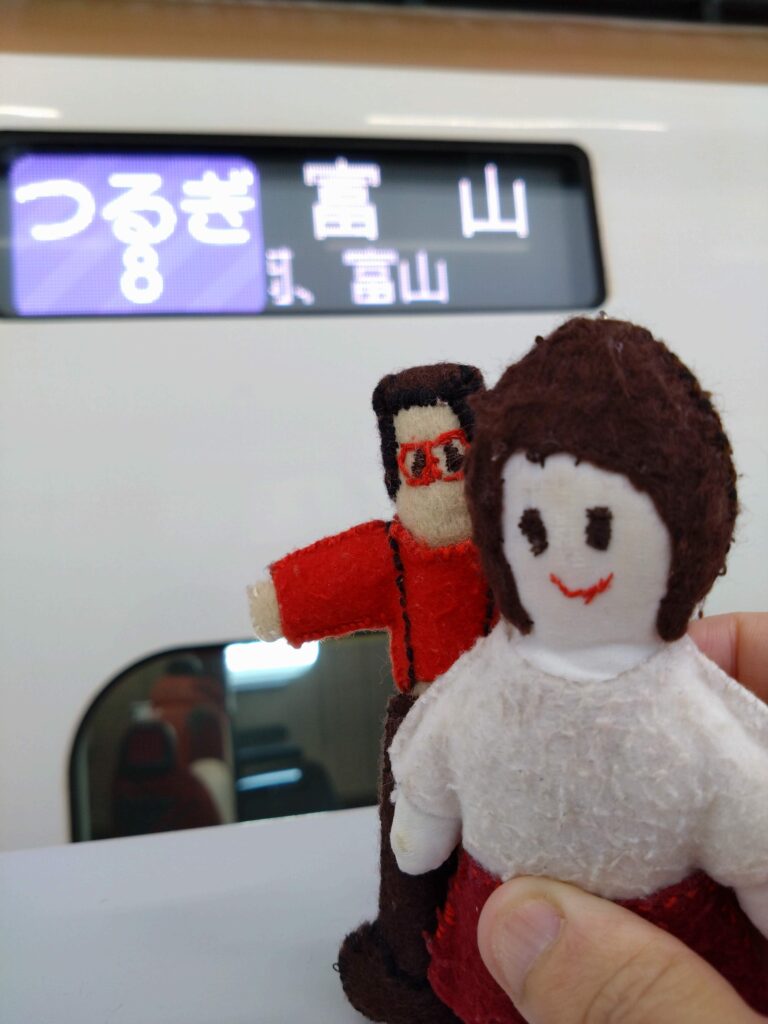
Hello, this is mascots! This time, I’m sharing a special rail journey to celebrate my birthday. Our destination: Amanohashidate, one of Japan’s three most scenic views. The weather turned out rainy, but thanks to some wonderful sightseeing trains, it became an unforgettable day. 🚃
From Shin-Osaka to Fukuchiyama on the Limited Express “Kounotori”
Our journey began at Shin-Osaka Station, where we boarded the limited express “Kounotori.”
Connecting Shin-Osaka with Fukuchiyama, this train is an essential gateway to the Kita-Kinki region. Watching the scenery gradually shift from cityscape to lush countryside through the window, our excitement for the trip steadily grew.
What is the Limited Express “Kounotori”? Operated by JR West, it connects Shin-Osaka/Osaka with Fukuchiyama, Toyooka, and Kinosaki Onsen. It’s a key means of access to the Kita-Kinki area.
Changing to the “Tango Relay No. 3” at Fukuchiyama
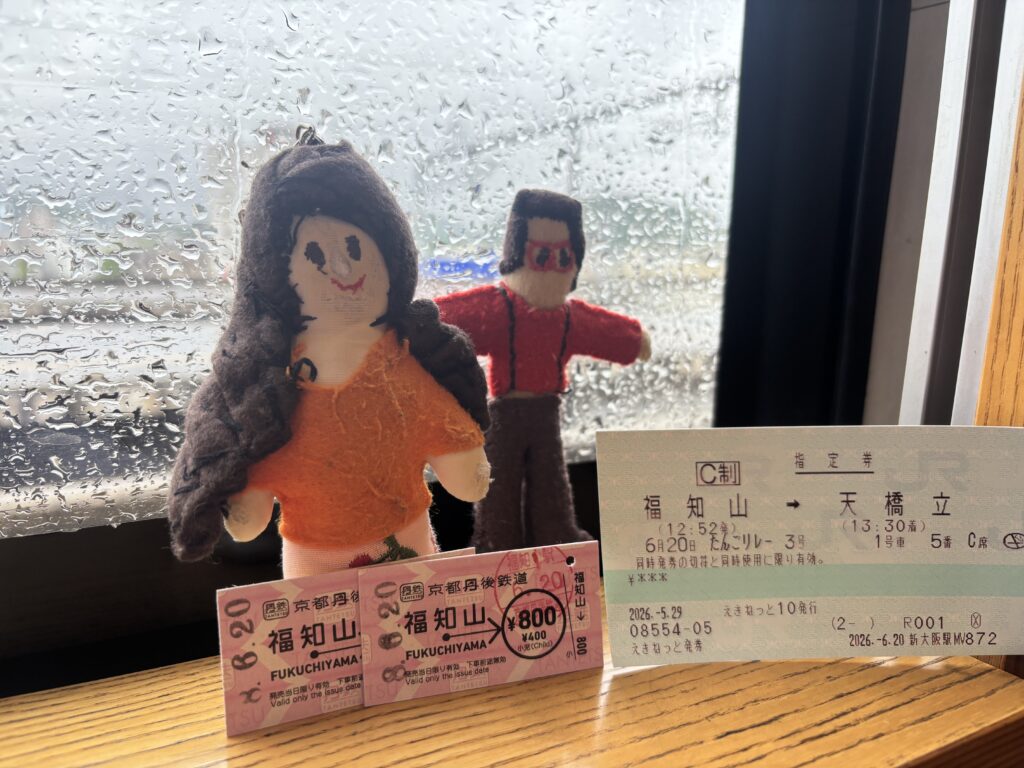
At Fukuchiyama Station, we transferred to the Kyoto Tango Railway’s “Tango Relay No. 3” to continue toward Amanohashidate.
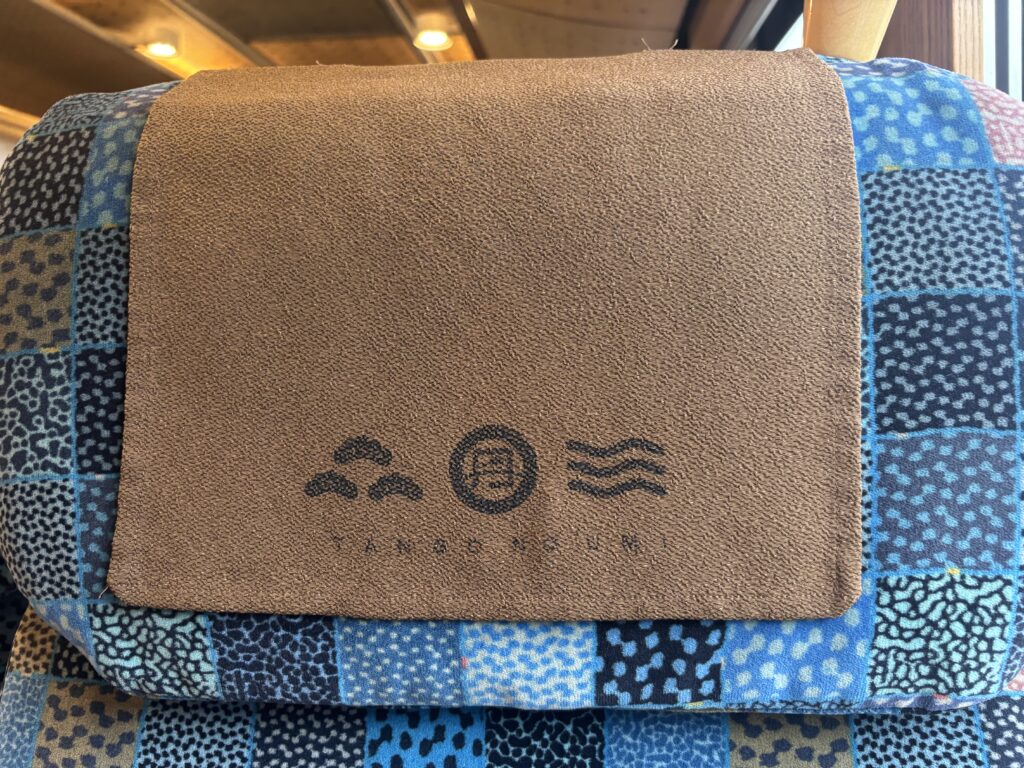
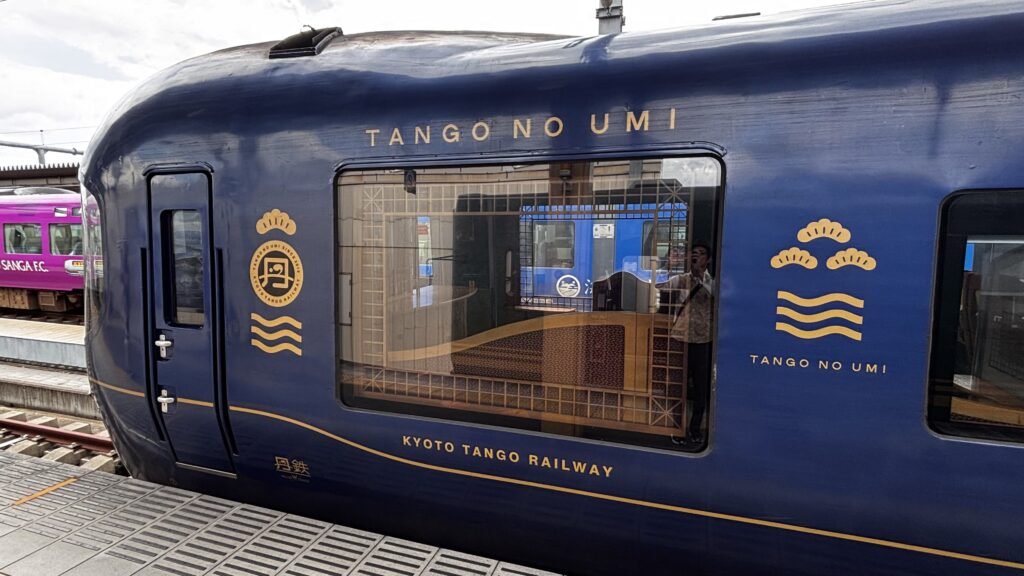
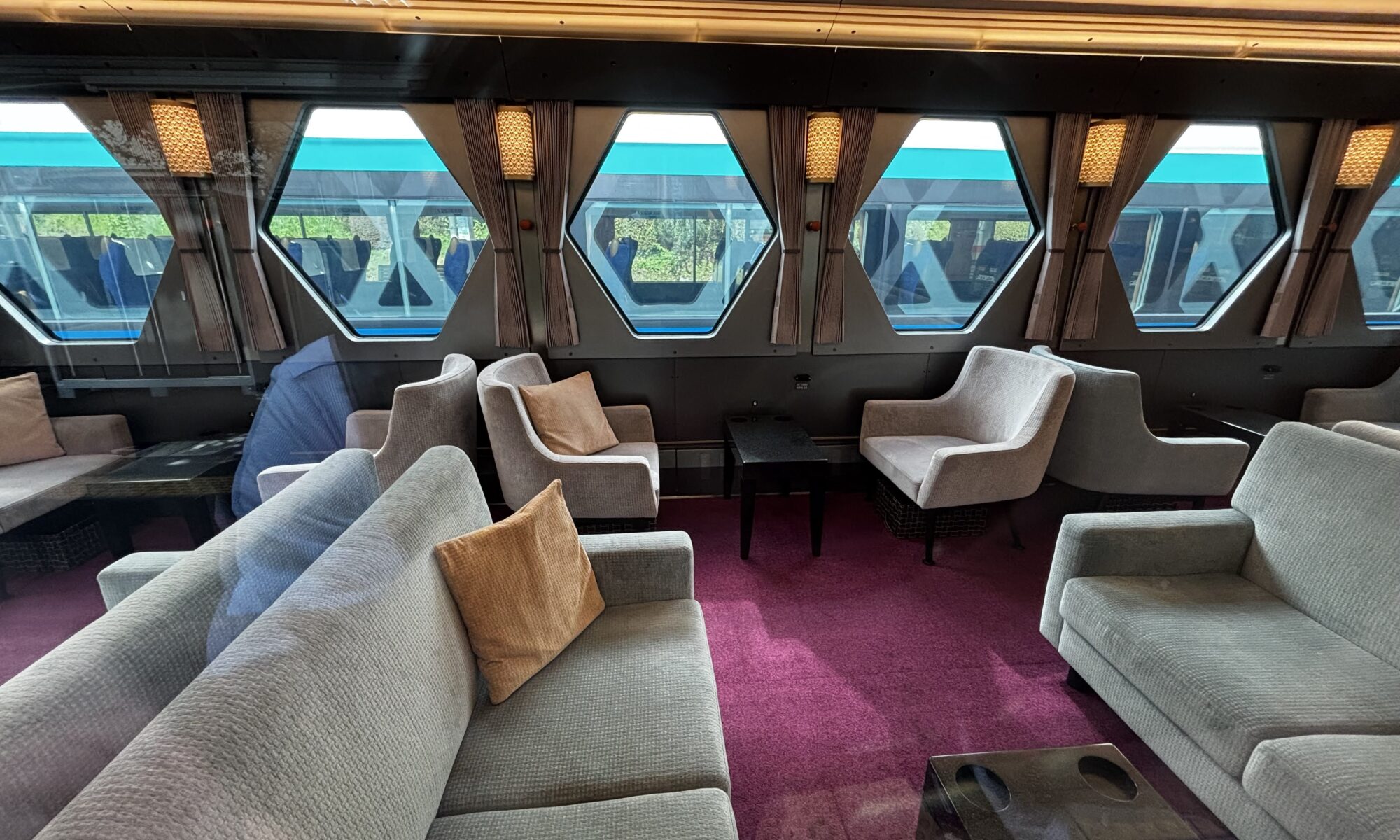
And what luck — the train we boarded was the popular “Tango no Umi” (Sea of Tango)! Designed by Eiji Mitooka, this beautiful train wears a deep indigo color known as “Tango Blue.” The elegant interior, generously finished with wood, feels almost like a moving drawing room. The slightly gloomy mood from the rain instantly lifted the moment we stepped aboard. ☂️✨
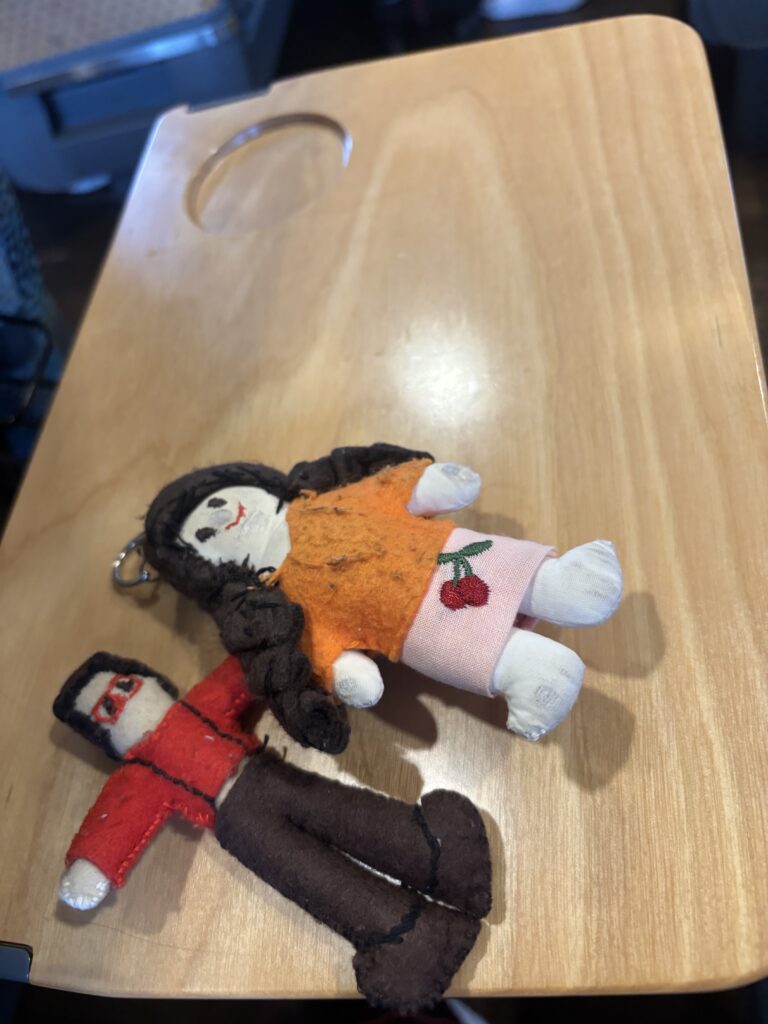
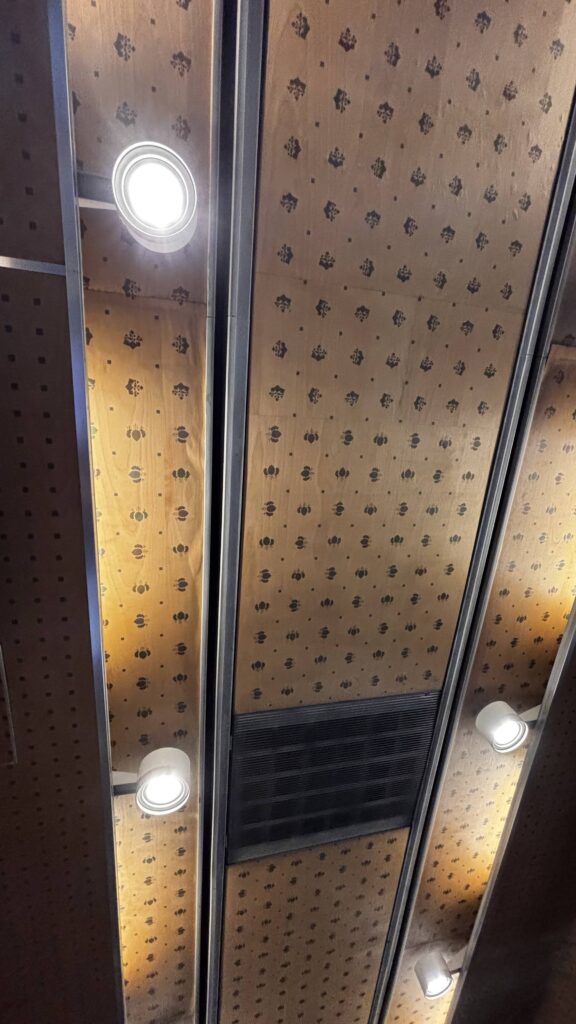
Glancing up, I noticed the mascots all frozen in place, staring at the ceiling. “What’s wrong?” I wondered, following their gaze upward — and there it was: a stunning ceiling design that drew me right in.
The refined decoration highlighting the wood grain, combined with carefully arranged geometric patterns. We usually only look down at our feet or out the window, so it’s easy to miss — but sightseeing trains are crafted with care right up to the ceiling. Thanks to the mascots’ “Look up!” discovery, I was able to appreciate a whole new charm of the train.
What is “Tango no Umi”? A sightseeing train of the Kyoto Tango Railway. Known for its calm indigo exterior and warm, wood-filled interior, it runs as the limited express “Hashidate” and as relay services.
Amanohashidate in the Rain — A Scenic 6-Minute Chairlift Ride
When we arrived at Amanohashidate, the rain was still falling. But giving up isn’t the mascots’ style (laughs).
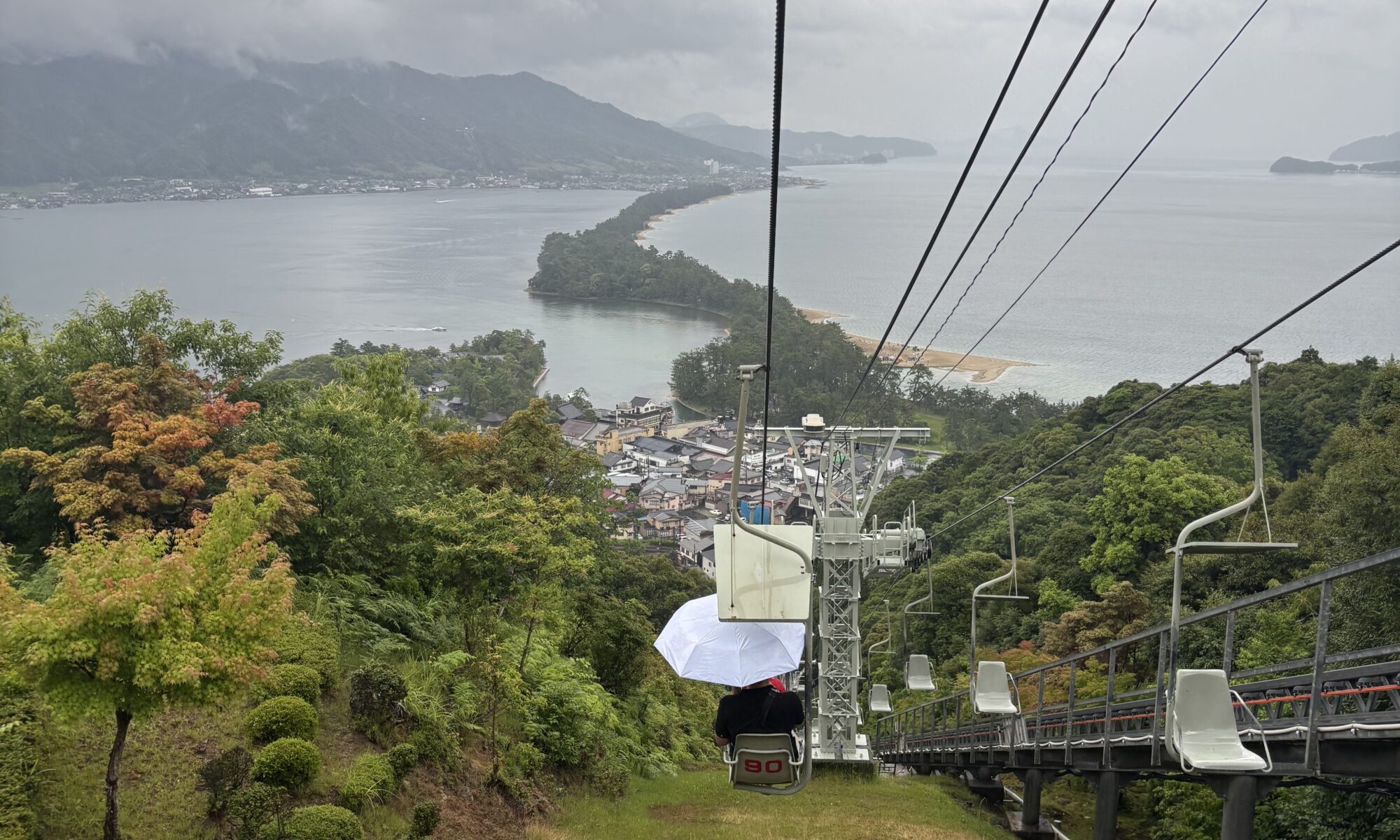
Umbrellas in hand, we took on the chairlift overlooking Amanohashidate! The roughly 6-minute aerial ride was thrilling even in the rain. Looking down at the pine-covered sandbar and the dreamy, mist-shrouded scenery, the mascots were absolutely thrilled. Experiencing a serene beauty different from a sunny day may well be a privilege unique to rainy weather. 🌧️
💡 Travel Tip: Coin Lockers Are a Lifesaver! Amanohashidate has coin lockers where you can store suitcases. They require ¥100, but it’s the type that returns your coin when you retrieve your bag — so it’s effectively free. Being able to drop off heavy luggage and explore hands-free is wonderful, and we especially appreciated it on a rainy day. 😊
The Highlight! The “Bar” Journey on the Tango Kuromatsu Train
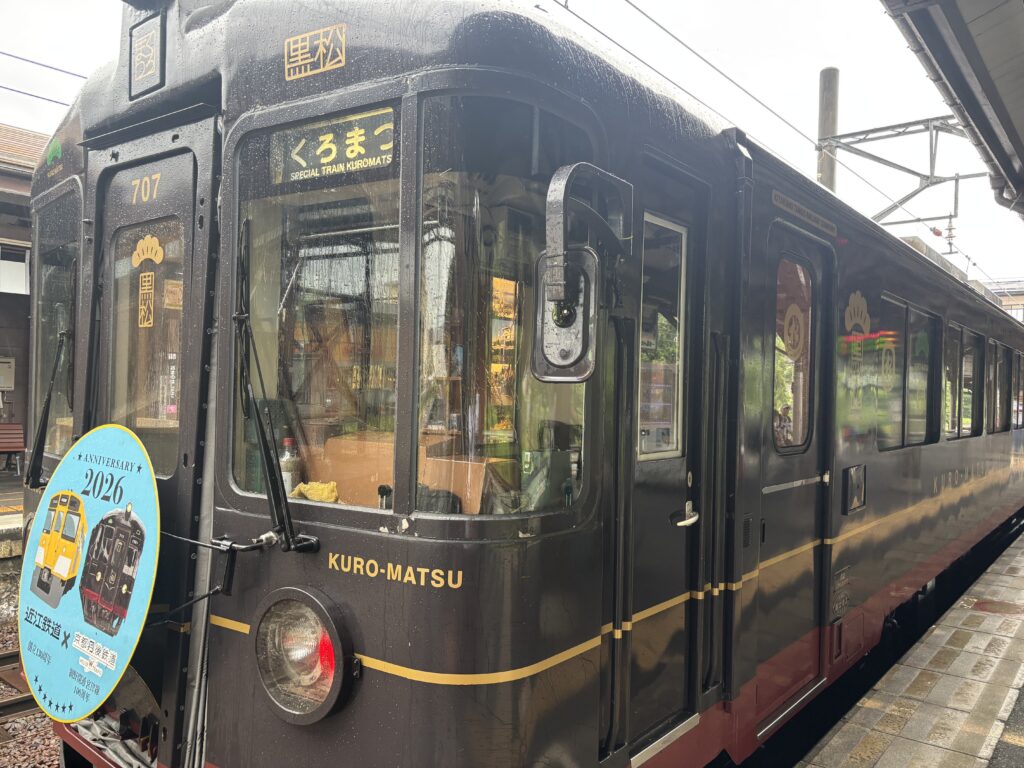
And now, the main goal of this trip — riding the sightseeing train “Tango Kuromatsu“!
We joined the evening “Bar” plan, savoring special dishes served aboard the moving train. The chic, dignified black carriage and the high-quality interior packed with attention to detail made the time feel truly extraordinary.
What impressed me most was how brilliantly the service makes use of the Kyoto Tango Railway’s “one train per hour” schedule. The relaxed timetable typical of a local line is instead elevated into “special time” — a clever approach that left me deeply impressed.
What is the Tango Kuromatsu Train? A restaurant train operated by the Kyoto Tango Railway. Of the three siblings — “Kuromatsu,” “Akamatsu,” and “Aomatsu” — it’s the top-tier, fully reservation-based carriage. Its meal-inclusive plans let you enjoy dishes made with seasonal local ingredients.
The Key to Success: Book Early for Sightseeing Trains
The reason we were able to fully enjoy the meal aboard the Kuromatsu was that we booked a month and a half in advance.
Popular sightseeing trains — especially meal-inclusive plans on weekends — sell out quickly. I was reminded once again that the moment you think “I want to ride this,” the most important thing is to check the reservation status right away.
Meal-inclusive plans are especially competitive
Check operating days and availability early on the official website
Book as soon as your travel dates are set
Summary: A Birthday Rail Trip That Was Wonderful Even in the Rain
Leg
Train
Shin-Osaka → Fukuchiyama
Limited Express “Kounotori”
Fukuchiyama → Amanohashidate
Tango Relay No. 3 “Tango no Umi”
Amanohashidate
Sightseeing (chairlift, coin lockers)
Departing Amanohashidate
Tango Kuromatsu Train “Bar”
It started with unexpected rain, but it became the best birthday trip — full of beautiful sightseeing trains, the dreamy scenery of Amanohashidate, and heartfelt cuisine.
Above all, it became a journey that made me genuinely think, “I want to keep booking and riding sightseeing trains all across Japan.” Which train should we ride next? I can hardly contain my excitement already. 🚃✨
If you’ve been hesitating about traveling on a rainy day, please find the courage to head out. A special memory — different from a sunny day — is surely waiting for you. 😊
How to get to the Mount Fuji area by train via Kaiji and Fujisan Express
The unique interior and headcovers of the Fujisan Express
All about Yoshida Udon — Fujiyoshida’s beloved local specialty
Information on the Fujisan View Express — next on our must-ride list!
Shin-Yokohama → Yokohama Line → Hachioji — Already Feeling the Yamanashi Vibe!
Our journey began at Shin-Yokohama Station, transferring to the Yokohama Line bound for Hachioji Station.
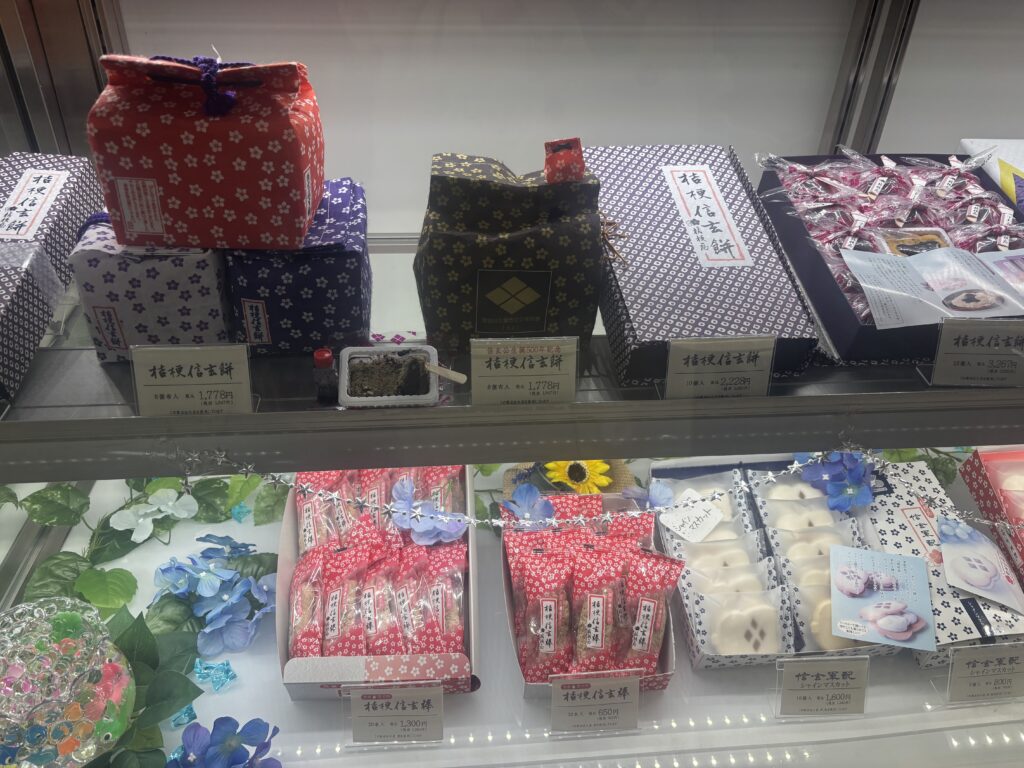
Despite still being within Tokyo, the Kiosk at Hachioji Station was already stocked with Shingen Mochi — the famous sweet from Yamanashi. And this time, a very special find caught our eye: a limited-edition Shingen Mochi in a commemorative drawstring pouch celebrating the 500th anniversary of Shingen’s birth! We made a firm mental note to pick one up on the way home, then boarded Kaiji No. 39.
Limited Express Kaiji is operated by JR East between Shinjuku and Kofu / Matsumoto. It also stops at Hachioji, reaching Otsuki in approximately 30 minutes. On weekday evenings, seats are plentiful and every seat comes with a power outlet — making it perfect for working on the go.
Kaiji on a Weekday Evening — The Perfect Mobile Office
On a weekday evening, the Kaiji was noticeably uncrowded, with power outlets at every seat. Laptop open, work in progress — the 30-minute ride to Otsuki passed in no time.
Tips for Riding the Kaiji
Power outlets at every seat — ideal for working on the go
Quieter than expected on weekday evenings
Only about 30 minutes from Hachioji to Otsuki
Both reserved and unreserved seating available
Transfer at Otsuki Station to the Fujisan Express — Welcome to the Fujikyu Railway World!
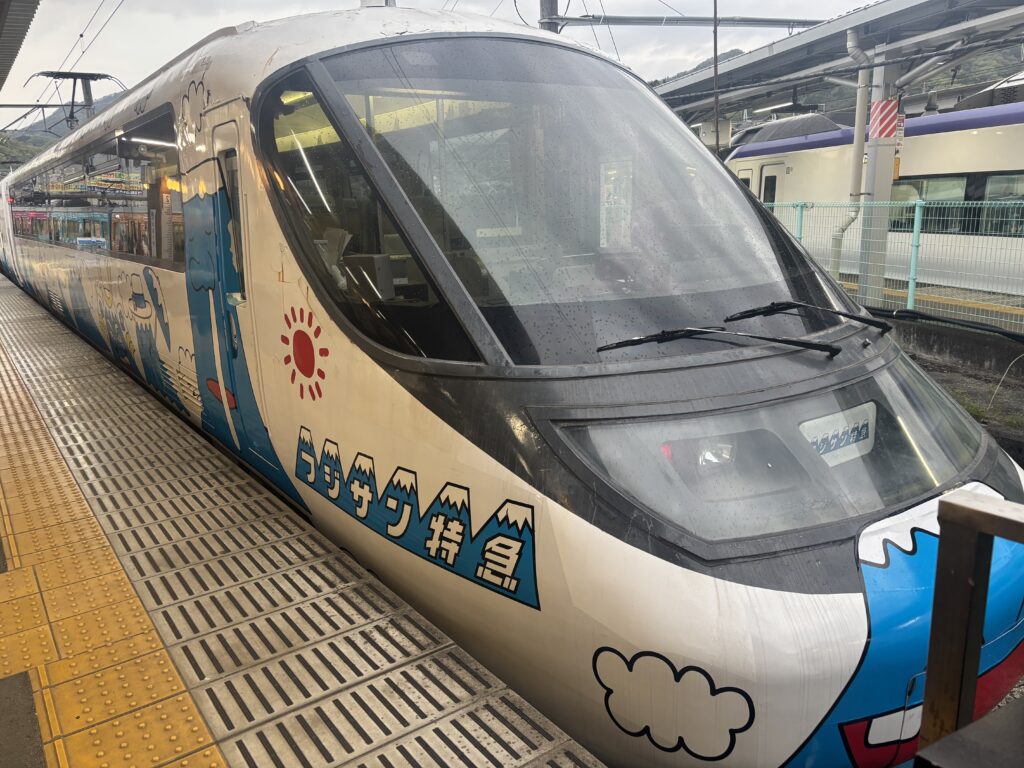
Just 30 minutes from Hachioji, we arrived at Otsuki Station and transferred to Fujisan Express No. 5.
Stepping onto the Fujikyu Railway platform, we were immediately greeted by a parade of brightly wrapped trains arriving and departing. The colorful lineup of vehicles made it instantly clear — we had arrived in Mount Fuji country.
The Fujisan Express Interior Is Pure Joy! Don’t Miss the Headcovers
The Fujisan Express is covered in Mount Fuji illustrations — inside and out. The moment you step aboard, your excitement levels shoot straight up.
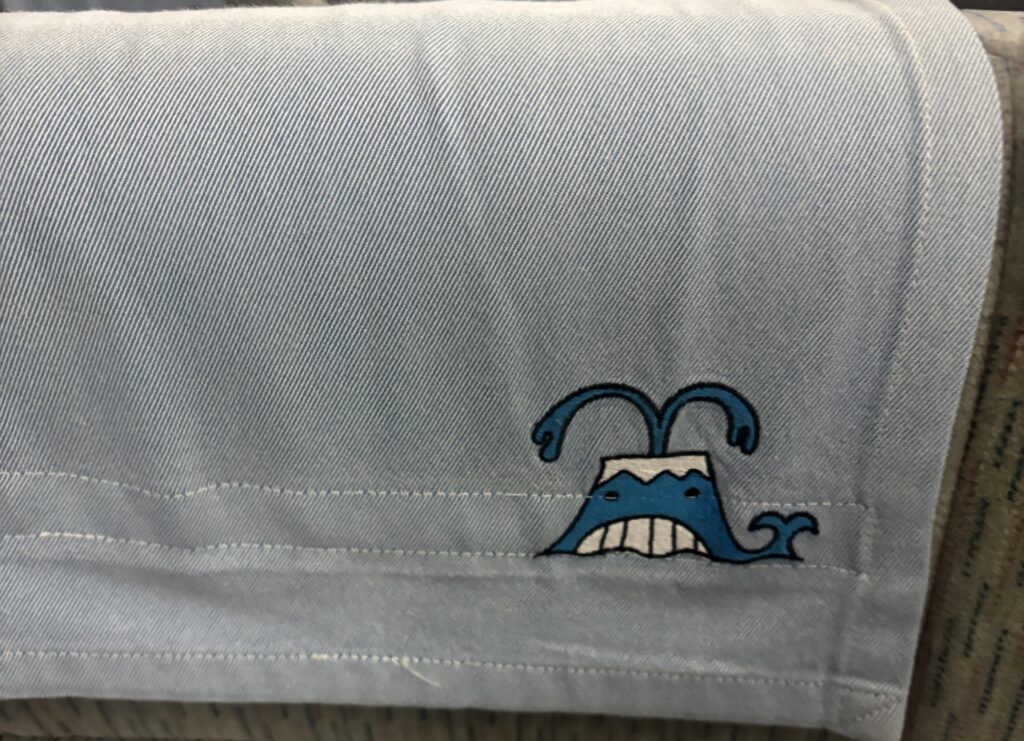
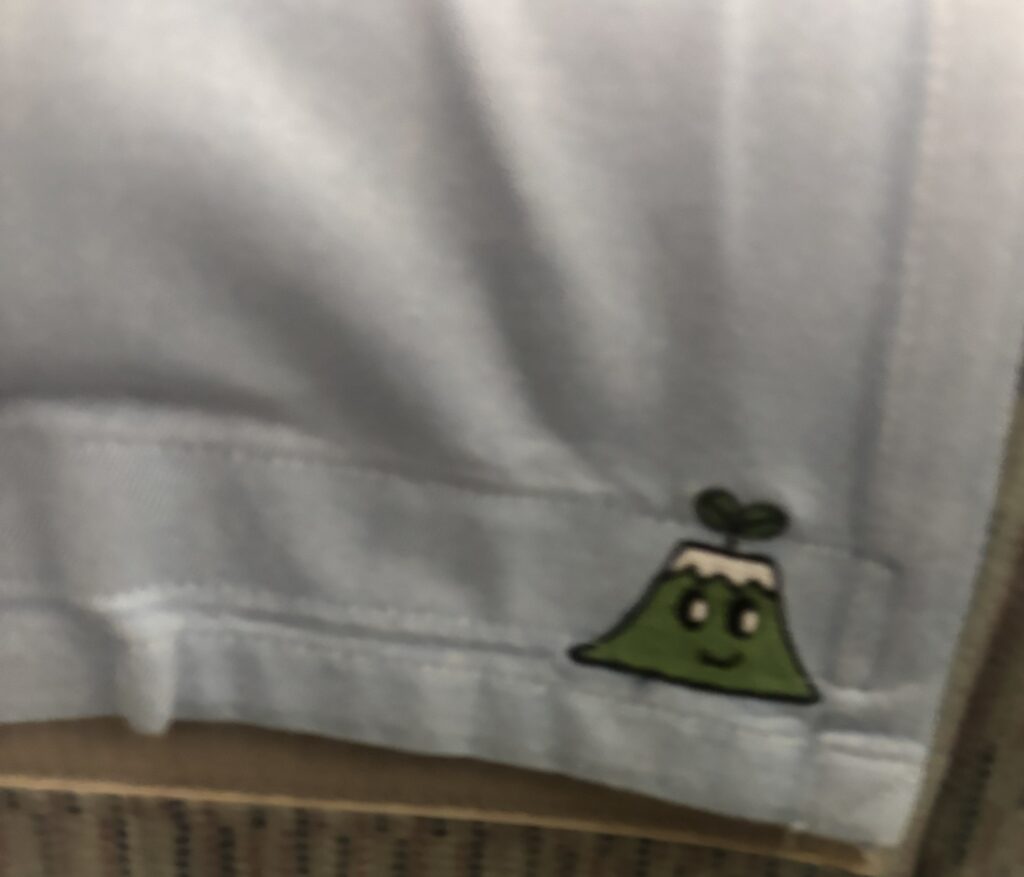
The real highlight? The headcovers on the seats, each featuring a completely different illustration of Mount Fuji. You’ll find yourself checking every single one.
A Selection of Unique Headcover Designs
“Whale Fuji” — a Mount Fuji that is also a whale, spouting from its summit
“Eco Fuji” — a green Mount Fuji with a sprout growing on top
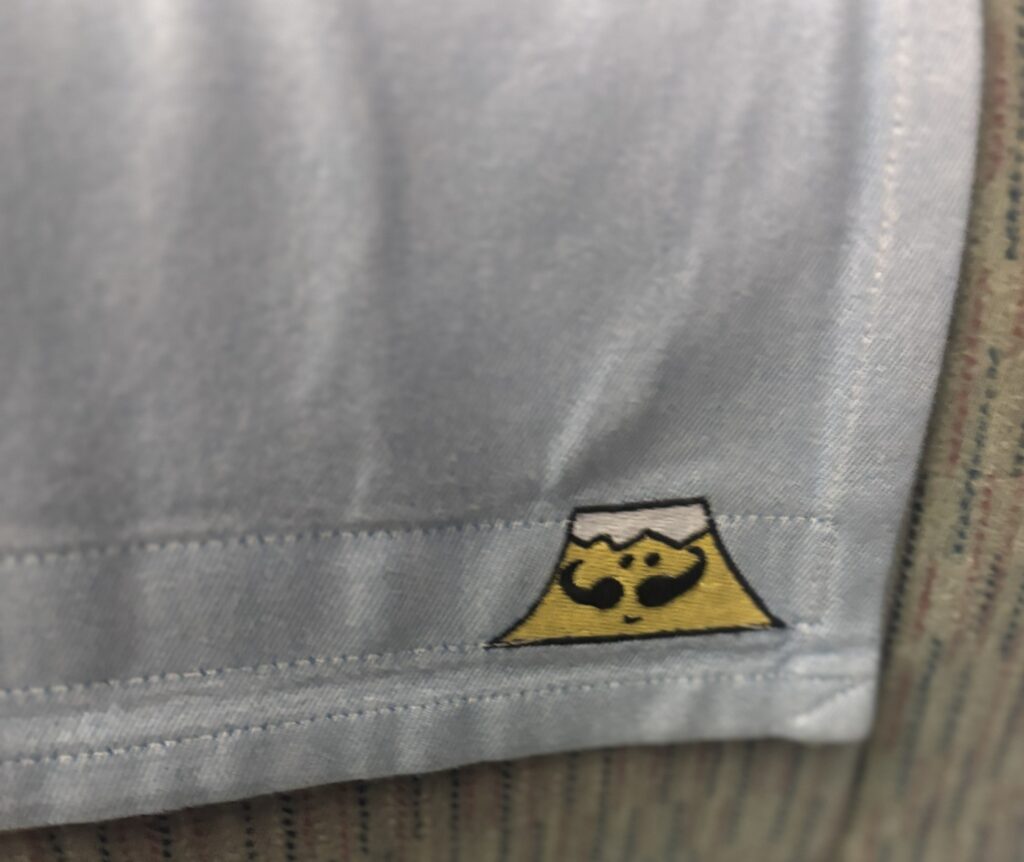
“Monsieur Fuji” — a yellow Mount Fuji sporting a moustache
Hunting for your favorite headcover design is one of the great joys of riding this train!
Fujisan Express is operated by Fujikyu Railway between Otsuki and Kawaguchiko. Filled with playful Mount Fuji-themed design throughout, it is enormously popular with tourists and railway fans alike.
Trying Yoshida Udon — Fujiyoshida’s Legendary Local Noodle
No visit to the Mount Fuji area is complete without Yoshida Udon — the proud local specialty of Fujiyoshida City.
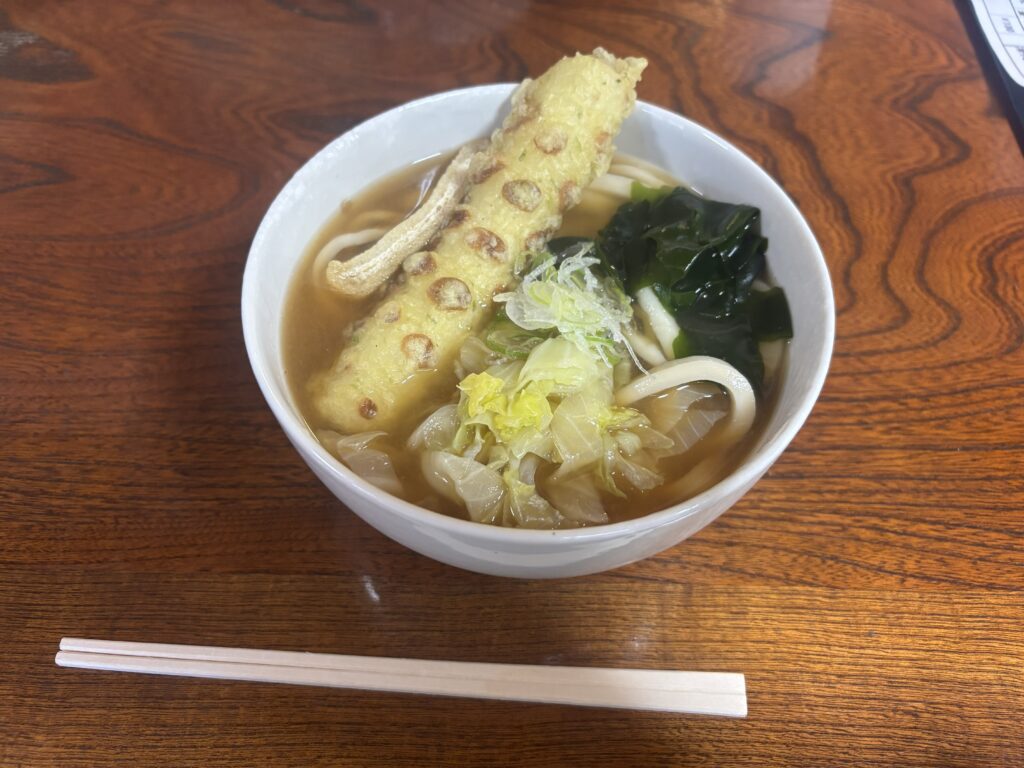
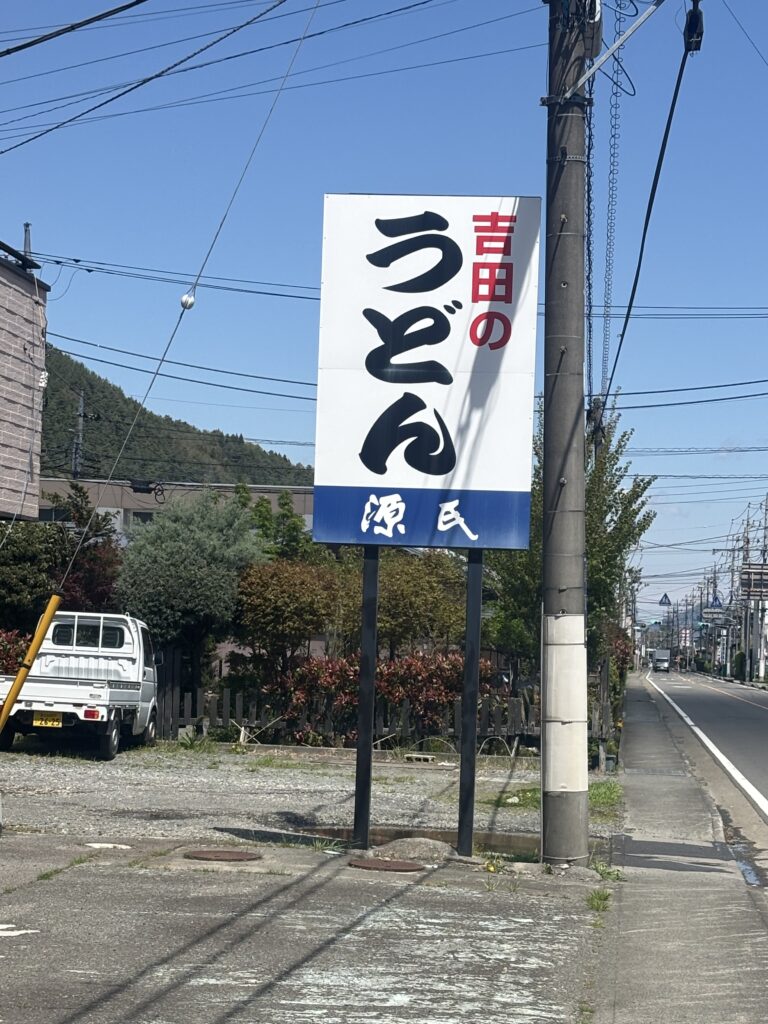
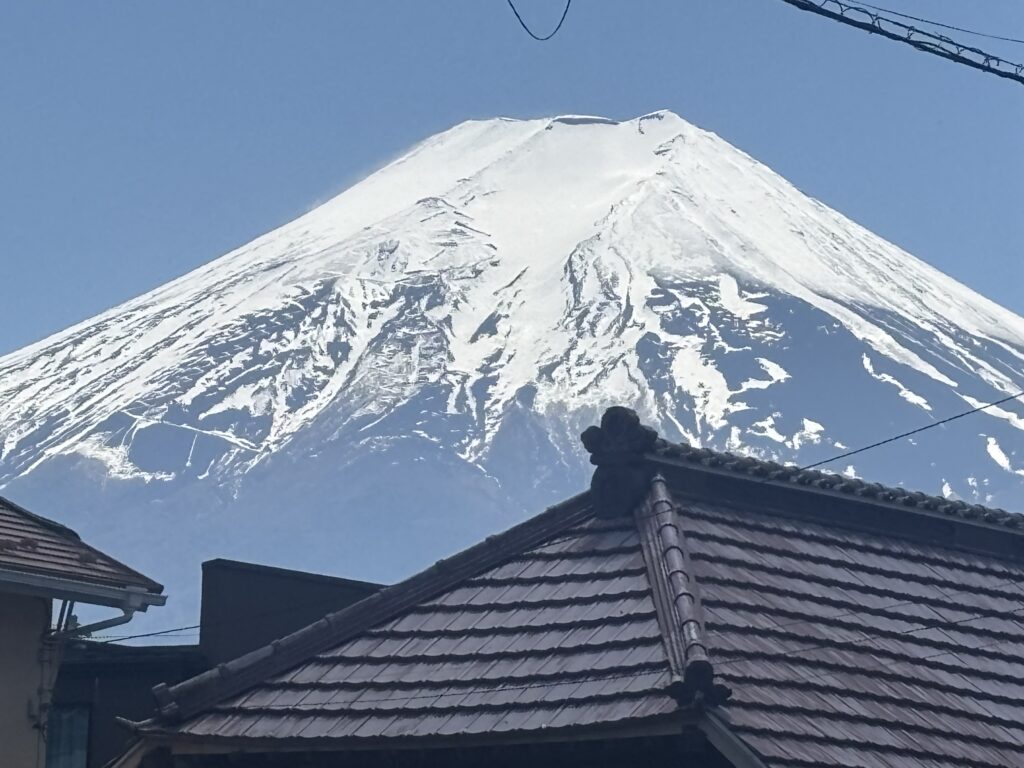
We ordered a bowl with miso broth and chikuwa tempura topping. The firm, chewy noodles paired beautifully with the miso-based soup, creating a simple but deeply satisfying flavor. Taking our seats at a restaurant called “Genji,” we looked up to find a stunning view of Mount Fuji framing the backdrop — a view that stopped us in our tracks all over again. Only in Fujiyoshida can you enjoy great food and a great view at the same time.
Yoshida Udon is a regional specialty of Fujiyoshida City, Yamanashi Prefecture. Known for its exceptionally firm and chewy texture and its distinctive blend of miso and soy sauce broth, it offers a completely different experience from typical Japanese udon. A must-try when visiting the Mount Fuji area!
The Return Journey on the Fuji Excursion (Fuji Kaiyu) — and a Stunning Surprise on the Platform
For the return leg, we took thethe Fuji Excursion (Fuji Kaiyu) — a direct and convenient option back toward Tokyo.
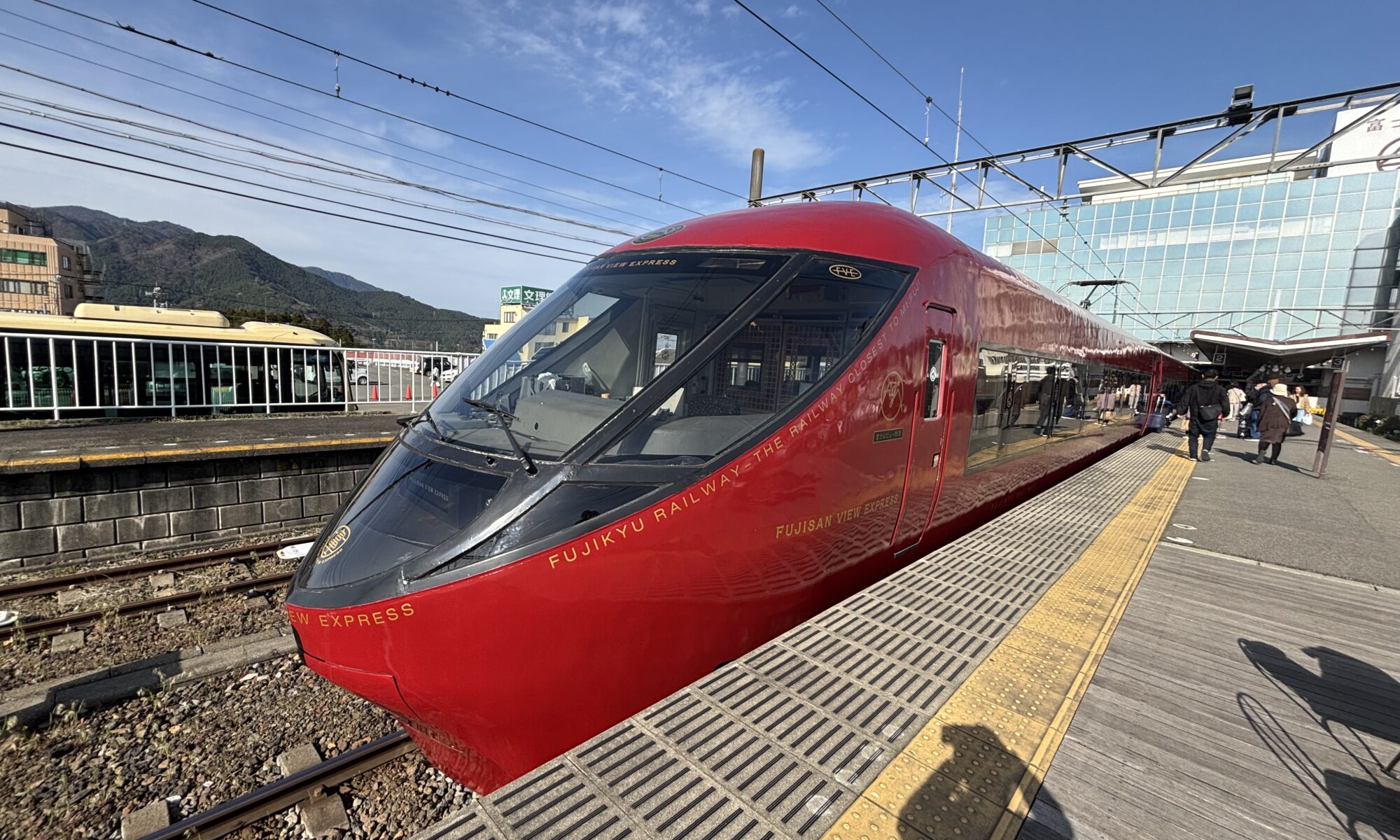
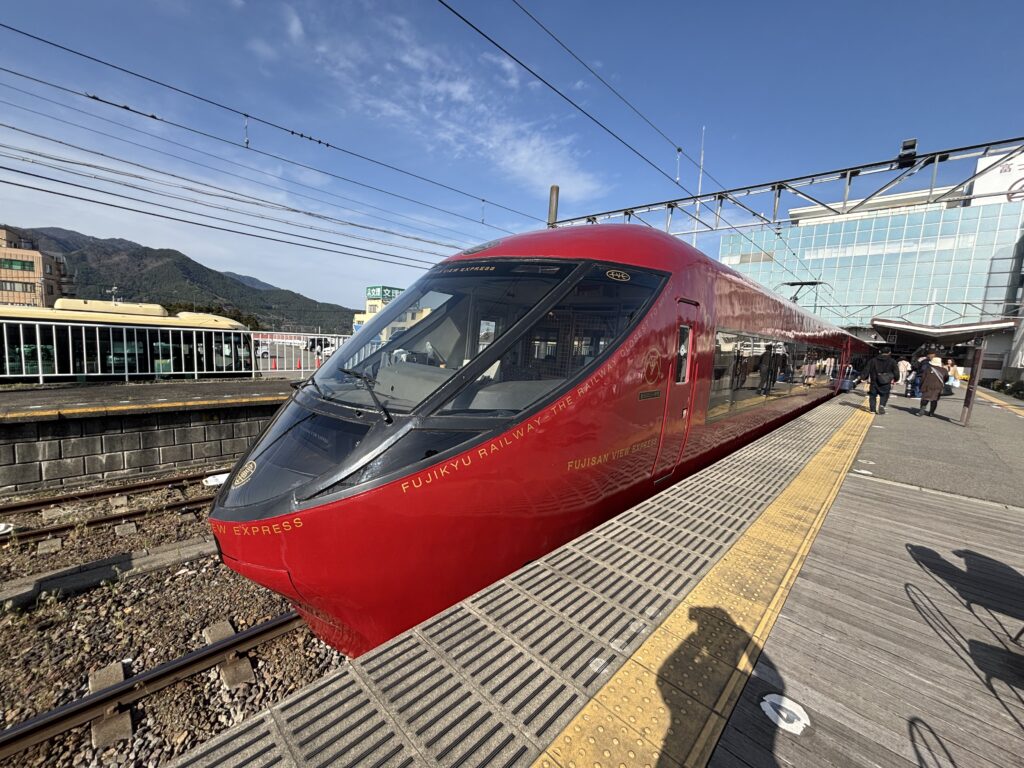
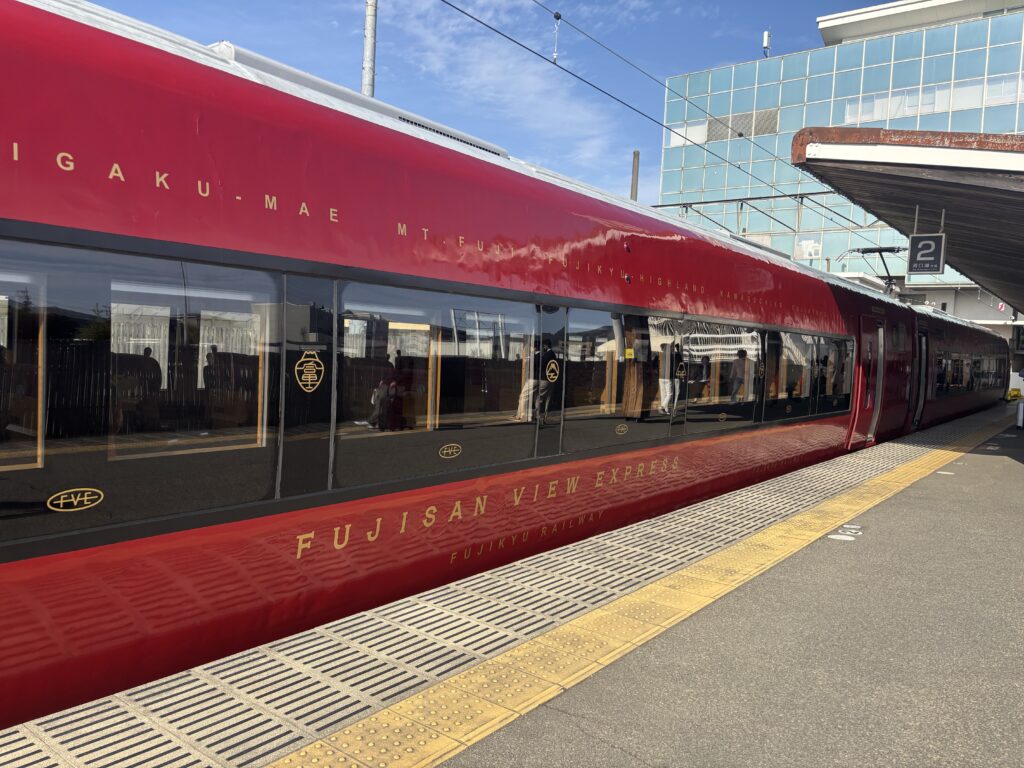
While waiting on the platform, a very special train glided in: the Fujisan View Express, designed by the industrial designer Eiji Mitooka. That striking crimson red body was absolutely breathtaking. This is officially next on our must-ride list!
Confusingly, the Fujisan Express we rode that day (8000 series) and the Fujisan View Express that pulled in (8500 series) are two different trains. Both run on the Fujikyu line, but the rolling stock and the interiors are completely different.
Fujisan View Express is a sightseeing limited express operated by Fujikyu Railway. Designed by Eiji Mitooka, the designer behind the Seven Stars in Kyushu, its bold crimson exterior is instantly recognizable. All seats are reserved, so advance booking is recommended if you’d like to ride.
Don’t Forget the Souvenir — Special Shingen Mochi at Hachioji!
On the way home at Hachioji Station, we successfully picked up the special 500th anniversary commemorative pouch Shingen Mochi we had spotted in the morning. A limited-edition souvenir that made the perfect memento of the trip.
Shingen Mochi is also available online!
Access Summary | Getting to the Mount Fuji Area by Train
Section
Train
Journey Time
Shin-Yokohama → Hachioji
Yokohama Line
Approx. 40 min
Hachioji → Otsuki
Limited Express Kaiji
Approx. 30 min
Otsuki → Kawaguchiko
Fujisan Express
Approx. 50 min
Return
the Fuji Excursion (Fuji Kaiyu)
Direct & convenient
Summary | The Mount Fuji Area Offers So Much More Than Just the Mountain!
Spot / Train
Highlights
Limited Express Kaiji
Power outlets at every seat — work while you travel
Fujisan Express
Unique headcovers & Mount Fuji-themed interior throughout
Yoshida Udon
Miso broth, chikuwa tempura & a stunning Fuji backdrop
Fujisan View Express
Eiji Mitooka’s crimson design — next on the must-ride list!
The Mount Fuji area offers a completely different experience with each train you ride. We highly recommend combining multiple trains for a truly memorable journey!
How to ride the Uzushio Limited Express and access the museum
Highlights and must-see exhibits at Otsuka Museum of Art
Important warnings about the Ikenotani Station transfer
Why checking timetables in advance is absolutely essential in Shikoku
First Ride on the Kotoku Line! Why We Chose the Uzushio Limited Express
The Kotoku Line connects Takamatsu and Tokushima — and this was our very first time riding it. The train we chose was the Limited Express “Uzushio.”
At Takamatsu Station, a member of staff helpfully walked us through the return journey options. Given that trains run only once per hour, we were truly grateful for that advice — as we would come to appreciate very deeply later in the day.
Limited Express Uzushio is operated by JR Shikoku between Takamatsu and Tokushima. Running on diesel multiple units (DMUs), this line has limited departures, making advance timetable checks absolutely essential. Miss your train and you could be waiting up to an hour for the next one.
Our Destination: Otsuka Museum of Art | 20 Minutes by Bus from Naruto Station
Our destination was the Otsuka Museum of Art, located approximately 20 minutes by bus from Naruto Station.
“It’s just reproductions, right?” — you might be thinking. But this is truly no ordinary museum. It brings together ceramic-plate reproductions of masterpieces from around the world, offering experiences like no other:
View all seven of Van Gogh’s Sunflowers paintings side by side in one visit
See The Last Supper — both the pre-restoration and post-restoration versions — displayed together in the same room
Experience Michelangelo’s Sistine Chapel ceiling reproduced at full scale
I actually visited here once during my student days, and seeing the Sistine Chapel ceiling here for the first time made the experience of seeing the real thing in Rome years later all the more moving. As a place to prepare yourself before encountering the originals, this museum is simply unmatched.
Otsuka Museum of Art is one of the largest ceramic art museums in the world, located in Naruto City, Tokushima Prefecture. It features approximately 1,000 Western masterpieces from over 190 museums across 26 countries, all faithfully reproduced at original scale on ceramic panels — including the full Sistine Chapel. Admission: ¥3,300 for adults. Allow a minimum of 3–4 hours for your visit.
Soak Your Tired Feet at Naruto Station’s Free Foot Bath
After a thoroughly satisfying museum visit, we stopped at the free foot bath right in front of Naruto Station to rest our weary legs. The warm water was an absolute blessing after hours of walking.
It’s completely free to use, so make sure to stop by whenever you’re passing through Naruto Station. Your feet will thank you!
Beware of Ikenotani Station! A 20-Minute Wait in the Rain
The painful lesson of the return journey came at Ikenotani (池谷) Station — a transfer point that caught us completely off guard.
Standing in the pouring rain, we waited a full 20 minutes for the next Uzushio Limited Express toward Takamatsu. In Shikoku, where trains are infrequent, missing a connection can mean a very long wait.
Important Warning — Ikenotani Station Transfer: This is the junction between the Kotoku Line and the Naruto Line, but waiting facilities are very limited. On rainy days especially, this transfer requires careful planning. Always check the timetable in detail before you travel.
Why Checking Timetables in Advance Is Non-Negotiable in Shikoku
Despite securing a seat in the unreserved car, we didn’t make it back to Takamatsu Station until after 6:30 PM.
Compared to the mainland, train services in Shikoku are significantly less frequent. Miss a connection and you could be stranded for a very long time. If you have plans later in the day, meticulous timetable planning is absolutely essential.
Key Planning Tips for Shikoku Travel
Check transfer waiting times at every station in advance
Always confirm the time of the last limited express of the day
Build generous buffer time into your itinerary
Have a plan for waiting in bad weather
Mascots Take on the Oni Stone Statue at Takamatsu Station!
Back at Takamatsu Station, the Mascots immediately set their sights on the Oni (demon) stone statue in front of the station — made from the prized local Aji Stone. They insisted on climbing up for a photo, scrambled their way up… and then couldn’t get back down. Classic Mascots (laughs).
Meanwhile, at Naruto Station, they posed quietly and obediently at the feet of the local mascot Uzuhime-chan. Apparently even the Mascots are a little intimidated by demons (laughs). The contrast in their expressions makes for one of the best photos of the entire trip.
Aji Stone (庵治石) is a premium granite quarried in Kagawa Prefecture. Known for its exceptionally fine grain and beautiful lustre, it is often called the “Diamond of Granite” and is one of Japan’s most prized natural stones.
Summary | Otsuka Museum of Art Is an Absolute Must on Any Shikoku Itinerary
Item
Details
Access
Takamatsu → Uzushio Ltd. Express → Naruto Station → Bus approx. 20 min
Key Warning
Ikenotani Station transfer / trains once per hour
Foot Bath
In front of Naruto Station (free)
Admission
¥3,300 for adults
Recommended Time
Minimum 3–4 hours
Top Tip
Check timetables thoroughly the day before you travel!
Otsuka Museum of Art has far more to offer than a single day can do justice to. For a truly relaxed experience, we recommend staying overnight in Naruto or Tokushima and taking two days to fully explore the collection.
Two ballots, a PCR test and half a year of waiting: The Royal Express from Yokohama to Izukyu-Shimoda, with a meal and live piano and violin, for 39,000 yen.
What this article covers
What it actually takes to get aboard The Royal Express — including the time we lost the ballot
The real cost and contents of the meal-inclusive boarding plan
What you’re given on board: the meal, the live music, the free drinks
The extra hoop we had to jump through during the pandemic
A News Item: The Royal Express Is Coming to Tokai
Recently we came across a news item reporting that The Royal Express would be running in the Tokai region.
That Royal Blue body, running through Tokai. Reading it brought back the time we actually rode it — and that’s what this article is about.
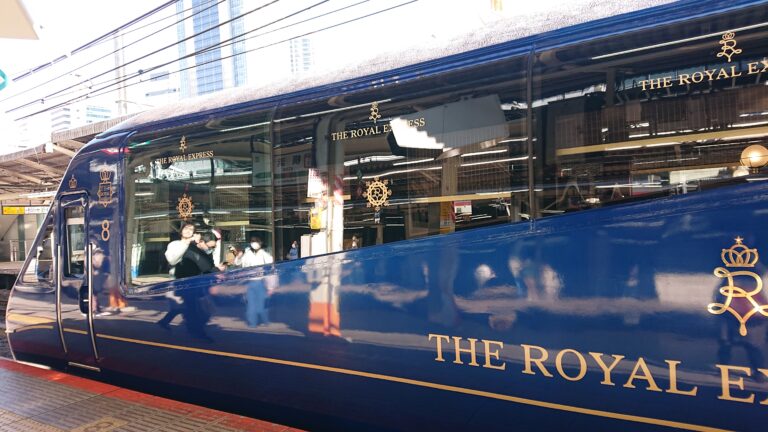
The Royal Express is a luxury sightseeing train operated by Tokyu Corporation. Known for its sleek Royal Blue livery and its onboard service, it runs as a tour train in Izu, Hokkaido and elsewhere. You cannot board it with an ordinary ticket — it is sold only as part of a travel package, which matters a great deal if you’re planning a trip to Japan around it.
Getting Aboard Took Half a Year — Including One Failed Ballot
We rode on 21 January 2022. Getting to that date was a long business.
Our first application went in on 6 August 2021, for a departure on 22 October. And then — we lost the ballot.
Because this is a tour train, applying does not mean riding. Capacity is 17 parties, and popular dates fill immediately.
Unwilling to let it go, we applied again on 18 October, this time for a departure the following January. And that one came through. Nearly six months had passed since our first attempt.
From “we have to ride this” to actually riding it took half a year. If you’re planning to try, it’s worth going in expecting that you may need more than one attempt — and worth knowing that a second application is entirely normal.
A Chaotic Run-Up: the PCR Test
This was a pandemic-era departure, which meant a PCR test was required shortly before travel. That part caused a certain amount of panic.
Booking the test, waiting for the result, and the knowledge that a positive result would undo everything — after waiting half a year, we weren’t calm about any of it until the last moment.
Looking back, the sheer amount of effort we put in purely to get on this train has become part of the memory of the trip.
The Meal-Inclusive Plan: What It Costs and What You Get
We booked the meal-inclusive boarding plan (one way).
The plan, as it was at the time Class: Platinum Class (Cars 5, 6 and 7) Route: JR Yokohama → Izukyu-Shimoda Duration: about 3 hours 20 minutes Price: ¥39,000 per person Meal: a set course, served with live music Drinks: free-flow Capacity: 17 parties / junior high school age and above
The meal came as a choice of Western, Japanese or creative Japanese courses. We chose the Western course, supervised by Shunkotei.
¥39,000 for a 3 hour 20 minute journey. Put like that it sounds steep, but it stops sounding steep once you understand that what you’re buying isn’t transport — it’s three hours with a meal and a live performance in it. When we pulled into Shimoda, our main feeling was that it had gone too quickly.
Passenger Badges — an Immediate Hit with the Mascots
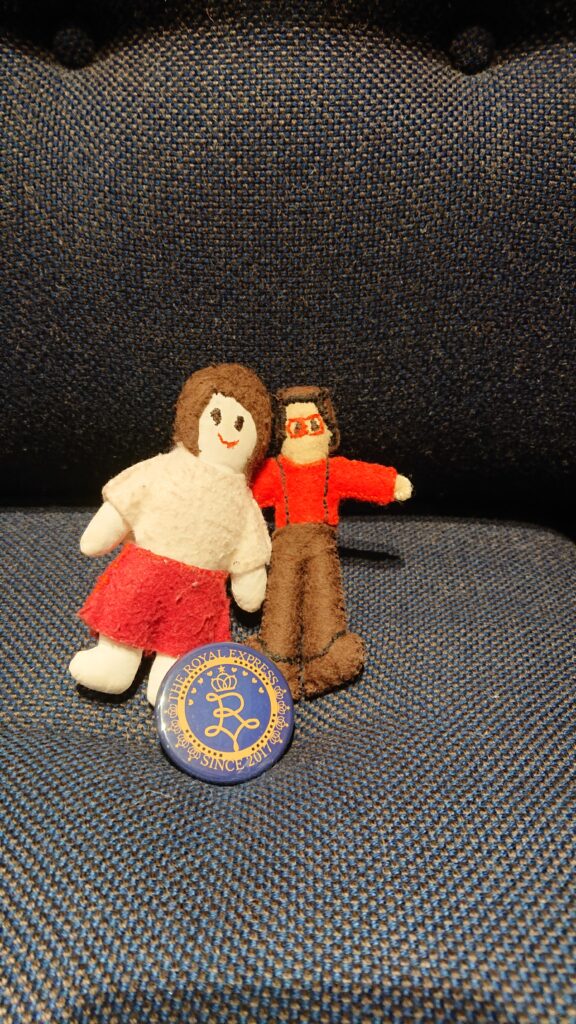
On boarding, the first thing handed to us was a passenger identification badge.
This went down enormously well with the mascots. From the moment the badges appeared they were beside themselves, and no amount of quiet encouragement had the slightest effect.
That a badge alone could produce this much delight was a surprise. The small ceremonial touches start lifting the mood before the train has even moved.
All Aboard — and the Mascots Go Wild
Stepping into an interior finished throughout in Royal Blue, the mascots were immediately, audibly thrilled.
It’s a calm, wood-toned space with the tables properly set. Because this is a tour train, there is no tour conductor travelling with you — The Royal Express’s own crew look after the carriage.
Live Piano and Violin On Board
One of the centrepieces of this plan is the live music.
We heard both piano and violin performed live in the carriage. Musicians playing a few feet in front of you, on a moving train — it isn’t an experience you can easily find elsewhere.
A meal in front of you, scenery sliding past the window, and music being played live. “Travel time” is not the right phrase for those three hours and twenty minutes.
A Rare Sight: The Mascots’ Wistful, Quiet Moment
Even these thoroughly excitable mascots had a moment of something like wistfulness.
Sitting and watching the scenery go by, they looked quite unlike their usual selves — a rare photograph. Drawing out an expression like that is something only a journey like this manages.
Mascots Will Be Mascots
The wistfulness didn’t last. By the end of the journey they were, inevitably, playing with a ball — making it entirely clear they hadn’t finished enjoying themselves.
Even a luxury train turns into something rather homely with the mascots along.
If You Want to Ride The Royal Express
You cannot board with an ordinary ticket. You must apply through a travel package.
Three things we’d pass on from our own experience:
Capacity is small, and you can lose the ballot. We did, once
Losing doesn’t end it. Apply for the next departure — if you’re prepared to wait half a year, there’s a way through
Operating dates are irregular. The official site and social media need checking regularly
Course contents and prices vary by operating period. Always check the current details before applying — what we describe here is how it stood in early 2022.
Summary | What ¥39,000 Buys for 3 Hours and 20 Minutes
Date
21 January 2022
Route
JR Yokohama → Izukyu-Shimoda (approx. 3 hr 20 min)
Class
Platinum Class (Cars 5, 6, 7)
Price
¥39,000 per person (meal-inclusive boarding plan)
Meal
Western course, supervised by Shunkotei
Music
Live piano and violin
Drinks
Free-flow
Booking
Lost the ballot on 6 August 2021; applied again 18 October and won
Requirement at the time
PCR test before departure
We lost a ballot, applied again, took a PCR test, and finally got three hours and twenty minutes aboard.
And now there’s news that it will be running in the Tokai region. If the chance comes round again, we won’t hesitate this time.
There are other trains where the ride itself is the destination. The Tango Kuromatsu is one of them.
14 August 2024. Our summer trip began early in the morning at Nagoya Station. Day one was meant to be a straightforward run up to Kanazawa and nothing more. Then, that evening, a typhoon turned the whole plan upside down.
Leaving Nagoya at 7:51 — and a Surprising Fact About the Shirasagi No. 1
The first train of the trip was the Limited Express Shirasagi No. 1, departing Nagoya at 7:51.
“Number 1 must mean it’s the first run of the day,” we assumed. It turns out that isn’t the case. This set had already made a run that morning as a “Home Liner” commuter service before taking up its duty as the Shirasagi.
So “No. 1” doesn’t mean the train hasn’t been anywhere yet. We boarded the freshly turned-out Shirasagi No. 1 and set off along the shore of Lake Biwa toward Tsuruga.
Day one, on the rails Limited Express Shirasagi No. 1 — Nagoya 7:51 → Tsuruga 9:27 (Car 4, seats 1A and 1B) ‹ 19-minute connection at Tsuruga › Hokuriku Shinkansen Tsurugi No. 8 — Tsuruga 9:46 → Kanazawa 10:43 (Car 7, seats 9D and 9E) ¥18,960 for two adults = ¥9,480 per person (¥4,970 limited express charge + ¥4,510 base fare) As of August 2024
Turning the Seats Around by Hand at Maibara
Partway through the run, at Maibara Station, a small task landed on us.
The train reverses direction here, which means passengers turn their own seats around. On local rapid services this is a familiar sight, but the chance to do it on a limited express is increasingly rare.
The mascots were thrilled to try it for the first time. Once the seats were swung round and we sat back down, the scenery that had been receding behind us was suddenly rushing toward us. Same train, but from here on it felt like a different vehicle entirely.
Changing to the Tsurugi No. 8 at Tsuruga
The connection at Tsuruga was 19 minutes — unhurried, with time to move without rushing.
The Tsurugi runs on the Hokuriku Shinkansen between Tsuruga and Toyama, a service introduced when the line was extended in March 2024. We were riding it in the summer of its first year. We reached Kanazawa at 10:43, roughly three hours out of Nagoya.
Kanazawa: Gold Leaf, Salt Bread and the Castle
Applying gold leaf at Sakuda, in Higashiyama
Kanazawa means gold leaf. We had booked a gold leaf application workshop at Sakuda in Higashiyama for 1pm.
Working under a craftsman’s guidance, you apply the leaf yourself. It is thin enough that a single breath will send it flying, so you find yourself breathing shallowly without meaning to. It takes real concentration, and finishing a piece is genuinely satisfying.
Kenrokuen: we gave up because of the heat
An honest admission. We had intended to visit Kenrokuen, one of Japan’s three great gardens.
The August heat in Kanazawa was beyond anything we had planned for. There was no shade on the walk, our willpower ran out, and we simply gave up — turning back with one of the country’s most famous gardens within reach.
Instead we headed for Higashi Chaya District, the old teahouse quarter, which lies in the same direction as the Higashiyama workshop, so we could walk straight on from there.
And then a local craft beer at a Kanazawa pudding shop. That cold glass was the most effective thing that happened all day. Because the plan fell apart, this is the part we remember most clearly.
If you’re walking around Kanazawa in midsummer, we’d suggest building more indoor stops into your plan than you think you need. Japanese summer heat is not something to underestimate.
Salt bread from Kanazawa German Bakery
At Kanazawa German Bakery in the Kanazawa Hyakubangai Rinto shopping area inside the station, we came across shiopan — salt bread. Simple, but the balance of salt is just right, and we ended up buying more to take home. Being inside the station, it’s easy to grab on your way out.
Kanazawa Castle
Under a clear August sky, the contrast between the stone walls and white plaster was superb. Kanazawa’s strength is that gold leaf workshops, food and historic sites all sit within walking distance of one another.
A Typhoon, an Emergency Meeting, and Giving Up on Tokyo
Then, that evening, word came that a typhoon was likely to make landfall in the Kanto region.
The plan for the following day had been to travel to Tokyo. The purpose was a railway event at Tokyo Big Sight, and the whole itinerary had been built around it.
We held an emergency meeting in our Kanazawa hotel — comparing the typhoon’s track and timing against the rail suspension notices. The conclusion:
“We give up on Tokyo. Let’s eat fish in Toyama, eat Hida beef, and come back to Nagoya via Takayama.”
Rather than heading east, we would run west, away from it. Letting go of an event we’d looked forward to was a disappointment, but far better than being stranded in Kanto. A determinedly positive decision, in true mascot style.
The revised route Kanazawa →(Hokuriku Shinkansen Hakutaka No. 560)→ Toyama →(Limited Express Hida)→ Takayama → Nagoya
How that decision played out the next day is covered in the typhoon day article. In short: we ended up riding Gran Class for the first time, and our train was halted at Gifu.
Summary | Day One’s Trains
Train
Section and times
Limited Express Shirasagi No. 1
Nagoya 7:51 → Tsuruga 9:27
Hokuriku Shinkansen Tsurugi No. 8
Tsuruga 9:46 → Kanazawa 10:43
Day one was a quiet one — travel and sightseeing, nothing more. Trips don’t always go to plan, but it’s equally true that abandoning the plan is what led us somewhere else. Behind the Kenrokuen we gave up on were a teahouse district and a cold beer.
The Tokyo railway event we abandoned here, we went back for in the summer of 2025. And from there we carried on into Tohoku, where this time we rode Gran Class for more than two hours. Homework, finally handed in a year late.
The previous day we had taken the limited express Revaty Kegon out to Tobu-Nikko and visited Nikko Toshogu Shrine. Day two of the trip belonged to steam locomotives and turntables — and as it turned out, we watched a turntable at work twice, at two different stations.
Shimo-Imaichi Station — A Hidden Sacred Ground for Railway Fans
“Shimo-Imaichi” is a bit of a mouthful if you’re not used to it, but the station is well worth a stop if you like railways.
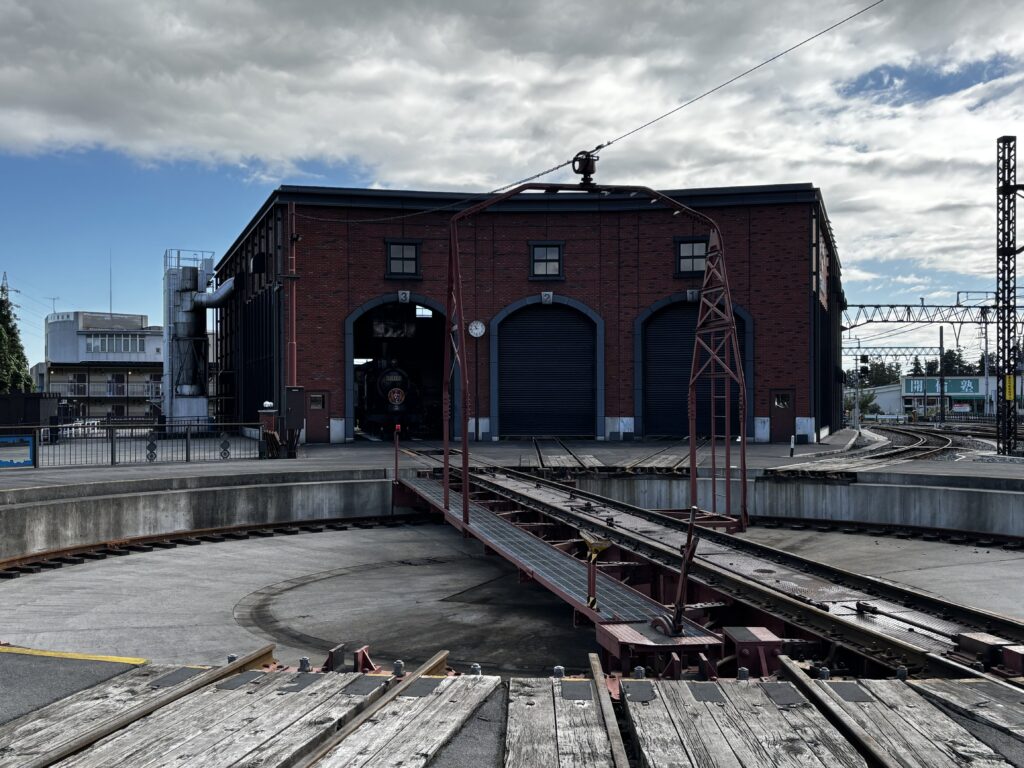
Shimo-Imaichi has both an engine shed and a turntable for its steam locomotives, so you can watch a locomotive emerge from the shed and be turned, right in front of you.
A turntable is the equipment used to rotate a steam locomotive through 180 degrees. The one at Shimo-Imaichi is in active service, which makes this a rare place to watch the process at close range.
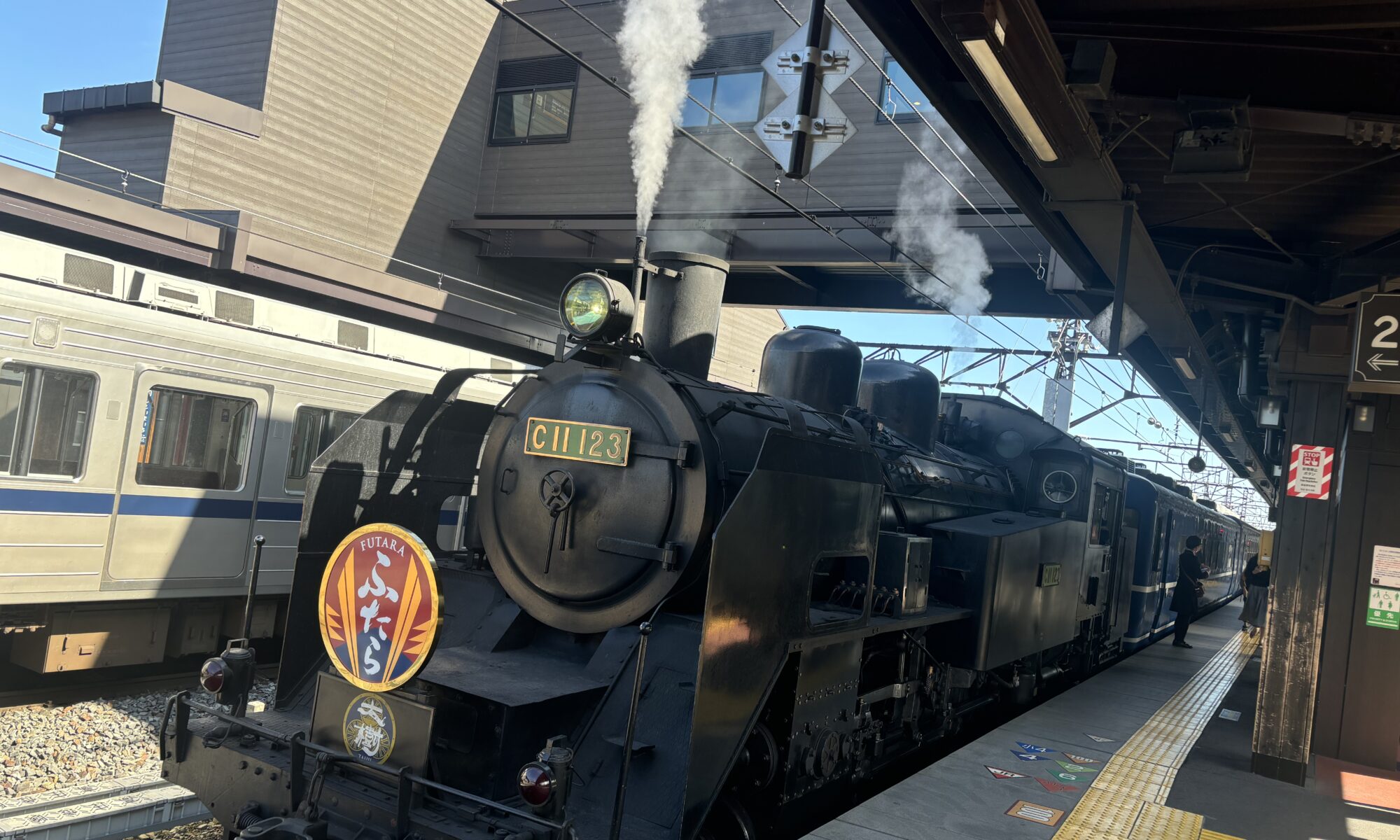
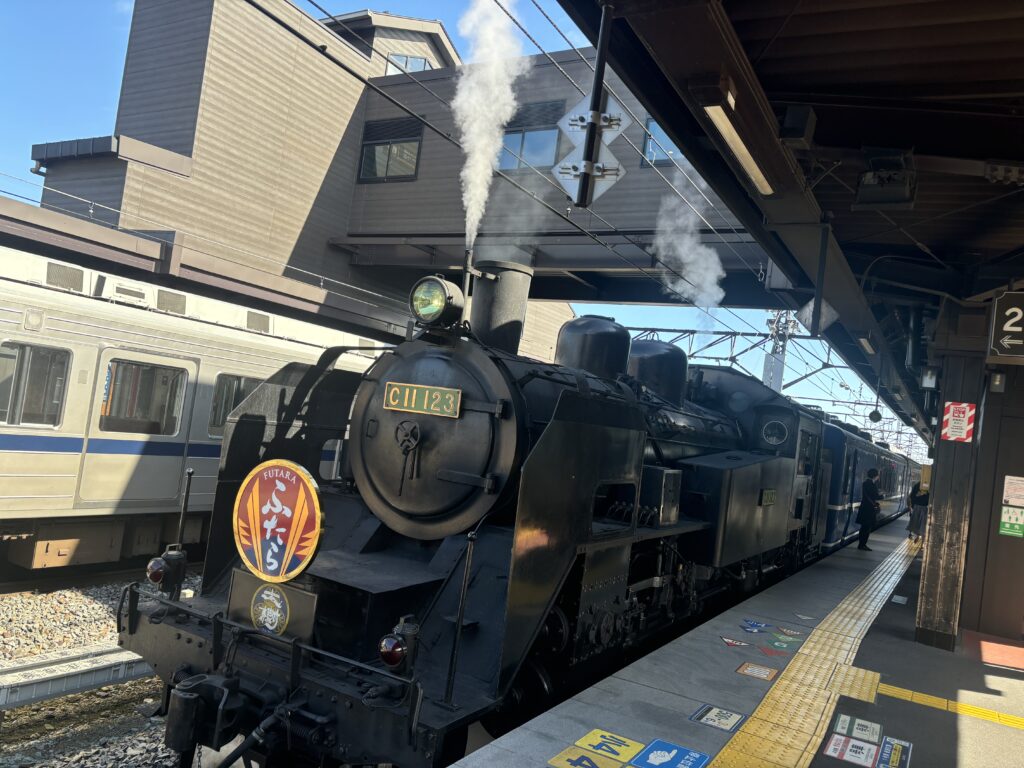
We began the morning by travelling from Tobu-Nikko across to Shimo-Imaichi to watch SL Taiju being turned. This is a different train from the SL Taiju Futara we would board later — the two work different sections, so Shimo-Imaichi gives you a chance to see both.
What Froze the Mascots Wasn’t the Turntable — It Was the Whistle
Watching a locomotive slowly change direction is impressive enough on its own. But what startled the mascots most wasn’t the turntable at all. It was the whistle.
A sound like the ground itself shifting — and every one of them stood frozen for several seconds. That was the moment we understood that the sheer presence of a working steam locomotive does not come through in photographs or video.
It’s worth experiencing whether or not you’re a railway fan, and perhaps especially if you’ve never stood next to a steam locomotive before. Sound is the one thing you can’t take home with you.
Back to Tobu-Nikko to Board SL Taiju Futara
Having watched the turning, we headed back to Tobu-Nikko Station. This was the main event: boarding SL Taiju Futara.
Departing Tobu-Nikko at 13:03, arriving Kinugawa-Onsen at 14:06 — about an hour on board.
What does a seat on SL Taiju Futara cost? Ours came to ¥1,080 per adult (as of October 2024). Note that this is a reserved seat ticket rather than a limited express ticket, and a separate base fare ticket is also required. Every seat is reserved, so booking ahead is the safe approach — weekends and holidays can sell out early.
Once under way, smoke and steam drift past the window. The pace and the sound are nothing like a Shinkansen or a modern limited express. There’s a distinct sense of riding something that was never built to get you anywhere quickly.
At Kinugawa-Onsen, the Train We’d Just Ridden Was the One Turning
Kinugawa-Onsen Station has a turntable of its own. And what you watch turning there is the very SL Taiju Futara you have just stepped down from.
That morning at Shimo-Imaichi, we had been watching an unfamiliar locomotive rotate. By the afternoon it had become “the train we were sitting on an hour ago is turning right in front of us.” The same sight — but having ridden it first changed it completely.
Being able to see the turntable at both Shimo-Imaichi and Kinugawa-Onsen is one of the quiet pleasures of the Tobu Nikko Line. If your schedule allows it, do both.
Home to Asakusa on the SPACIA X
From Kinugawa-Onsen we changed to the SPACIA X for the journey home.
Departing Kinugawa-Onsen at 15:21, arriving Asakusa at 17:35 — two hours and fourteen minutes. We were in Car 3.
What does the SPACIA X cost? Kinugawa-Onsen to Asakusa came to ¥1,940 per adult (as of October 2024). That figure is the limited express charge; a separate base fare ticket is also required.
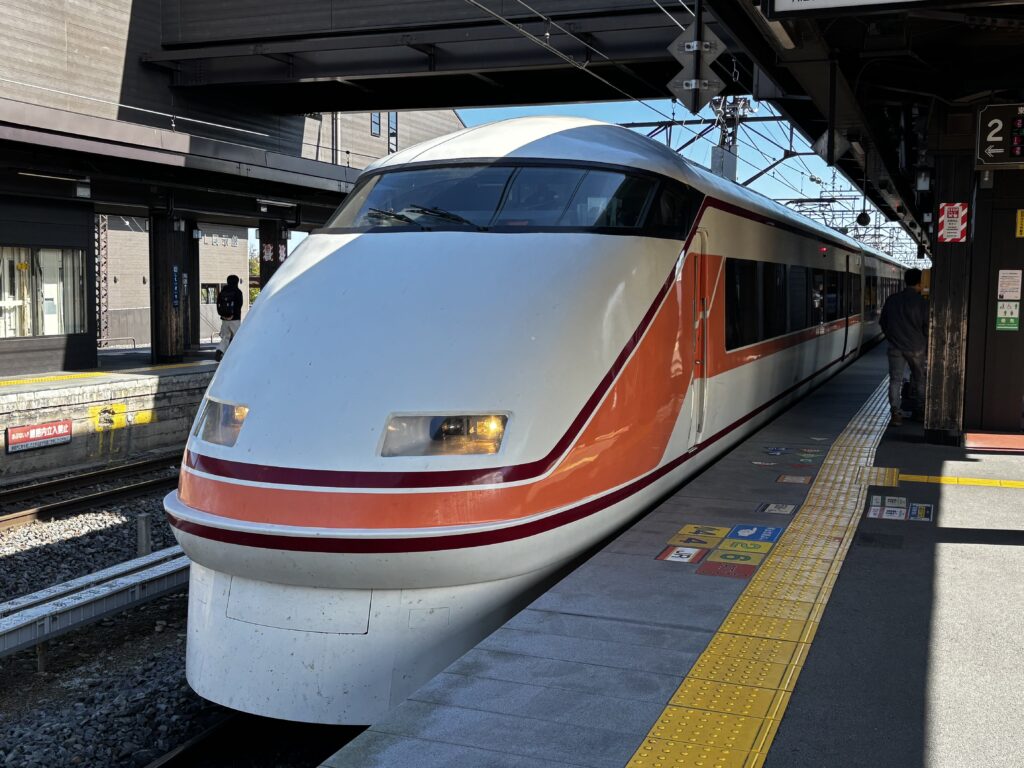
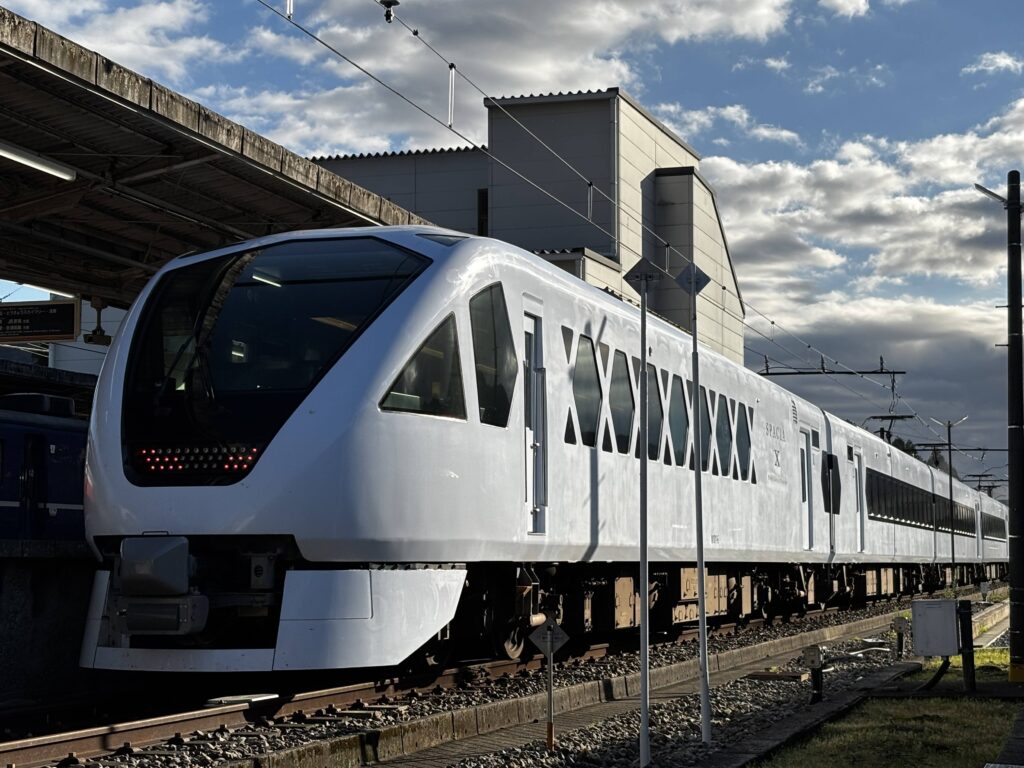
The SPACIA X entered service in 2023 as Tobu Railway’s new flagship limited express. With seating that runs from the Cockpit Lounge to private compartments, it’s the kind of train where the ride itself becomes the reason for the trip.
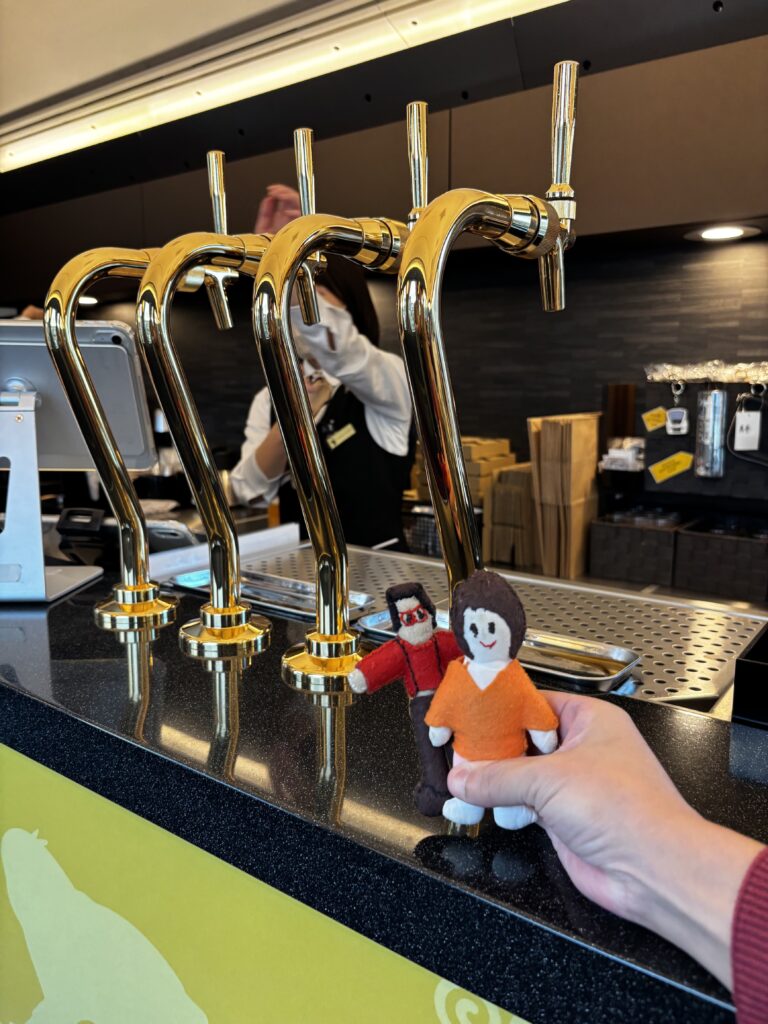
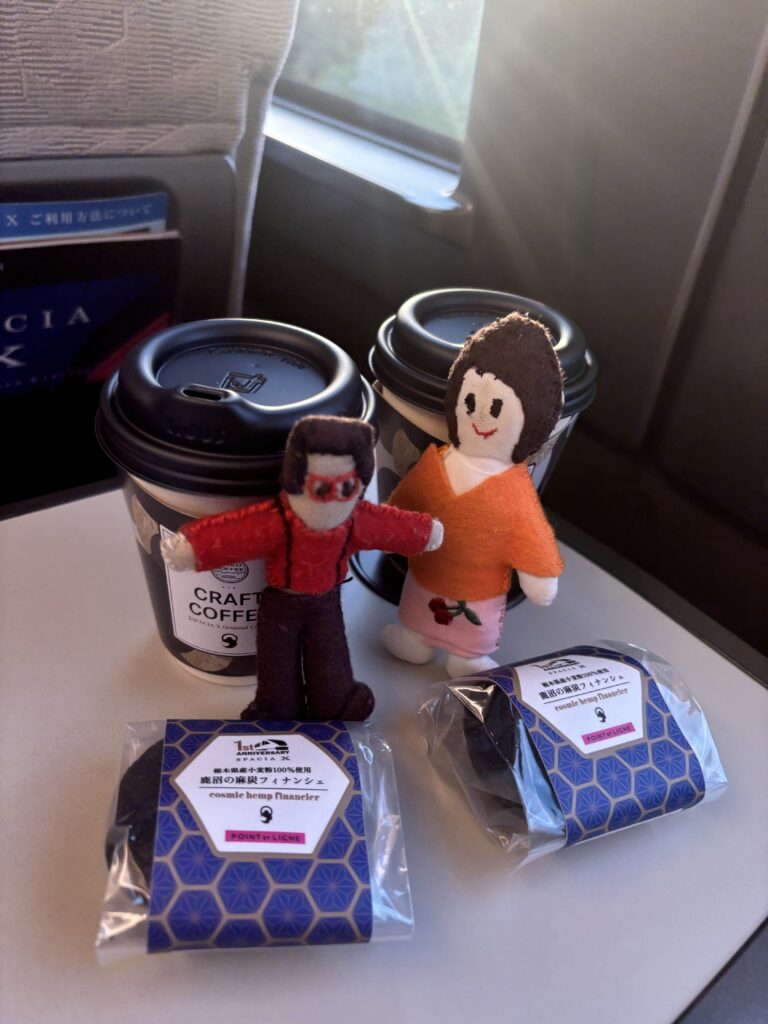
On board there’s a café counter called GOEN CAFE, serving drinks and sweets made specifically for the SPACIA X. Coffee taken while the scenery slides past is its own small luxury, and the mascots were thoroughly content. Popular items do sell out, so it’s worth going along early.
In the morning we were frozen in place by a steam whistle; by late afternoon we were drinking coffee aboard a brand-new express. Feeling close to a century of engineering difference in a single day, on a single line, is what makes the Tobu Nikko Line such a rewarding trip.
Summary | Two Turntables in One Day — Shimo-Imaichi and Kinugawa-Onsen
Station / train
What to see
Cost (Oct 2024, per adult)
Shimo-Imaichi Station
Engine shed and turntable; SL Taiju being turned
—
SL Taiju Futara No. 72
Tobu-Nikko 13:03 → Kinugawa-Onsen 14:06
Reserved seat ticket ¥1,080
Kinugawa-Onsen Station
The SL Taiju Futara you rode, being turned
—
SPACIA X No. 8
Kinugawa-Onsen 15:21 → Asakusa 17:35
Limited express charge ¥1,940
Steam locomotives, a brand-new flagship express, and turntables at both ends. There aren’t many lines where a single trip gives you all of that. If you’re heading for Nikko or Kinugawa-Onsen, it’s well worth breaking the journey here.
Day one of this trip is covered in a separate article — taking the Revaty Kegon out to Tobu-Nikko and visiting Nikko Toshogu Shrine.
Kita-Senju to Tobu-Nikko on the Revaty Kegon for 1,650 yen, where the seat outlets hide, a day at Nikko Toshogu, and the free shuttle to our hot spring inn.
Taking the Revaty Kegon Straight to Tobu-Nikko
Our trip began aboard the limited express Revaty Kegon, operated by Tobu Railway. We left Kita-Senju at 9:43 and pulled into Tobu-Nikko at 11:22 — about an hour and forty minutes on the rails.
The Revaty Aizu and the Revaty Kegon run coupled together as a single six-car train. At Shimo-Imaichi Station on the Nikko Line, the front three cars (Revaty Aizu) are uncoupled from the rear three (Revaty Kegon). For railway fans, this uncoupling is a sight not to be missed. One word of caution, though: the Revaty Aizu pulls out almost immediately after separating, so be careful not to find yourself on the wrong half. The Revaty Kegon waits until the Aizu has gone, which gives you two or three minutes of breathing room.
The cabin is comfortable, and every seat on the Revaty has a power outlet — but it sits right next to the recline button on the armrest, which makes it surprisingly easy to miss. We never spotted ours and spent the whole ride nursing our phone batteries. Check your armrest as soon as you sit down.
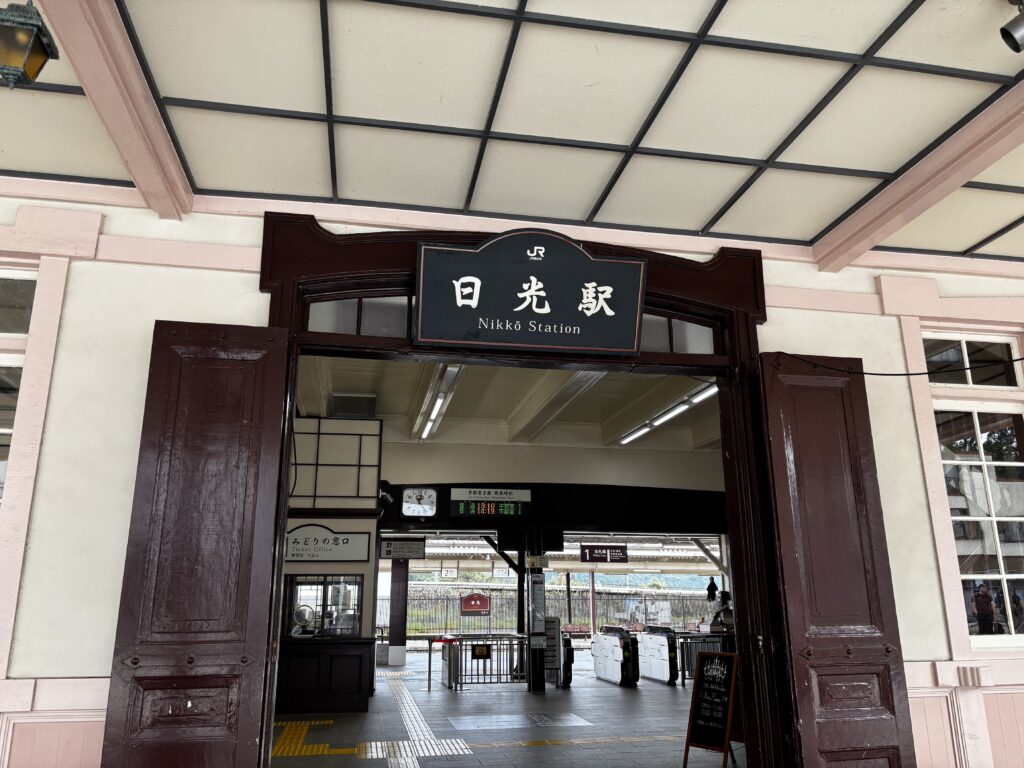
Nikko has two stations, by the way: Tobu-Nikko and JR Nikko. The handsome old station building in the photo is JR Nikko. Both have real character, and simply looking at them puts you in a traveling mood.
About Tobu Limited Express Tickets
SPACIA X, Kegon and Kinu, Revaty Kegon / Revaty Kinu / Revaty Aizu, Revaty Ryomo, Ryomo, Skytree Liner — “limited express” covers a lot of ground on Tobu. The mascots genuinely agonized over whether to take the Revaty Ryomo, the Revaty Kegon, or the SPACIA X.
You need both a base fare ticket and a limited express ticket, and the total changes quite a bit depending on which train you pick. It goes more smoothly if you decide which limited express you want on the Tobu Railway website before you book. Reservations open one month ahead, and at that point you still have your pick of trains.
Revaty Kegon limited express fare Ours came to ¥1,650 per adult for Kita-Senju to Tobu-Nikko (as of October 2024). That is the limited express charge only — a separate base fare ticket is also required.
A SPACIA X Welcome at Tobu-Nikko Station
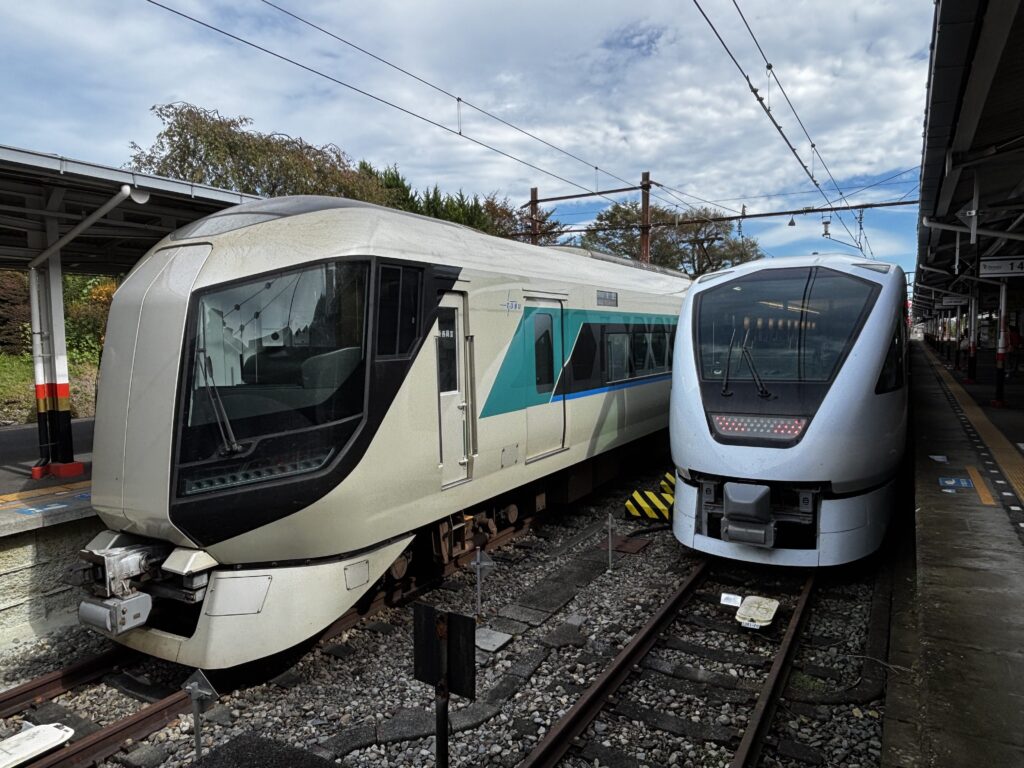
We stepped off at Tobu-Nikko Station to find a SPACIA X sitting right there on the platform. We couldn’t resist lining up beside it for a photo. 📷
We snuck a look inside as well, and the interior was so beautiful that we wanted to board on the spot. But our SPACIA X reservation was for the return trip the following day, so we held ourselves back, switched gears, and set off for Nikko Toshogu.
The SPACIA X is Tobu Railway’s newest limited express, introduced in 2023. Its range of seating — the Cockpit Lounge and box seats among them — has made it enormously popular, and reservations can be hard to come by.
Leave the Big Bags at the Hotel
Hauling heavy luggage around Nikko Toshogu is no fun at all. Our hotel had an affiliated property right in front of JR Nikko Station, so we dropped our bags there first.
That turned out to be exactly the right call. Traveling light, we caught a bus from in front of JR Nikko Station and headed for the shrine.
Getting to Nikko Toshogu: Local buses run from both JR Nikko and Tobu-Nikko stations. The ones leaving from in front of Tobu-Nikko Station are more frequent and the more convenient option. The ride takes about 10 minutes, and since this is a major sightseeing area, you rarely wait long for the next bus.
Visiting Nikko Toshogu Shrine
Hands free at last, we made our way into Nikko Toshogu — where the ticket counter had a very long line. Tickets can be purchased online in advance, and next time we certainly will. There are two main options: shrine admission on its own, or a combined ticket that includes the Treasure Museum. Full details are on the Nikko Toshogu website.
Shrine-only ticket*: ¥1,600 for adults and high school students, ¥550 for elementary and junior high school students (includes the Yomeimon Gate and the Sleeping Cat)
Shrine + Treasure Museum ticket*: ¥2,400 for adults and high school students (covers shrine admission and entry to the Treasure Museum)
*As of July 2026
Ringed by centuries-old architecture and deep forest, the grounds reward you no matter how many times you visit.
Nikko Toshogu overwhelms visitors with solemn carvings and vividly colored buildings, but what made the mascots’ eyes light up most was the Sleeping Cat, a designated National Treasure. It is one of the most famous decorative carvings at this shrine dedicated to Tokugawa Ieyasu — small, yet with tremendous presence. “There it is! The real thing!” they cried, and we couldn’t help laughing at the sight of them. In a space so heavy with history, it was that endearing little cat that captured them completely. The Three Wise Monkeys — “see no evil, speak no evil, hear no evil” — were there too, but we walked straight past them. There is simply that much to take in, and the time disappeared.
The Sleeping Cat is far from the only highlight here. The Yomeimon Gate is also known as the Higurashi-no-mon, the “twilight gate,” because it is said you can stand and admire it until the sun goes down without noticing. The gilded, richly colored detail work is breathtaking, and after several centuries it has lost none of its brilliance.
The cedar avenue leading to the inner shrine includes many trees more than 400 years old, and the atmosphere along it is genuinely sacred. There is so much to see at Nikko Toshogu that you should set aside two to three hours if you want to take your time.
Where We Stayed | Hotel Eurocity, a Hot Spring Inn with Its Own Source
After the shrine we took the bus back to Tobu-Nikko Station and picked up bento for dinner. From there we went over to JR Nikko Station and collected our luggage from the Nikko Station Hotel Classic, where we had left it that morning.
That is also the pick-up point for the hotel’s shuttle. We were staying at Hotel Eurocity, about five minutes away by car, so there was no need for a twenty-minute walk with our bags.
Our stay Room: Maisonette room with a private garden open-air bath (a two-storey room) Plan: one night with breakfast Price: 37,400 yen for two, tax and service included (as of October 2024) Booking: we secured it six days before the stay
The room has its own garden open-air bath, fed entirely by the hotel’s own hot spring source. The maples were just beginning to turn, and soaking there while looking out at them was the best possible reward at the end of the day.
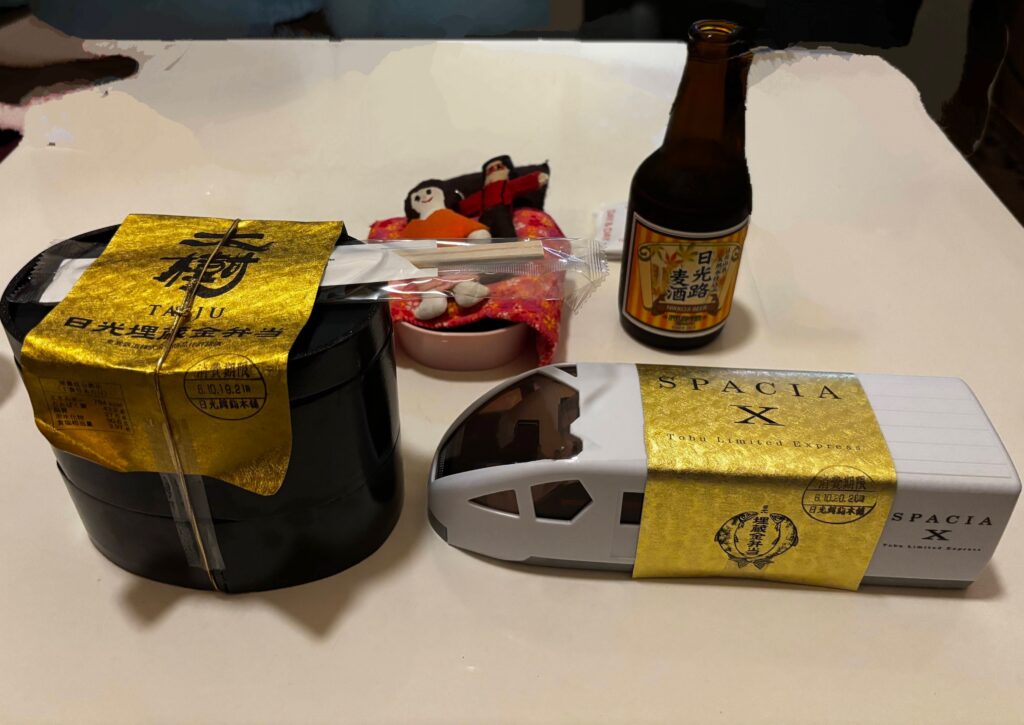
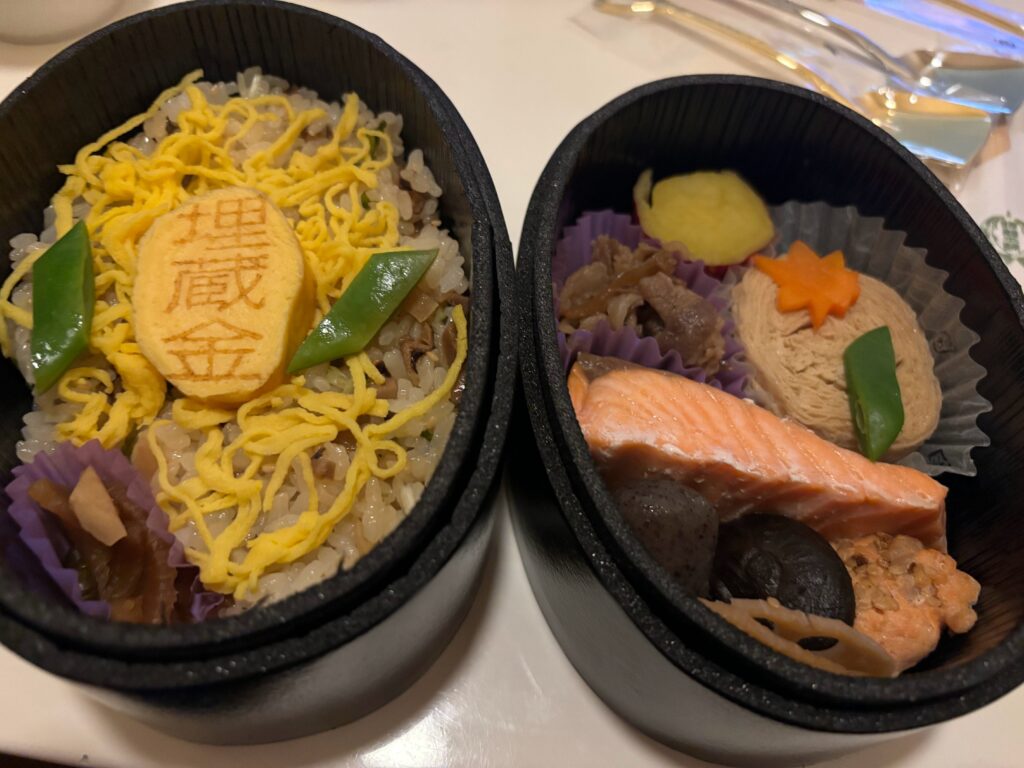
Dinner was Nikko Maizokin bento from Tobu-Nikko Station, eaten in our room: one in a Taiju wrapper, one in a box shaped like the SPACIA X. Eating the next day’s train in bento form the night before felt suitably railway-minded. The plan’s selling point was the next morning’s breakfast, so keeping the evening light turned out to be the right call.
About the Free Shuttle
There are four departures: 15:15, 16:15, 17:15 and 18:15. You request it by phone on the day; it cannot be booked in advance. The meeting point is in front of the main entrance of the Nikko Station Hotel Classic. On foot the hotel is about twenty minutes from the station, so if you have luggage, the shuttle is the safer choice.
Please check before booking All rooms at this hotel are smoking rooms; there are no non-smoking rooms (deodorising can be arranged on request). If smoke bothers you, it is worth confirming in advance.
A Model Course for Nikko (Day 1)
Time
What we did
Morning
Arrive at Tobu-Nikko Station on the Revaty Kegon
Morning
Drop luggage at the hotel in front of JR Nikko Station