Inside the Doctor Yellow at the SCMAGLEV and Railway Park – and the Driver’s Seat of the 955 Series “300X”

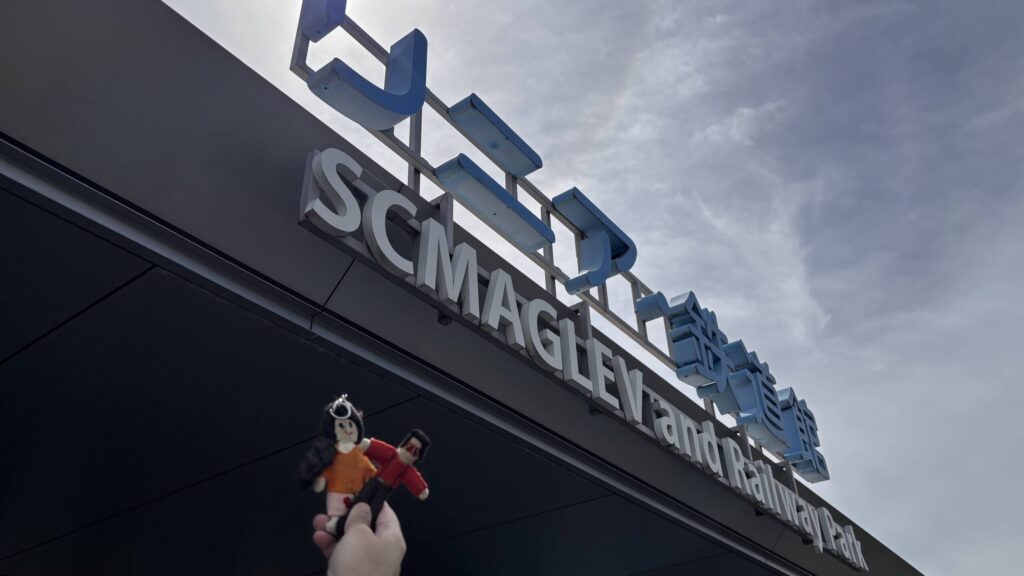
Tikoppi and Presley looking up at the SCMAGLEV and Railway Park sign

Four hours at the SCMAGLEV and Railway Park: the driver’s seat of the 955 Series 300X, and inside a 923 Series Doctor Yellow. Ninety minutes of it queuing.

Two years on, we went back to the SCMAGLEV and Railway Park. Last time we lost two hours in front of the model railway diorama and left without seeing half the museum. This visit we had two things in mind. One was the Doctor Yellow display, the one we described in our earlier article as “starting soon.” The other was open for these two days only. As it turned out, we ended up inside two different trains that day. Railway vehicles on display are usually something you look at from the outside. Days when you can get in are rare.

Arriving at 11:18, and Straight into the Queue for the 300X

It was a special opening of the interior and driver’s cab of the 955 Series Shinkansen test train, the “300X.” Two days only, 20 and 21 September, with roughly 1,000 people admitted each day on a first-come basis. The notice said you could sit in the driver’s seat.

We hesitated for a moment about joining. In the end we queued for about an hour, and it was the right call.

About the 300X: 443 km/h, set in 1996
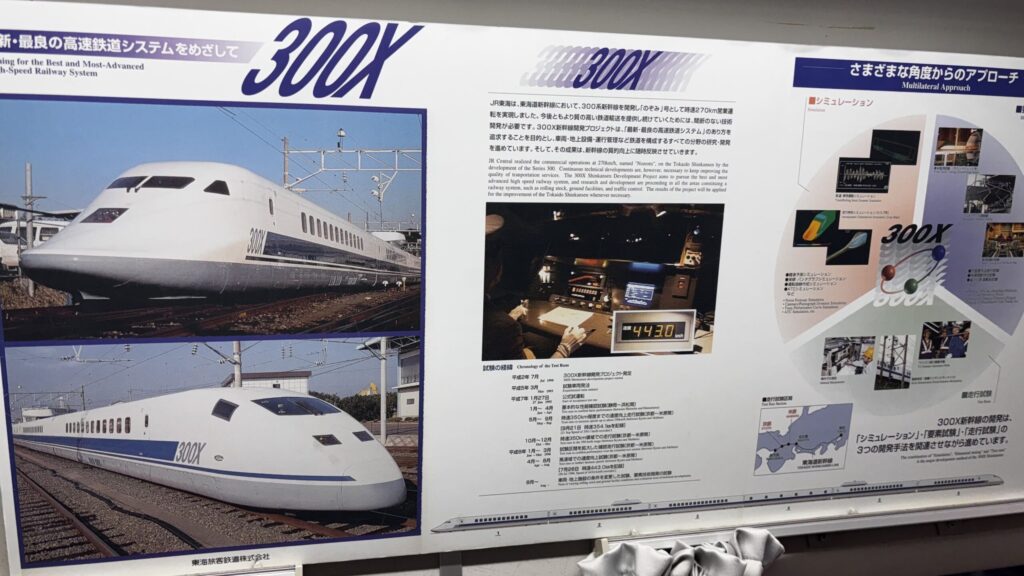
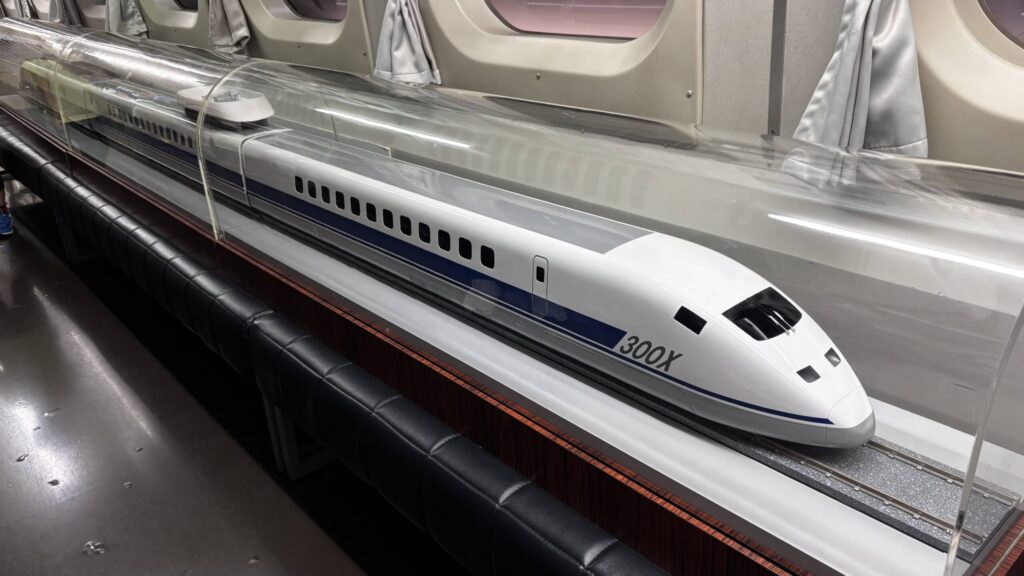
A model of the 300X, displayed inside the 300X itself

The 300X was a Shinkansen test train developed by JR Central in pursuit of “the best and most advanced high-speed railway system.” Its formal designation is the 955 Series. The project began in July 1990, and on 26 July 1996 the train recorded 443.0 km/h – at the time the fastest speed ever achieved by an electric multiple unit. A photograph of the speedometer from that day is part of the display inside the museum.

Sitting in the Driver’s Seat, Somewhere Nobody Normally Goes

When our turn came, we boarded. Sitting down, we found a model of the 300X in a case right in front of us – looking at the shape of the very vehicle we were sitting in, from inside it.

And then the cab.
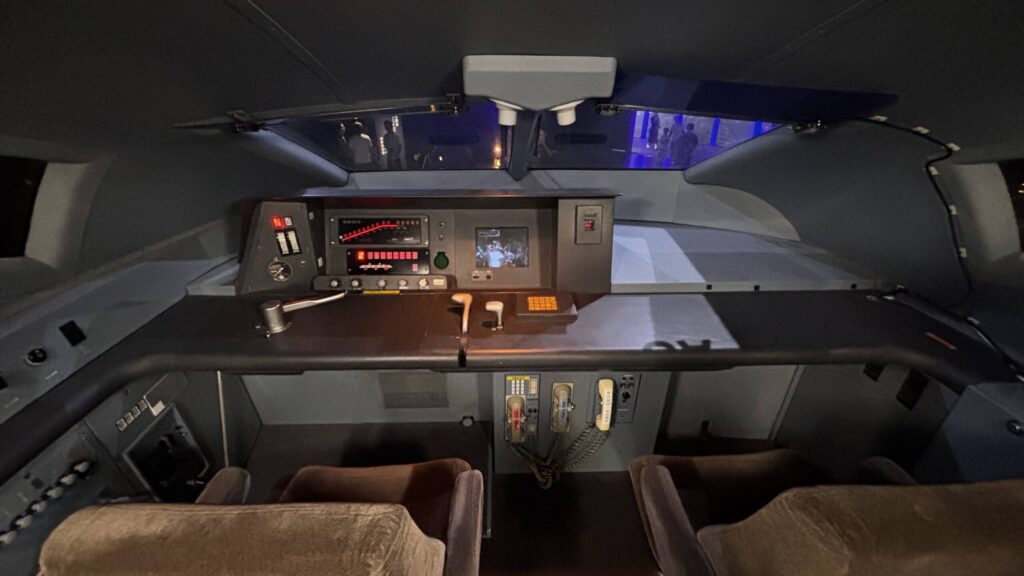
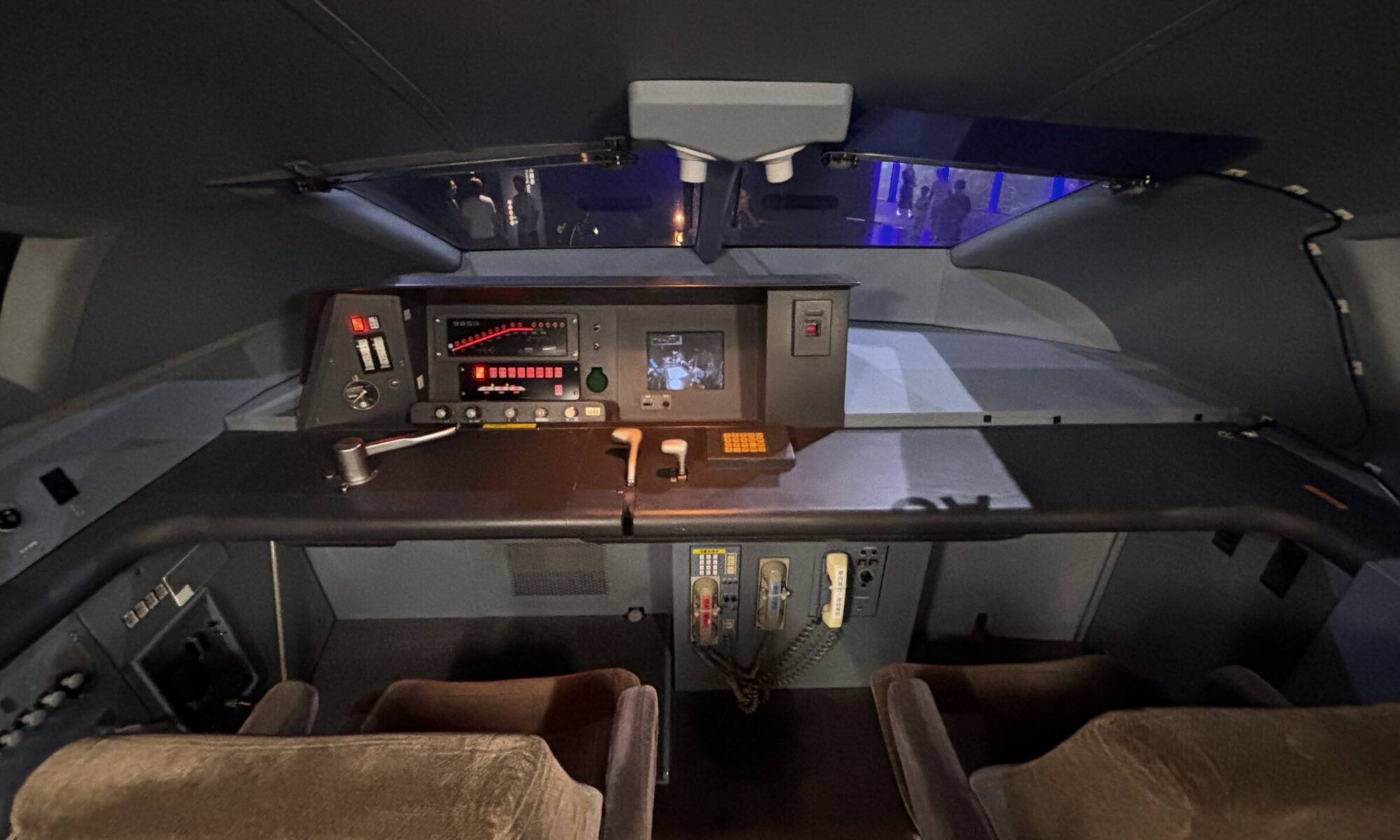
The driver's cab of the 955 Series "300X", with its instrument panel, master controller and brake handle

There is an instrument panel, a master controller and a brake handle, and three telephones lined up on the right. Through the windscreen we could see the people still waiting their turn. This is the cab of a test train, so what is laid out in front of the driver is not quite what you would find in a service train. Simply looking at the markings on the speedometer told us what this vehicle had been built to do.

The hour we had spent queuing stopped mattering.

Lunch Meant Another 30 Minutes in Line – Eaten Inside a Display Train

After the 300X came lunch. We bought bento boxes inside the museum.
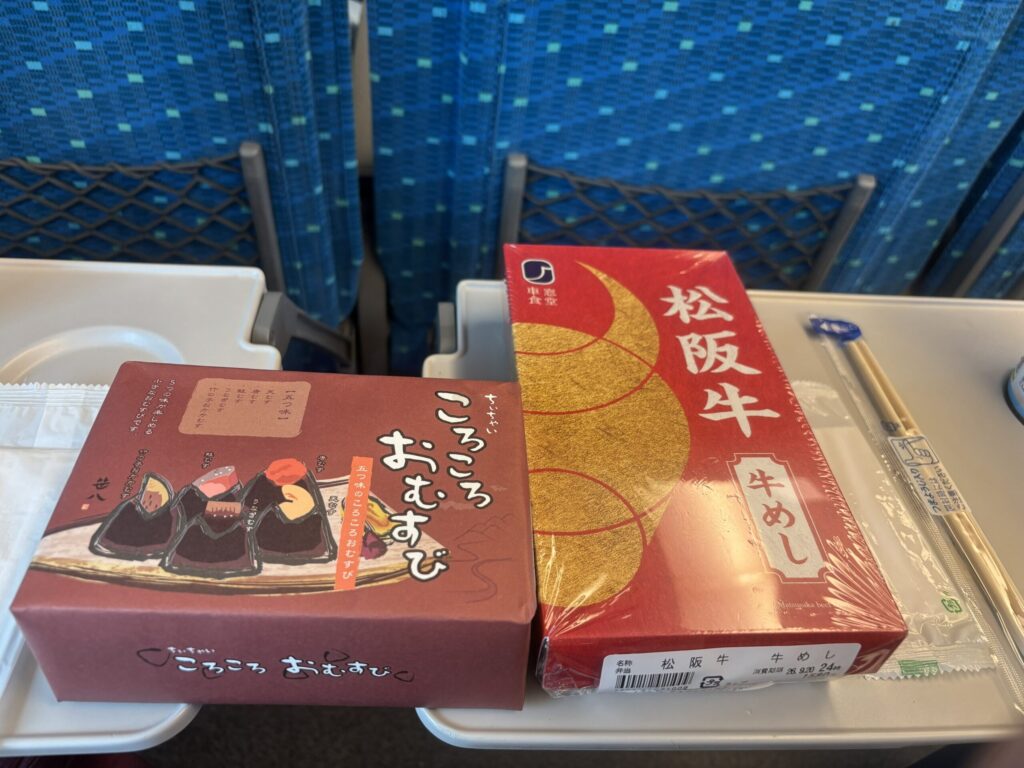
Matsusaka Beef Gyumeshi and Chiichai Korokoro Omusubi on a seat tray inside a display train

That meant another thirty minutes of queuing. It was a Sunday, so this was hardly a surprise. We chose the Matsusaka Beef Gyumeshi and the Chiichai Korokoro Omusubi, 2,560 yen for the two of us. The latter is a set of small rice balls in five flavours.

The good thing about the SCMAGLEV and Railway Park is that you can eat what you have bought inside the display trains. Sitting in a Shinkansen seat and opening a station bento. The train is not moving, and yet it feels like travelling. Here too, being allowed inside is what makes the place enjoyable.

Inside the Doctor Yellow – Now a 923 Series

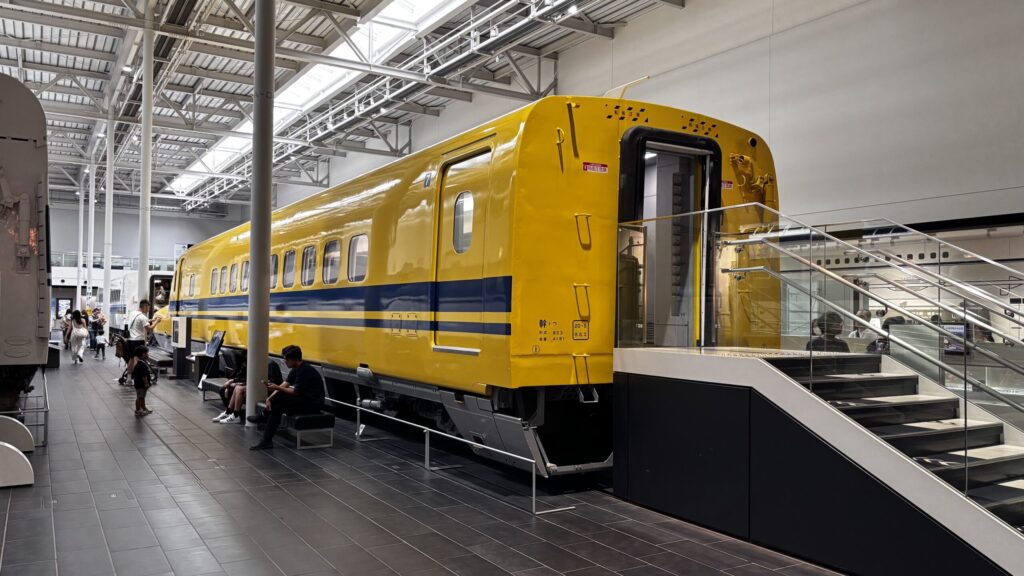
Fed and watered, we finally reached the Doctor Yellow.
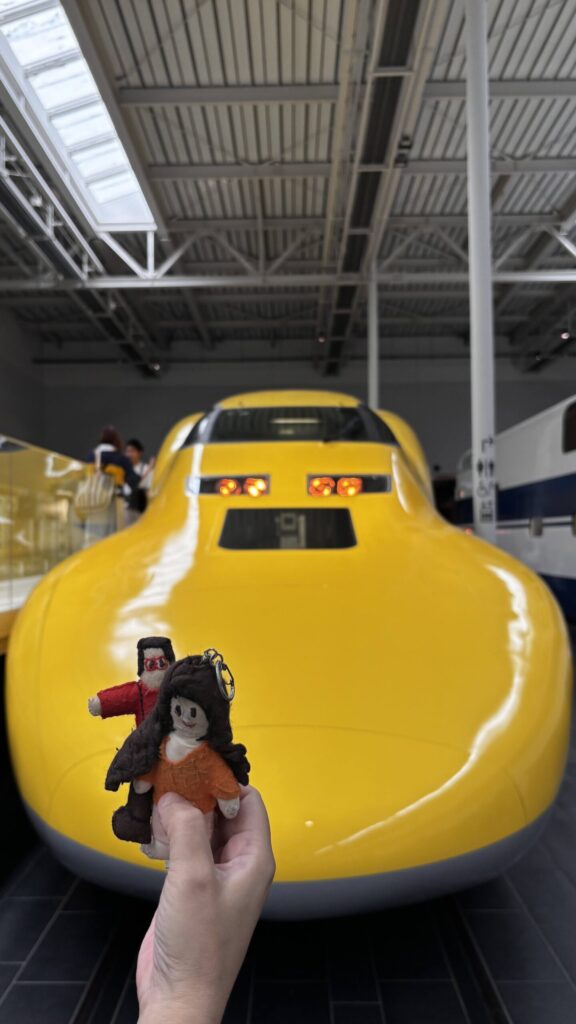
Tikoppi and Presley looking up at the nose of the 923 Series Doctor Yellow
The side of Doctor Yellow car 7, marked "Series 923, tare weight 41.8 t"

The car on display is number 7 of the 923 Series T4 set, open to the public since 14 June 2025. This time we were able to go inside.

Looking up at the yellow nose, the mascots started making a fuss. The same yellow Shinkansen we saw at Shin-Osaka, they insisted. Strictly speaking it is not the same car – what we photographed that day was car 1, and what stands here is car 7. Even so, the yellow that swept past the platform in a few seconds is now standing still in front of us. That day all we could do was chase it. This time we could look for as long as we liked, and step inside as well.

We Spotted Doctor Yellow at a Live Event! Photographing the Legendary Train Near Shin-Osaka

The One on Display Two Years Ago Was the Older 922 Series

When we came here two years ago, the train in this spot was the previous generation, the 922 Series T3 set. After the 923 Series T4 set finished its working life in January 2025, the 922 was moved out on 7 June that year and the 923 took its place. The 922 that left is now on display at Train Park Hakusan in Ishikawa Prefecture. Come back to the same place after two years and the exhibit itself has been replaced. We had not expected that.

The Diorama at Night, and the Work of Maintenance

The Doctor Yellow is a maintenance vehicle: it inspects the track and the electrical equipment. Perhaps because of its arrival, the museum seemed to us to have more on maintenance than it did before.
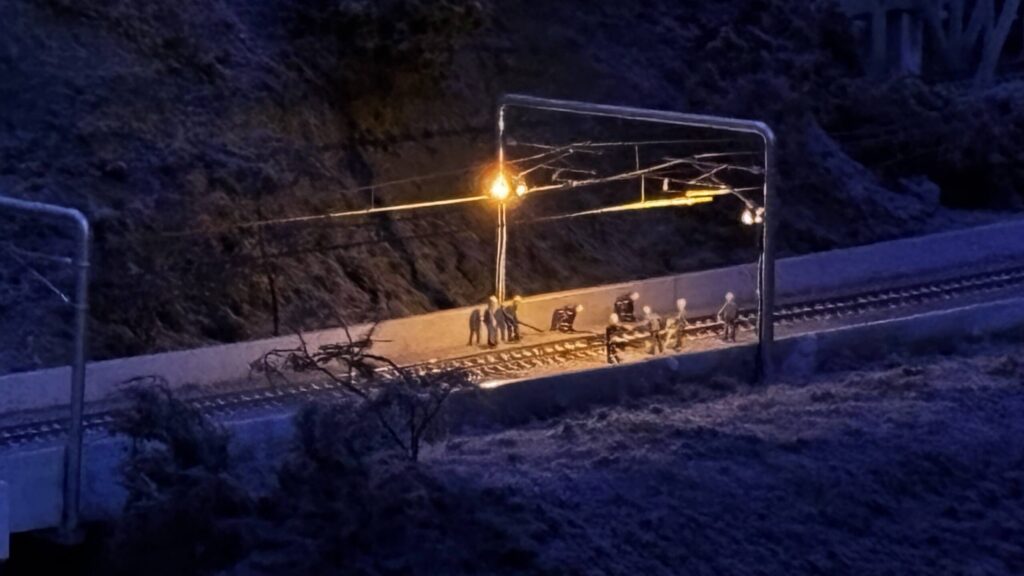
The diorama switched to night, with maintenance crews working on the track under the lights

The large diorama moves through the hours, and eventually night falls. Lights come on beside the darkened track, and looking closely we found a line of maintenance workers at work on the rails. It is a quiet scene, quite unlike the bright running sequences of the daytime. Somebody is out repairing the track during the hours when no trains run. We stood watching that for a while, struck that anyone had thought to model it.
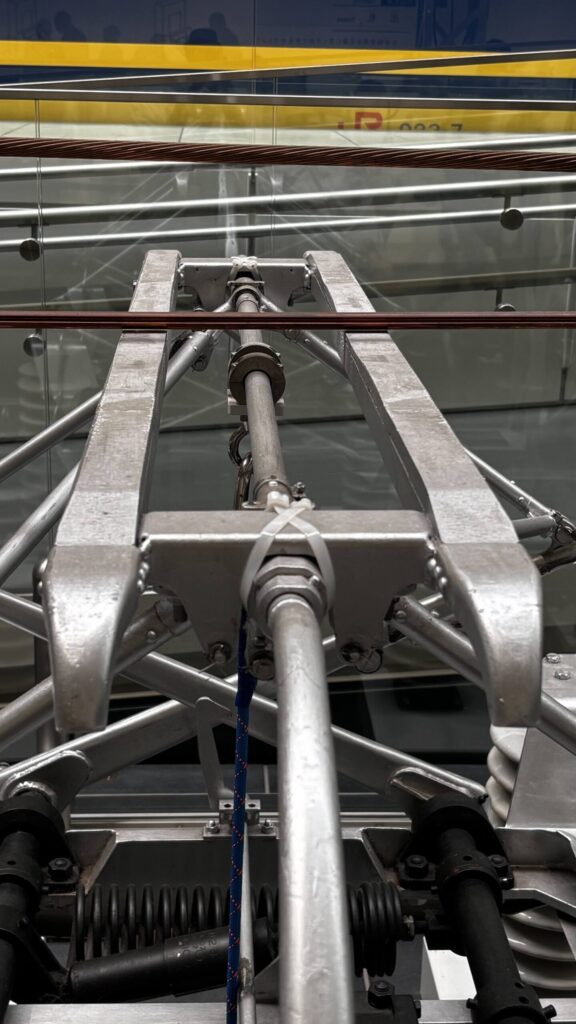
A full-size pantograph and contact wire, the contact strip visible where it meets the wire
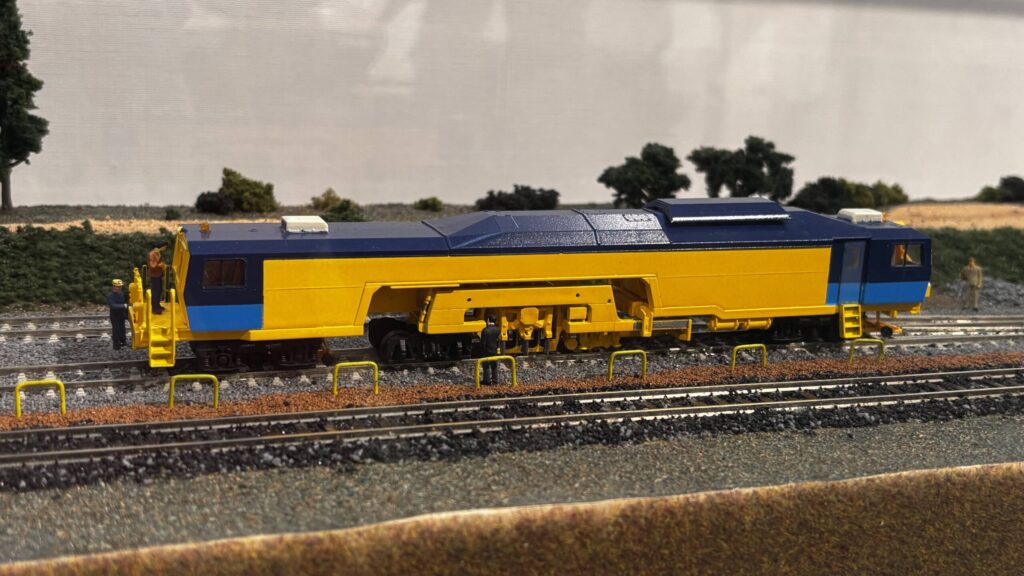
A model of a maintenance vehicle in yellow and blue, standing on the track

The full-size exhibits were just as good. A pantograph and its contact wire are set close enough to touch. Normally these things are high above you and can only be looked up at; the chance to see one from the side is rare. The whole current is collected through a single point where the contact strip meets the wire. Seen properly, it looks a remarkably slender arrangement.

There was a model of a maintenance vehicle on display too – yellow and blue, carrying the machinery used to tamp and align the track. An unglamorous train, but laid out like this it gives you some sense of what goes on behind the scenes to keep a railway running.

What It Cost, and Where the Four Hours Went

Here is what we spent, and how the time broke down.

Admission: 1,200 yen per adult x 2 = 2,400 yen
Bento: Matsusaka Beef Gyumeshi + Chiichai Korokoro Omusubi = 2,560 yen
Total: 4,960 yen

We were there from 11:18 to 15:30 – four hours and twelve minutes.

To be honest about it, an hour and a half of that was spent queuing. An hour for the 300X, thirty minutes for lunch. Out of four hours, that is more than a third.

It still did not feel like a long visit. If anything, we ran short of time for the exhibits. If you expect to queue for something, the safest plan is to be there when the doors open at 10:00. Our 11:18 arrival was, on reflection, a little late.

In Summary: What We Couldn’t Do Last Time, We Did This Time

Our earlier article carried this heading: the driving simulator, which we never got a turn on. The queue never reached us.

Two years later, it was not a simulator we sat in but a real cab. And not just any cab: the one from a test train that recorded 443 km/h.

The display we described back then as “starting soon” is one we have now properly seen. There is something satisfying about a trip taken to close a loop you opened yourself.

Best of all this time was being allowed inside two trains – the cab of the 300X and the interior of the Doctor Yellow. Neither is somewhere you can normally go. We had thought of exhibited vehicles as things to be viewed from outside; from within, what you take away is a different thing entirely. The SCMAGLEV and Railway Park changes between visits. Sometimes the vehicles themselves are swapped out. It is not a place you can tick off after going once.

We Visited the SCMAGLEV and Railway Park! From Gachapin & Mook to a Giant Turnip
The 25th International Model Railway Convention | A 93-Year-Old Driver on the Day the Shinkansen Began

The man who drove the first Shinkansen out of Shin-Osaka on 1 October 1964 is ninety-three, and he was at Tokyo Big Sight on 22 August 2026 to talk about it. This is what he said, and what else I saw at the 25th International Model Railway Convention.

This Year’s Theme: The Shinkansen and the Eve of Its Opening

This was my second time at this convention. In 2024 a typhoon stopped me from going at all. In 2025 I finally made it, and this year makes two. Last year’s theme was freight trains

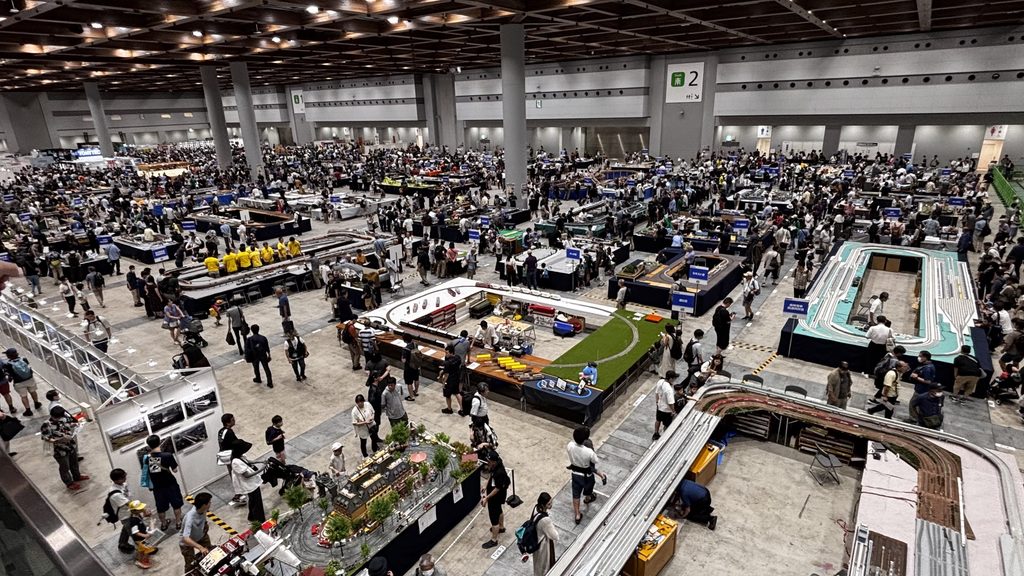
Model railway layouts filling the hall at Tokyo Big Sight, with crowds of visitors

The convention ran for three days, 21 to 23 August, and I went on the Saturday. The venue was Tokyo Big Sight again, the same as last year. Looking down from above, the layouts fill the floor almost edge to edge, with people flowing between them. I was there from half past eleven until a little after five, five and a half hours in all

A 93-Year-Old on the Day the Shinkansen Began

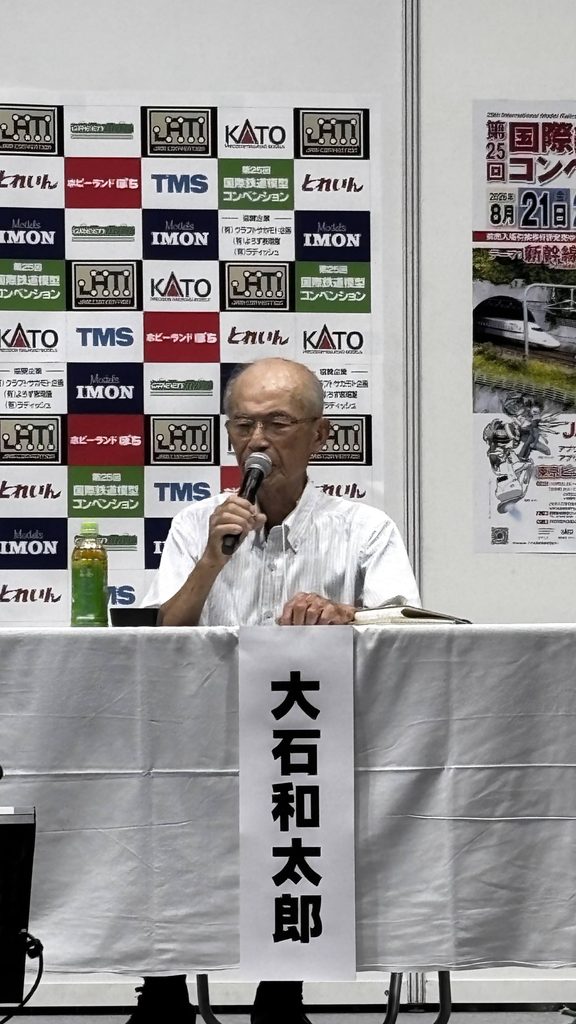
Wataro Oishi speaking at the 25th International Model Railway Convention

The speaker was Wataro Oishi. On 1 October 1964, the day the Tokaido Shinkansen opened, he drove the first up train out of Shin-Osaka Station.

I was told he is ninety-three, and I did not believe it. Nothing in his voice or his delivery suggested it. The stories came out as though they had happened the day before.

According to his talk, on that opening day the drivers had been instructed to keep the speed down to 160 km/h, out of consideration for how the operation would be seen internationally. Oishi, though, wanted to reach 200 km/h. So he ran slowly at first, deliberately, and then made up the lost time — and in doing so finally touched 200 km/h, or about 124 mph.

The opening was nine days before the opening ceremony of the Tokyo Olympics. The eyes of the world were on Japan. It is not hard to see why caution was called for.

He did it anyway. Watching him tell that story with the face of a child whose prank has come off was, honestly, the best thing I saw all day.

There was one more thing I have not been able to forget. The Shinkansen project itself had been opposed from many directions. It could not be done; nothing could run that fast. That was the air in which the driving training was carried out.

Sharpening a skill in the face of opposition, reaching the opening day, and then hitting a speed nobody had reached before — I heard the whole of it from the man himself.

There is something good about the view you get from taking on a challenge. Without those 200 km/h on that day, the Shinkansen we know might have taken a different shape.

What I Noticed in My Second Year: How the Booths Present Themselves

When I stood in this hall last year, I was simply overwhelmed. I had no idea there were so many different kinds of railway enthusiast.

In my second year, my eye went somewhere else: to how each booth presents itself.

Some had put out chairs so that visitors could sit down. That is a deliberate choice — it invites people to stop and look properly rather than drift past. Others had set their layouts low, at the eye level of a child.

Every booth is built as a place to show what its people love. It is not simply a matter of laying things out. Who you want to look, and how you want them to look, shows up in the height and the arrangement. Noticing that was what I took away this year.

I do not think I would have seen it without looking at the same hall twice.

Tikoppi and Presley Tried to Jump on the Models Again

Our two mascots came along, as always.

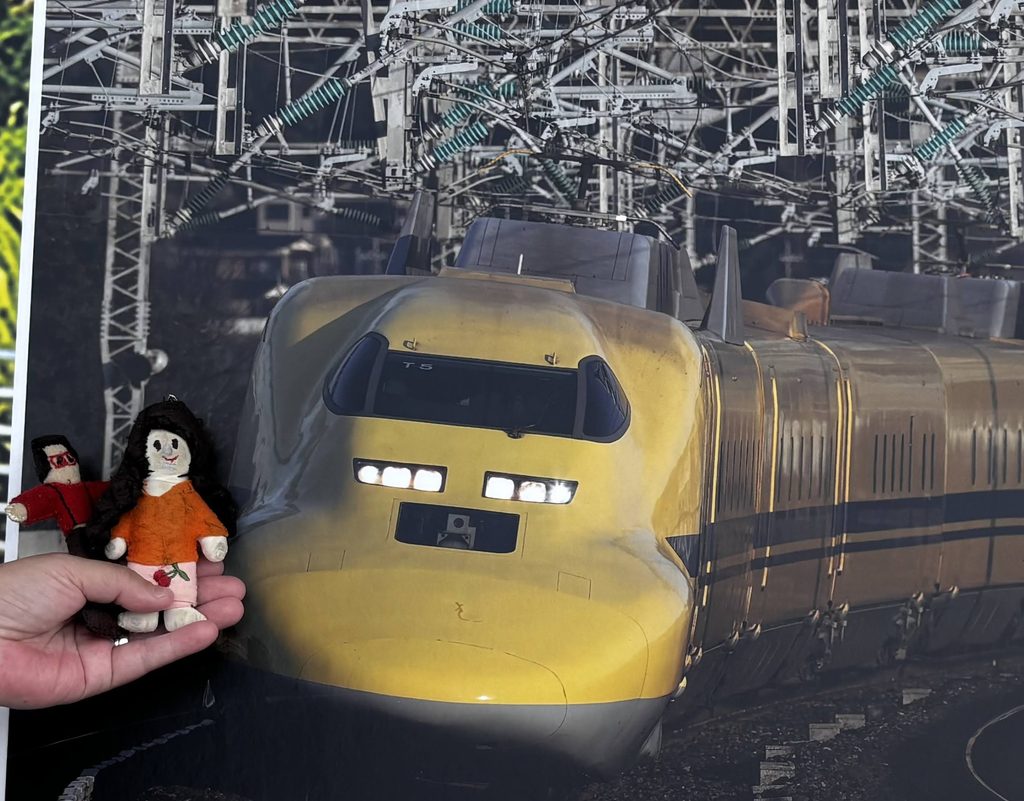
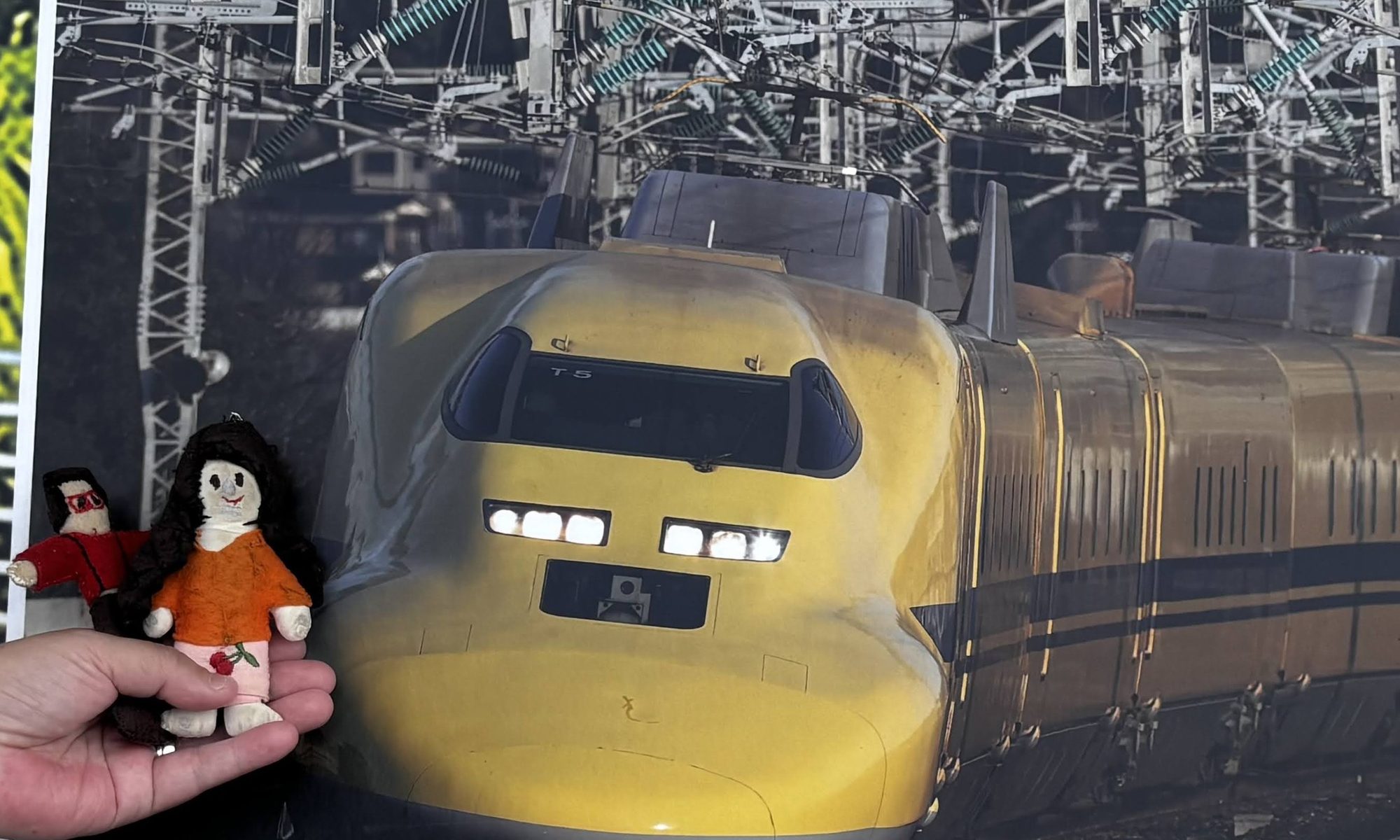
Presley and Tikoppi held on a palm in front of a photo panel of Doctor Yellow

The photograph behind them is a display panel of Doctor Yellow, the yellow inspection train, which was on show at the venue (photograph by Kunihiko Tsuji).

And they were exactly as they always are. The moment they spot a model in motion they try to jump aboard, and stopping them is hard work. A hall with that many running layouts must have been nothing but temptation for those two.

My one regret is that I never got a photograph of that. I had my hands full holding on to them.

In Closing: What Changes Between the First Year and the Second

Last year I came home overwhelmed, thinking only that it was an extraordinary world. This year I could see further in — as far as how the people inside that world choose to show it.

And hearing Mr Oishi speak was something that could only have happened in a year whose theme was the Shinkansen. More than sixty years have passed since the line opened, and the number of people who can still describe that day from memory is small. Being able to hear that voice directly is what made the trip worth it.
I intend to go again next year. In the third year, perhaps something else will come into view.

Last year’s convention, with freight trains as its theme, is written up here → the 2025 convention
If you are interested in riding the Shinkansen yourself, the seat to ask for is here → the E seat on the Tokaido Shinkansen

A Summer Day Trip to Kyoto: The Mitarashi Festival, Echoes of Gion Matsuri, and Honno-ji Temple

A one-day summer trip to Kyoto: the Keihan Rakuraku from Osaka, cooling our feet at Shimogamo Shrine’s Mitarashi Festival, and Honno-ji Temple.

When you think of summer in Kyoto, the Gion Festival is probably the first thing that comes to mind. This time, I hopped on the Keihan Railway’s rapid limited express “Rakuraku” for a day trip covering the Mitarashi Festival at Shimogamo Shrine, the Shijo area where traces of the Gion Festival linger, and Honno-ji Temple — a must-see for history fans. Here’s my full report on the charms of Kyoto that you can only experience in the heat of summer!

Starting the Trip in Comfort on the Keihan Rapid Limited Express “Rakuraku”

Whenever I travel from Osaka to Kyoto, my goto train is the Keihan Railway’s rapid limited express “Rakuraku.” You can board at Yodoyabashi or Kyobashi Station, and with only a few stops along the way, it whisks you to Demachiyanagi Station in no time. True to its name — a play on words meaning “to Kyoto (Raku), with ease (raku)” — the concept itself is charming.

The best thing about the Rakuraku is, without a doubt, its comfort. If you opt for the Premium Car, you can spend the ride in style in a spacious reclining seat. The Uji River and Kyoto’s townscape drift past the window, building anticipation for the day ahead. Departing while the morning is still cool also means you get a full day for sightseeing. This time, I left Yodoyabashi Station around 10 a.m. and arrived at Demachiyanagi Station about 50 minutes later. Note that the Rakuraku mainly runs on weekends and public holidays, so be sure to check the schedule before you go. Advance reservations are required for the Premium Car — book here!

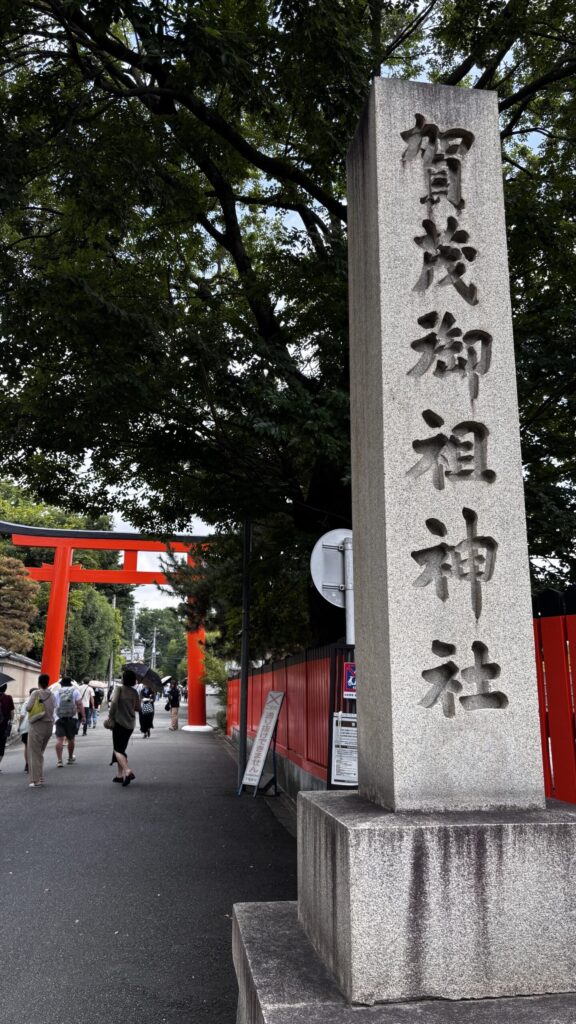
The stone pillar reading Kamo-mioya Shrine, the formal name of Shimogamo Shrine, beside the red torii
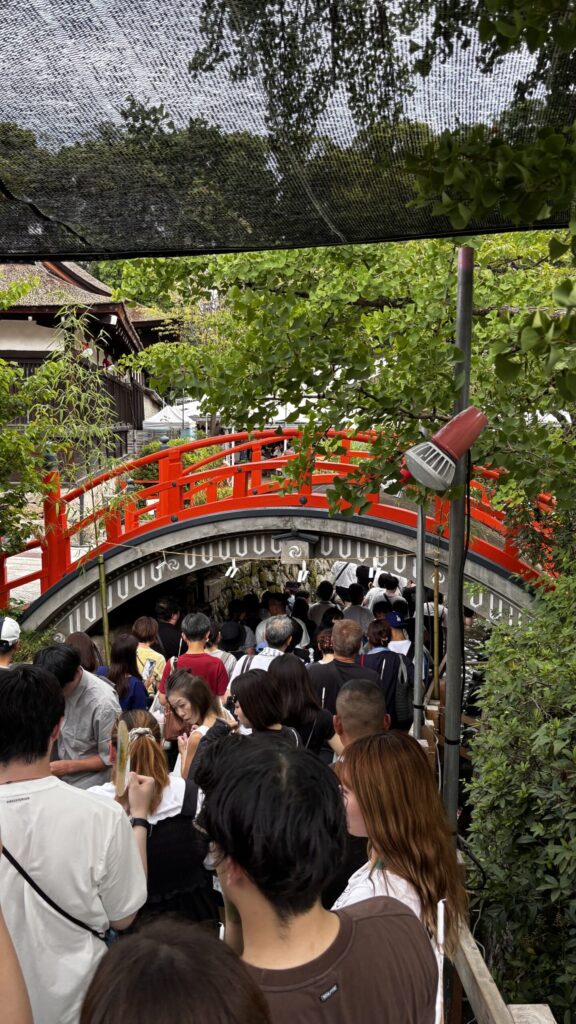
Crowds queuing over the vermilion arched bridge at Shimogamo Shrine during the Mitarashi Festival

Praying for Good Health at Shimogamo Shrine’s Mitarashi Festival

About a 12minute walk from Demachiyanagi Station, I arrived at Shimogamo Shrine, nestled in the greenery of the Tadasu no Mori forest. Officially known as Kamo Mioya Shrine, it is a venerable shrine registered as a UNESCO World Heritage Site. Summer at Shimogamo Shrine is synonymous with the famous Mitarashi Festival, held every year around the “Doyo no Ushi” day of midsummer.

Also known as the “footdipping ritual” (ashitsuke shinji), the Mitarashi Festival is a beloved summer tradition in which visitors wade into the shrine’s Mitarashi Pond to pray for health and protection from illness. Holding a candle in hand, you walk through the chilly spring water. The water is said to stay around 15°C even in summer — cold enough to make you gasp at first! But as I kept walking, it strangely began to feel pleasant, and I felt a refreshing sensation, as if all the impurities were being washed out of my body.

I offered my candle at the small shrine at the far end of the pond and prayed earnestly for good health. After drying your feet, you can also write a wish on an “ashigata kitogi” (foot-shaped prayer plaque) available at the shrine and dedicate it. And here’s a fun fact: this Mitarashi Pond is said to be the birthplace of mitarashi dango, the famous sweet soy-glazed dumplings! After your visit, be sure to try some at a nearby teahouse — the fragrant aroma of freshly grilled dango is irresistible.

A word of advice: weekends during this period get extremely crowded. That said, the Tadasu no Mori forest provides plenty of shade, and the line moves quickly, so this is one ritual I wholeheartedly recommend experiencing.

Strolling Shijo and the Otabisho: Echoes of the Gion Festival

Leaving Shimogamo Shrine behind, I took the Keihan Line from Demachiyanagi to Gion-Shijo Station. In July, Kyoto is all about the Gion Festival. Even if you miss the grand float processions of the Saki Matsuri (early festival) and Ato Matsuri (later festival), the afterglow of the celebration lingers everywhere.

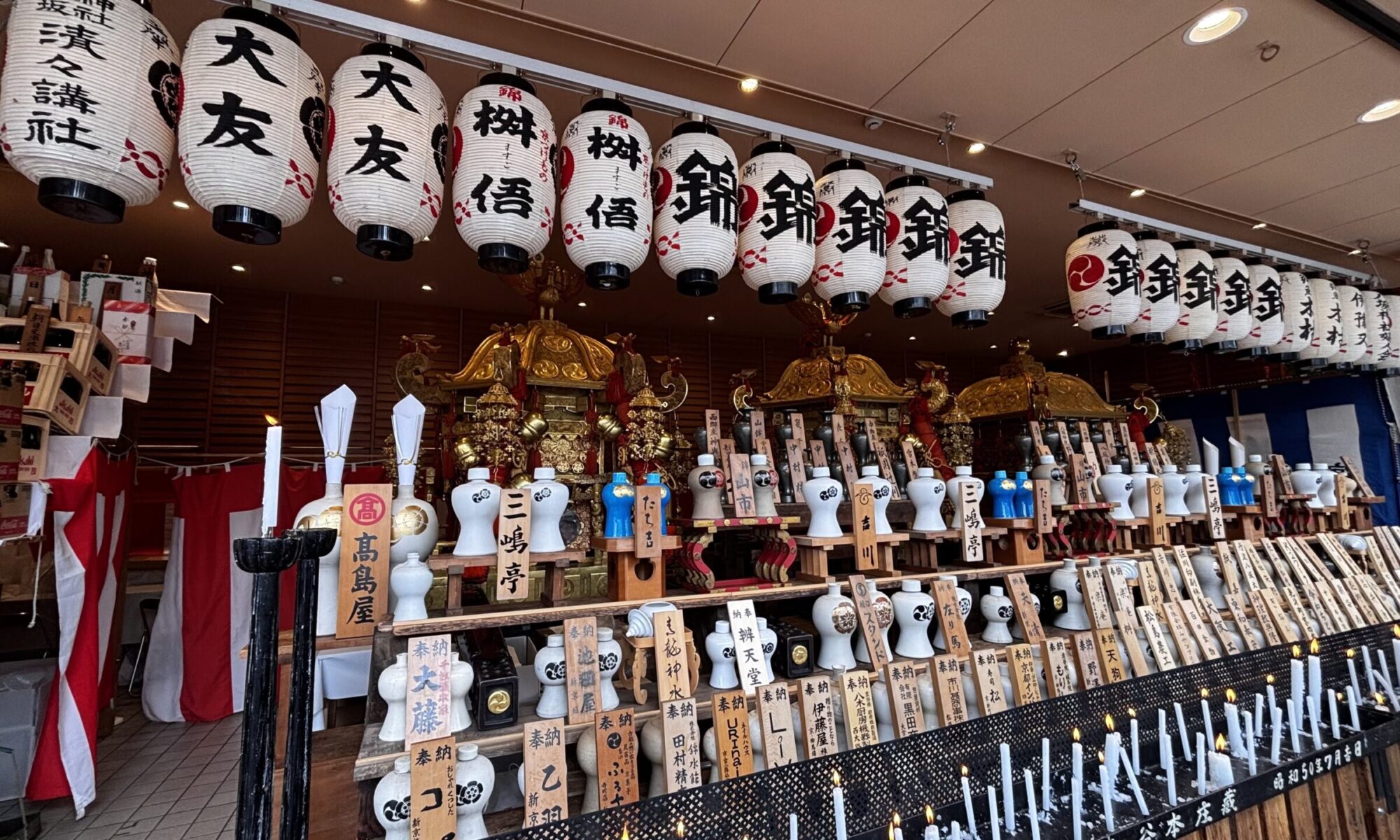
Walking along Shijo Street, I came across the Otabisho — the resting place where the portable shrines (mikoshi) of Yasaka Shrine are enshrined after the Shinkosai procession. Known as the Shijo Otabisho, it stands on Shijo Street just east of Teramachi Street. During the Gion Festival, the mikoshi remain here for seven days, receiving the prayers of the townspeople. Even when the mikoshi are absent, passing by the Otabisho you can sense the living history and tradition of the Gion Festival — I couldn’t help but stop and take it all in.

Step into the side streets off Shijo, and you’ll catch glimpses of how deeply the festival is woven into local life: machiya townhouses that retain the atmosphere of the historic float-building neighborhoods, residents putting away festival lanterns, and more. Visiting slightly off-peak lets you connect with Kyoto’s culture on a deeper level — one of the true joys of travel.

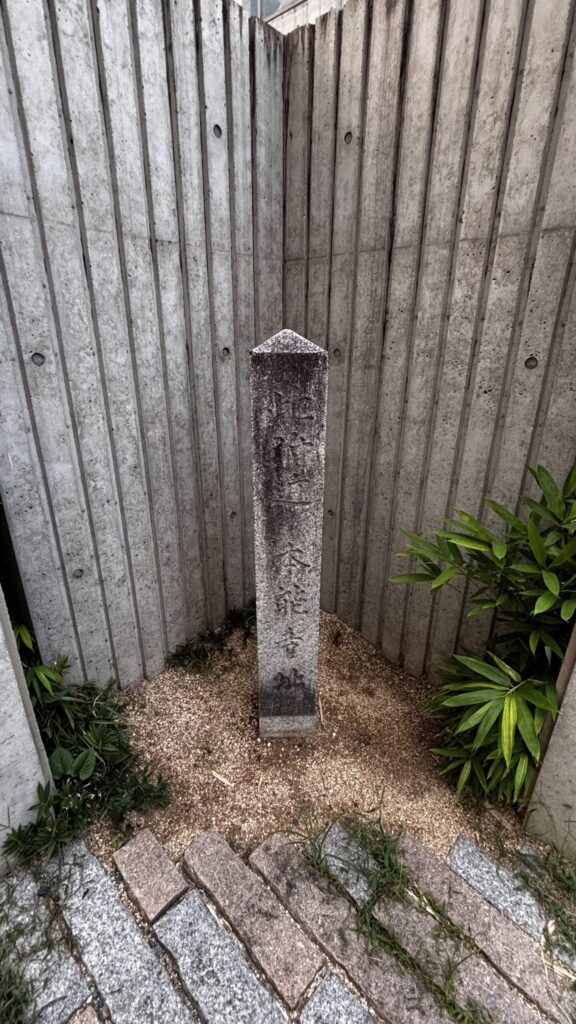
The stone marker showing the site of the original Honno-ji Temple, tucked between concrete walls

Honno-ji Temple and the Site of the Honno-ji Incident: Visiting a Turning Point in History

A short walk north from Shijo brought me to Honno-ji Temple on Teramachi Street. The temple is famous for the “Honno-ji Incident,” but here’s the thing: the present-day Honno-ji actually stands in a different location from where Oda Nobunaga met his end.

The current temple was relocated to this site in 1591 (Tensho 19) as part of Toyotomi Hideyoshi’s redevelopment of Kyoto. The grounds include a memorial tower for Nobunaga and a treasure museum displaying items connected to him — an absolute delight for fans of Sengoku-era history. After paying my respects at the main hall, I toured the museum and viewed Nobunaga’s personal effects and letters. The history you learned from textbooks confronts you here as vivid reality.

And there’s one more place I urge you to visit: the site of the original Honno-ji. The actual location of the Honno-ji Incident lies about one kilometer west of the current temple, near the intersection of Aburanokoji and Takoyakushi Streets. Today, only a stone marker and an information board remain, surrounded by apartment buildings and shops. Yet standing on that unassuming street corner, you can’t help but be moved by the thought that an event which changed the course of Japanese history happened right here. Visiting both the temple and the original site gave me a much deeper appreciation of the layers of history.

In Closing: Summer in Kyoto Is Best Enjoyed Chasing History and Cool Relief

This trip packed a lot into one day: a comfortable ride on the Keihan Rakuraku, cooling off at Shimogamo Shrine’s Mitarashi Festival while praying for good health, strolling the Shijo area still aglow with the spirit of the Gion Festival, and soaking in history at Honno-ji Temple and the site of the original temple.

Kyoto summers have a reputation for brutal heat, but there are plenty of places to stay cool — the chilly spring water of the Mitarashi Festival, the shade of the Tadasu no Mori forest, and more. And by timing your visit to avoid peak events like the float processions, you can enjoy the festival atmosphere without the crowds. History, nature, and living traditions — that’s summer in Kyoto. Hop on the Rakuraku and discover your own Kyoto journey!

The day I walked the back streets of Gion Matsuri is written up separately.

There is another way from Osaka to Kyoto: the Thunderbird limited express, 27 minutes for 450 yen

To Amanohashidate by Kounotori & Tango Relay! Plus the Tango Kuromatsu Train — A Birthday Rail Trip Fully Enjoyed Even in the Rain [With Booking Tips]

Hello, this is mascots! This time, I’m sharing a special rail journey to celebrate my birthday. Our destination: Amanohashidate, one of Japan’s three most scenic views. The weather turned out rainy, but thanks to some wonderful sightseeing trains, it became an unforgettable day. 🚃


From Shin-Osaka to Fukuchiyama on the Limited Express “Kounotori”

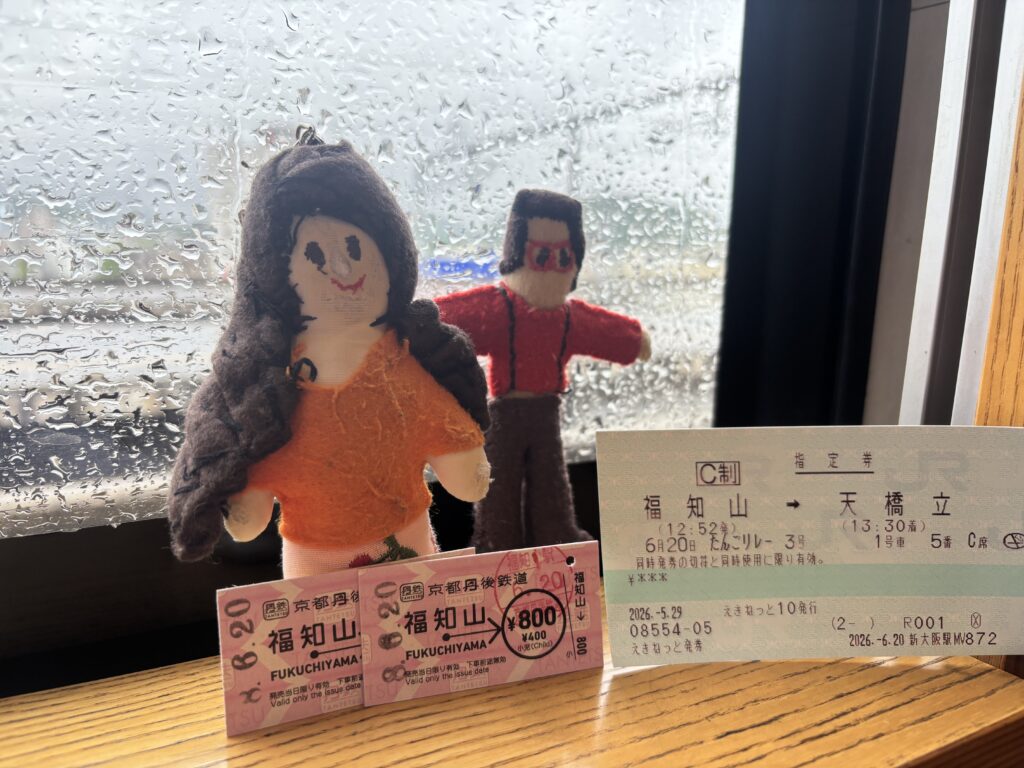
Our journey began at Shin-Osaka Station, where we boarded the limited express “Kounotori.”

Connecting Shin-Osaka with Fukuchiyama, this train is an essential gateway to the Kita-Kinki region. Watching the scenery gradually shift from cityscape to lush countryside through the window, our excitement for the trip steadily grew.

What is the Limited Express “Kounotori”?
Operated by JR West, it connects Shin-Osaka/Osaka with Fukuchiyama, Toyooka, and Kinosaki Onsen. It’s a key means of access to the Kita-Kinki area.


Changing to the “Tango Relay No. 3” at Fukuchiyama

At Fukuchiyama Station, we transferred to the Kyoto Tango Railway’s “Tango Relay No. 3” to continue toward Amanohashidate.

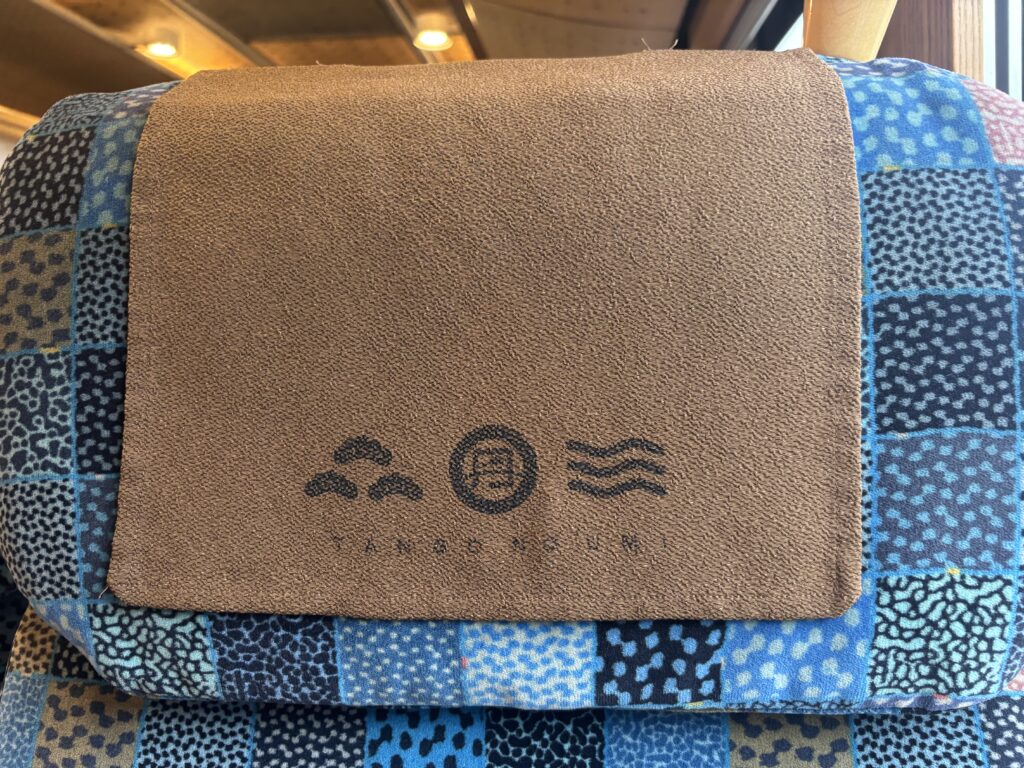
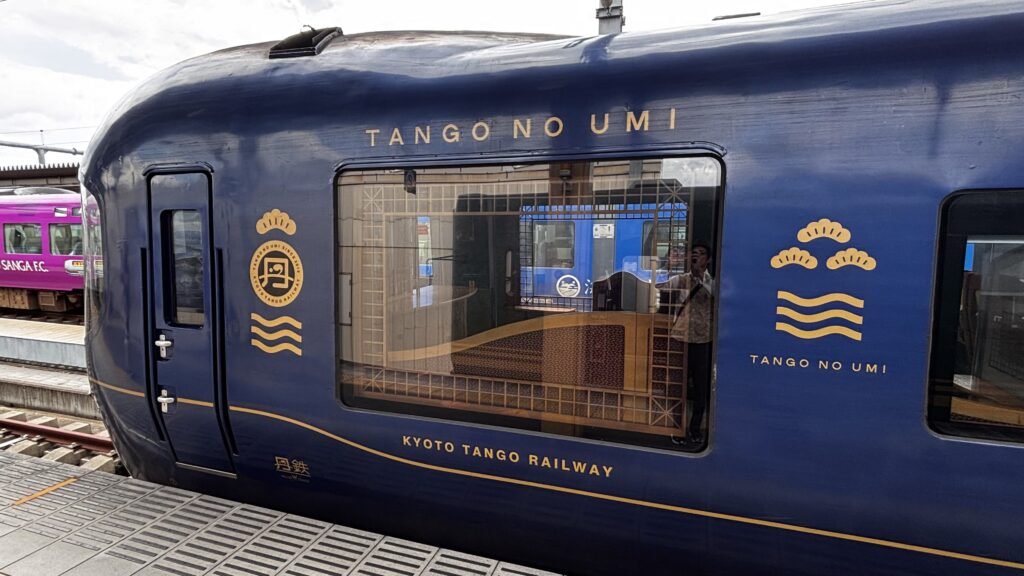
And what luck — the train we boarded was the popular “Tango no Umi” (Sea of Tango)! Designed by Eiji Mitooka, this beautiful train wears a deep indigo color known as “Tango Blue.” The elegant interior, generously finished with wood, feels almost like a moving drawing room. The slightly gloomy mood from the rain instantly lifted the moment we stepped aboard. ☂️✨

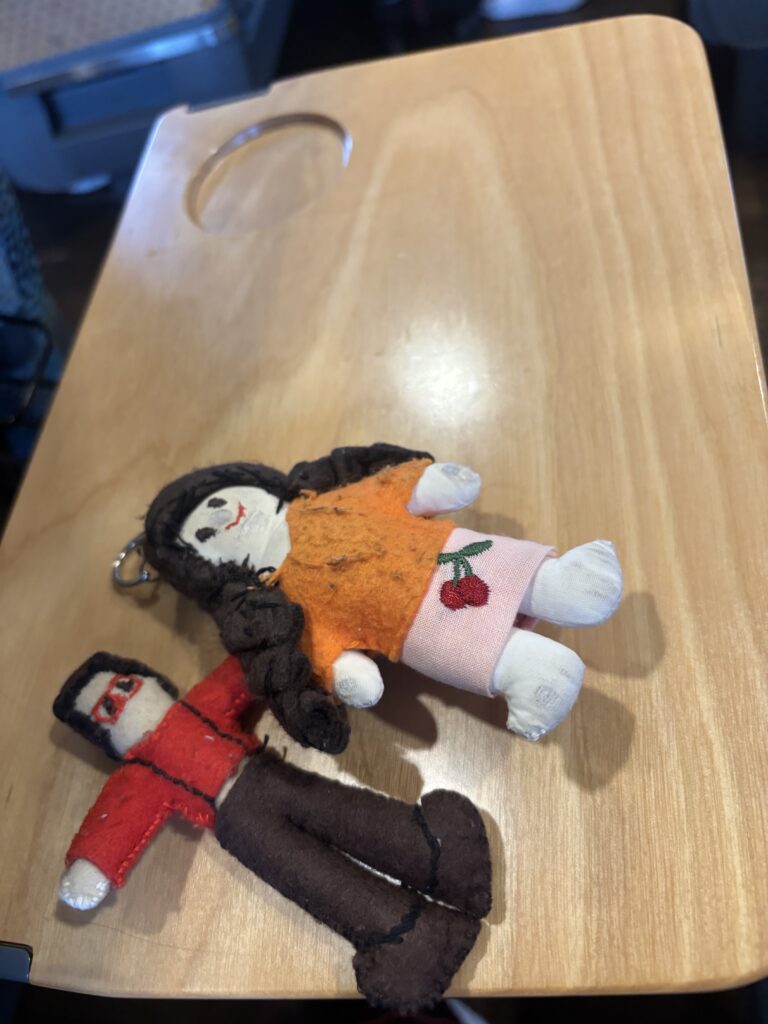
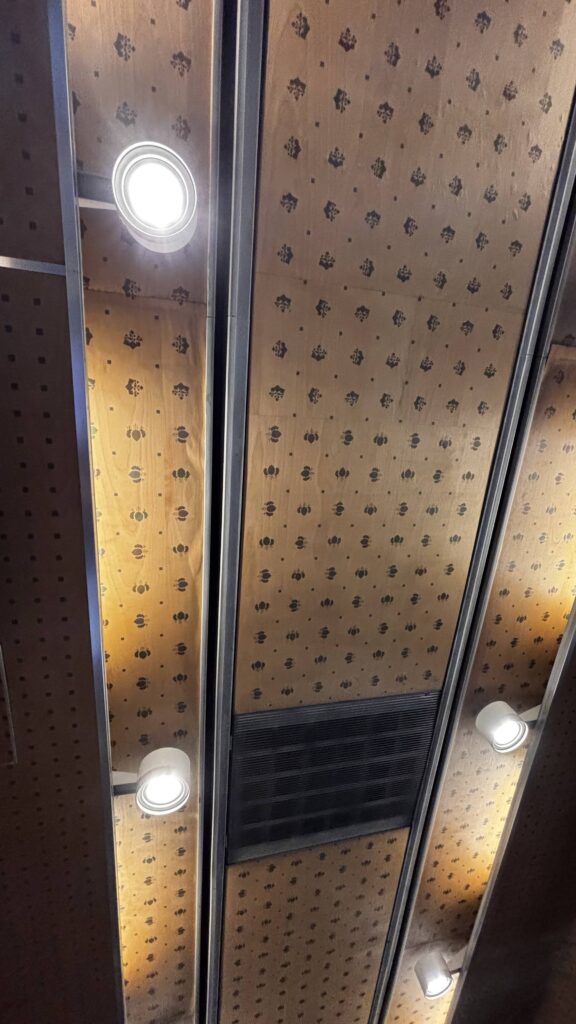
Glancing up, I noticed the mascots all frozen in place, staring at the ceiling. “What’s wrong?” I wondered, following their gaze upward — and there it was: a stunning ceiling design that drew me right in.

The refined decoration highlighting the wood grain, combined with carefully arranged geometric patterns. We usually only look down at our feet or out the window, so it’s easy to miss — but sightseeing trains are crafted with care right up to the ceiling. Thanks to the mascots’ “Look up!” discovery, I was able to appreciate a whole new charm of the train.

What is “Tango no Umi”?
A sightseeing train of the Kyoto Tango Railway. Known for its calm indigo exterior and warm, wood-filled interior, it runs as the limited express “Hashidate” and as relay services.

The deep indigo Tango no Umi, lettered "TANGO NO UMI" in gold

Amanohashidate in the Rain — A Scenic 6-Minute Chairlift Ride

When we arrived at Amanohashidate, the rain was still falling. But giving up isn’t the mascots’ style (laughs).

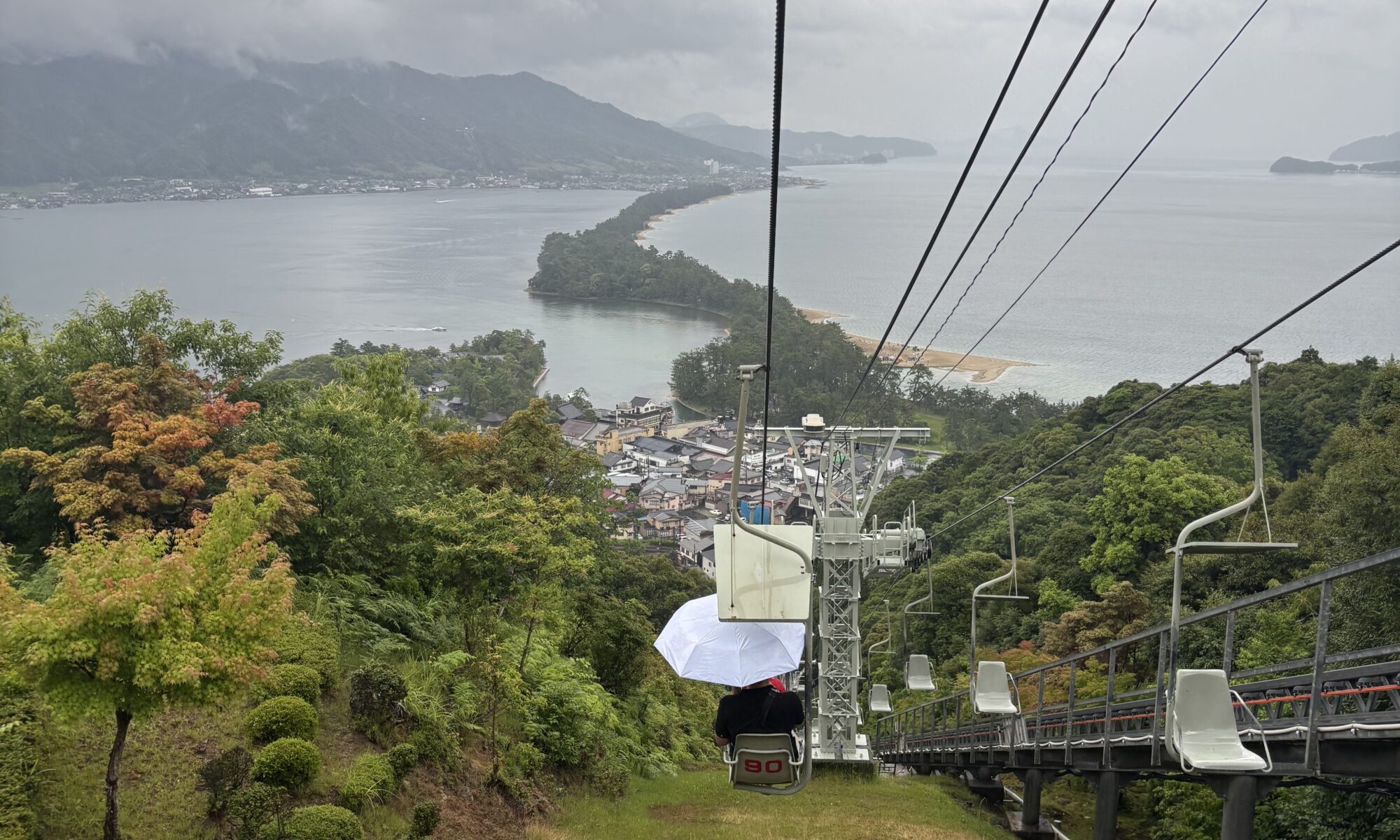
Umbrellas in hand, we took on the chairlift overlooking Amanohashidate! The roughly 6-minute aerial ride was thrilling even in the rain. Looking down at the pine-covered sandbar and the dreamy, mist-shrouded scenery, the mascots were absolutely thrilled. Experiencing a serene beauty different from a sunny day may well be a privilege unique to rainy weather. 🌧️

💡 Travel Tip: Coin Lockers Are a Lifesaver!
Amanohashidate has coin lockers where you can store suitcases. They require ¥100, but it’s the type that returns your coin when you retrieve your bag — so it’s effectively free. Being able to drop off heavy luggage and explore hands-free is wonderful, and we especially appreciated it on a rainy day. 😊


The Highlight! The “Bar” Journey on the Tango Kuromatsu Train

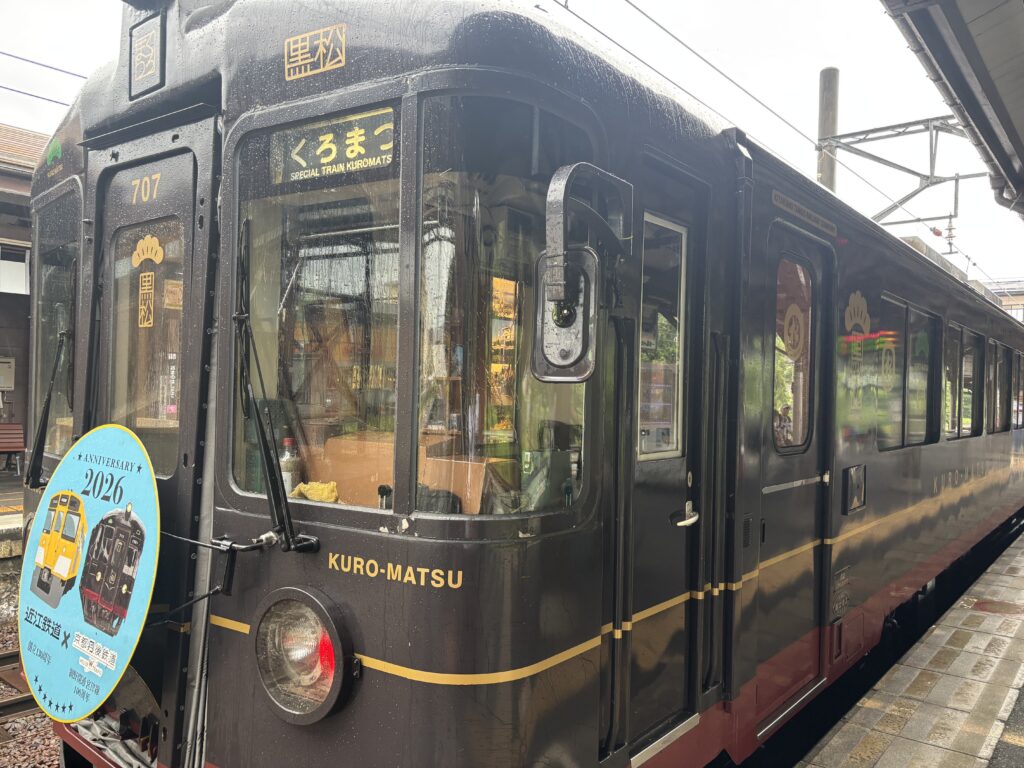
The Tango Kuromatsu in the rain, with a 2026 anniversary headmark marking a collaboration between Ohmi Railway and Kyoto Tango Railway

And now, the main goal of this trip — riding the sightseeing train “Tango Kuromatsu“!

We joined the evening “Bar” plan, savoring special dishes served aboard the moving train. The chic, dignified black carriage and the high-quality interior packed with attention to detail made the time feel truly extraordinary.

What impressed me most was how brilliantly the service makes use of the Kyoto Tango Railway’s “one train per hour” schedule. The relaxed timetable typical of a local line is instead elevated into “special time” — a clever approach that left me deeply impressed.

What is the Tango Kuromatsu Train?
A restaurant train operated by the Kyoto Tango Railway. Of the three siblings — “Kuromatsu,” “Akamatsu,” and “Aomatsu” — it’s the top-tier, fully reservation-based carriage. Its meal-inclusive plans let you enjoy dishes made with seasonal local ingredients.


The Key to Success: Book Early for Sightseeing Trains

The reason we were able to fully enjoy the meal aboard the Kuromatsu was that we booked a month and a half in advance.

Popular sightseeing trains — especially meal-inclusive plans on weekends — sell out quickly. I was reminded once again that the moment you think “I want to ride this,” the most important thing is to check the reservation status right away.

  • Meal-inclusive plans are especially competitive
  • Check operating days and availability early on the official website
  • Book as soon as your travel dates are set

Summary: A Birthday Rail Trip That Was Wonderful Even in the Rain

LegTrain
Shin-Osaka → FukuchiyamaLimited Express “Kounotori”
Fukuchiyama → AmanohashidateTango Relay No. 3 “Tango no Umi”
AmanohashidateSightseeing (chairlift, coin lockers)
Departing AmanohashidateTango Kuromatsu Train “Bar”

It started with unexpected rain, but it became the best birthday trip — full of beautiful sightseeing trains, the dreamy scenery of Amanohashidate, and heartfelt cuisine.

Above all, it became a journey that made me genuinely think, “I want to keep booking and riding sightseeing trains all across Japan.” Which train should we ride next? I can hardly contain my excitement already. 🚃✨

If you’ve been hesitating about traveling on a rainy day, please find the courage to head out. A special memory — different from a sunny day — is surely waiting for you. 😊

As trains where the ride itself is the destination go, the Royal Express from Yokohama down to Izu is hard to forget.

Aman Ruins Park in Takatsuki — A Paradise for Train Lovers! Watching JR & Hankyu Trains from the Starbucks Terrace

We paid a visit to Aman Ruins Park (Aman Iseki Koen) in Takatsuki City, Osaka Prefecture — a park with the JR Kyoto Line running along one edge and the Hankyu Kyoto Line along the other, which makes it close to ideal if you like trains. We went on 23 May 2026, arriving around 2pm, and stayed about an hour. Even in that short window we saw a remarkable number of trains.

Watching JR and Hankyu at the Same Time

The appeal of this park is its position. The Hankyu Kyoto Line runs along the southern edge and the JR Kyoto Line along the northern edge, so both are visible from inside the park.

What surprised us most was how frequently the Hankyu trains come through — roughly one every five minutes, without pause. There’s no sense of waiting at all. You look up and the next one is already arriving.

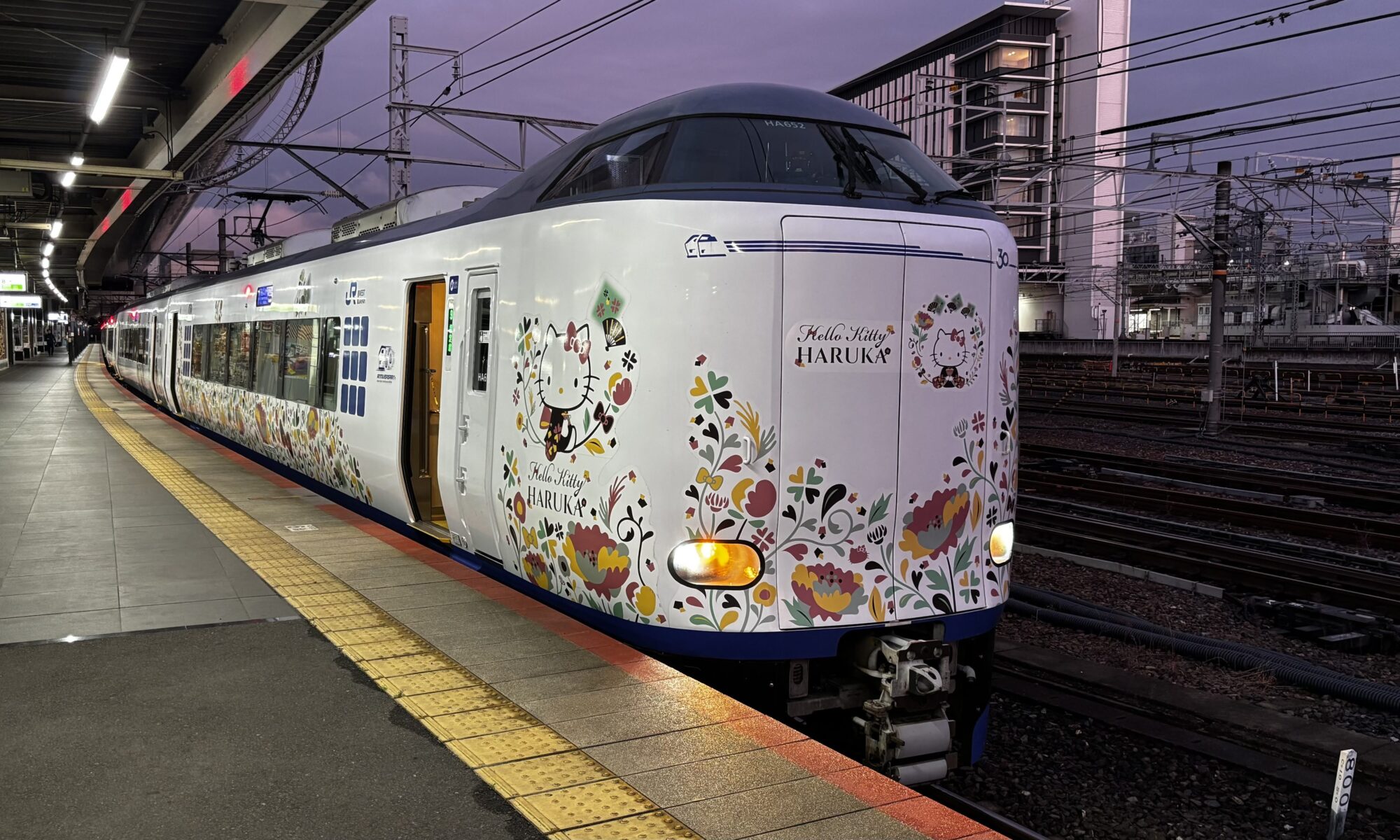
The JR side sits a little further off, across the park. The distance takes some of the impact away, but the variety makes up for it: Limited Express Thunderbird, Limited Express Haruka and the Special Rapid Service all pass this way. On the Hankyu side we also caught the sightseeing train Kyo-train Garaku.

And there is one more star attraction here, which we’ll come to shortly.

Stretching out on the wide lawn and watching trains against an open sky is a pleasure in itself. Bringing a packed lunch would work nicely.

The Starbucks Terrace — The Best Seat in the House

There’s a Starbucks inside the park, and its terrace is the best seat on the Hankyu side. You can sit with a coffee while trains run past directly in front of you. At one every five minutes, you’ll see a good few before your cup is empty.

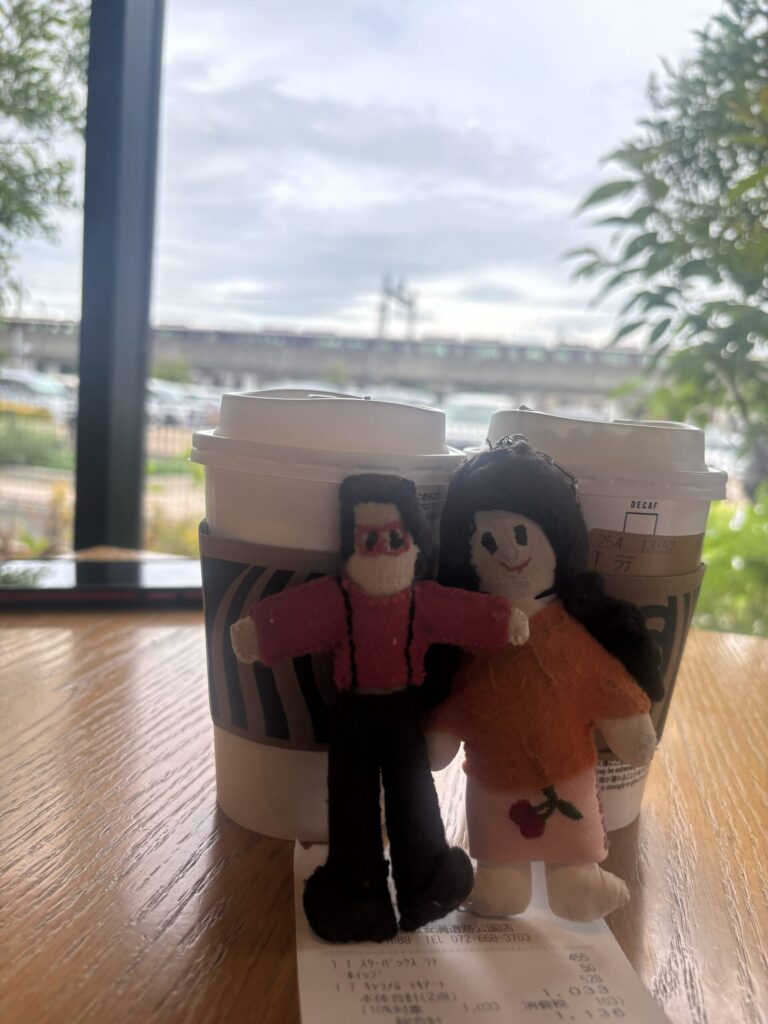
Tikoppi and Presley with two coffee cups at the Starbucks window, a train passing on the viaduct outside

By the time we arrived, around 2pm, the seats were already filling up. If you’d like to settle in properly, a slightly earlier visit would be safer. The interior is spacious and easy to get into with a stroller.

We gather that in the evening you can watch train silhouettes against an orange sky, but ours was an early-afternoon visit, so we can’t vouch for that ourselves. Something to save for next time.

The Real Thrill Is Beside the JR Tracks

After our break at Starbucks, we walked across the park to the edge of the JR line. This turned out to be the highlight of the day.

The JR Kyoto Line that had looked so distant from the terrace is suddenly right beside you. The Special Rapid Services and limited expresses are impressive enough on their own — but what genuinely stopped us was JR Freight.

A long freight train came through with a sound like the ground shifting, rolling past just a few metres away, on and on and on. A photograph cannot convey it. It is a completely different experience from watching quietly from the café terrace.

We’d read beforehand that freight runs on this stretch, so we went looking for it deliberately — and seeing it from that close exceeded anything we’d pictured. If you have a child who loves trains, this is the spot to bring them.


Play Facilities — You Could Spend All Day Here

There’s more to the park than train-watching. Alongside the large play equipment there’s Bornelund Playville, a play space produced by Bornelund (paid entry).

There’s also an exhibition centre covering the Yayoi-period Aman ruins the park is named after, which was free to visit.

There is parking, though it’s paid, and it apparently fills up at weekends. Both JR Takatsuki and Hankyu Takatsukishi stations are within walking distance, so coming by train, watching trains, and going home by train is perhaps the most fitting way to do this park.

Basic Information

ItemDetails
LocationHatchonawate-cho, Takatsuki, Osaka
Opening hoursOpen at all times (individual facilities vary)
AdmissionFree
AccessAbout 15 min on foot from JR Takatsuki Station / about 10 min from Hankyu Takatsukishi Station
ParkingAvailable (paid)
Date visited23 May 2026

Where to Watch the Trains

The Starbucks terrace Hankyu trains pass right by. At one every five minutes you’ll see them continuously without moving from your seat. Best before the terrace fills up.

Beside the JR tracks We’d call this the real draw of the park. Special Rapid Services, limited expresses and freight all pass close enough to feel, and the impact is on another level.

The lawn Lie back and take in the sky and the trains together. Good for a slower afternoon.

A note on timing We were there for about an hour in the early afternoon and still saw more than enough. This is a park where you never have to wait. Weekdays are apparently quieter.

About the Aman Ruins

The Aman ruins that give the park its name are the remains of a large Yayoi-period settlement. The exhibition centre inside the park introduces excavated pottery and what daily life looked like at the time.

Trains to watch, playgrounds to run around, and history to take in — there aren’t many parks that manage all three.

Why Families with Young Children Will Love It

From what we saw walking the grounds ourselves, this is an easy place to bring children.

  • Nursing room and nappy-changing facilities (we checked these on site)
  • The lawn gives plenty of room to run
  • Bornelund Playville is paid entry but well equipped
  • Strollers are fine inside Starbucks
  • With a train every five minutes, children don’t get bored

It would make a good choice for a child’s first go at train-watching — and the freight trains on the JR side are the sort of thing you don’t forget in a hurry.

Watching a freight train pass right beside you at the fence is something this park does better than anywhere else I know. There is also an event built entirely around freight trains, which I wrote up separately.

Hello Kitty Haruka and Hello Kitty Shinkansen: Kansai’s Two Kitty Trains, Now Ended

⚠️ Service ended — Both of Kansai’s Hello Kitty trains have now finished running. The Hello Kitty livery on the Haruka airport express ended in March 2026, and the Hello Kitty Shinkansen made its final run on Sunday, 17 May 2026. This article is a record of what they were like. If you are planning a trip and looking for what you can still ride, skip to the last two sections.

What this article covers

・What the two Hello Kitty trains of Kansai were actually like

・Where to find the Hello Kitty headrest covers on the Haruka

・Inside the Hello Kitty Shinkansen, and the goods sold on board

・How hard the reservations were, and what you can still ride today

Kansai Had Two Hello Kitty Trains, and Most People Only Knew About One

Even railway fans in Japan were often surprised by this: Kansai had two trains themed around Hello Kitty, not one. There was the Haruka, the limited express that runs from Kansai International Airport, and there was the Hello Kitty Shinkansen on the Sanyo line. They were completely different experiences, and I rode both.


1. The Haruka: Look Closely and Hello Kitty Is on Every Seat

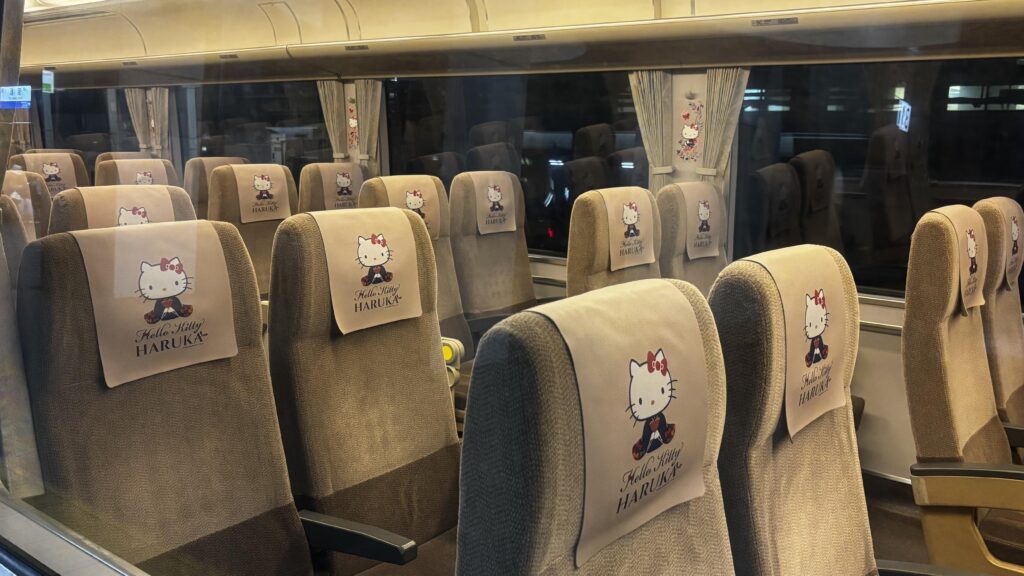
The Haruka is the limited express most travellers take out of Kansai International Airport, heading for Kyoto and Shin-Osaka. Look into the carriage and you will find Hello Kitty on the headrest cover of every seat, in a kimono. It is easy to miss if you are not looking for it.

The Haruka is operated by JR West and reaches Kyoto from the airport in about 75 minutes. IC cards such as ICOCA and Suica can be used, which makes it a straightforward first train to take after you land.


2. The Hello Kitty Shinkansen: The 500 Series I Booked a Trip Around

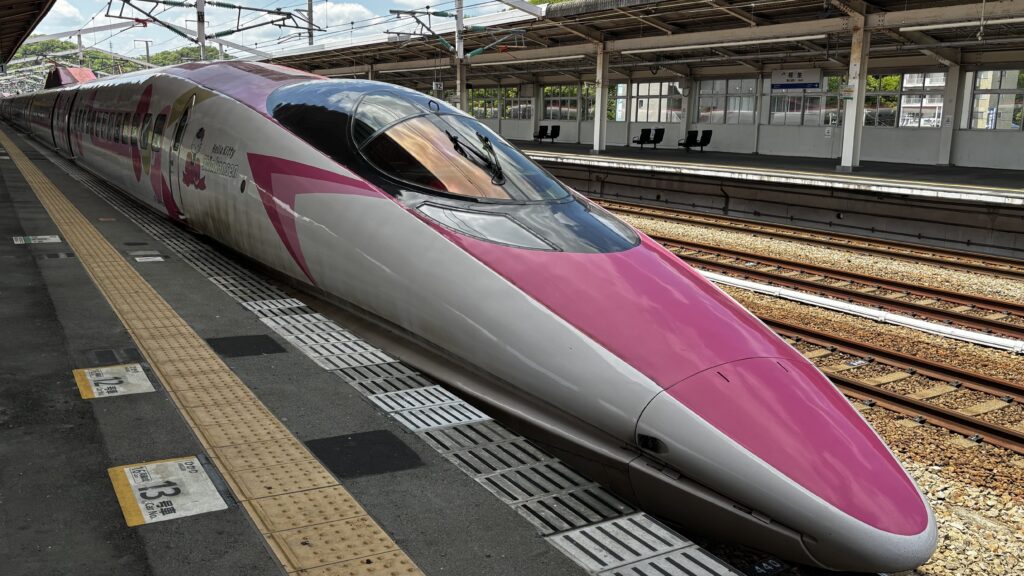
The pink and white nose of the 500 Series Hello Kitty Shinkansen

This was the one I had wanted to ride for years, and finally did.

It ran just one round trip a day between Hakata and Shin-Osaka, which made it a rare train to catch. A reservation was essential — you could not simply turn up and hope.

Hello Kitty Inside and Out

What made this Shinkansen remarkable was that the theme did not stop at the paintwork. The seats, the walls, the floor — Hello Kitty was everywhere you looked inside the carriage.

Hello Kitty Goods Sold On Board

There was also a range of Hello Kitty Shinkansen exclusive goods sold on board. Even if you are not particularly a Hello Kitty person, they were charming enough that you found yourself buying something before you had really decided to.

The Hello Kitty Shinkansen was a 500 Series train operated by JR West, running one round trip a day between Hakata and Shin-Osaka. The 500 Series itself is now approaching retirement.


The People Who Loved This Train

While it was running, the Hello Kitty Shinkansen was the sort of train that drew a particular mix of passenger

  • People who loved Hello Kitty
  • People who wanted to ride a 500 Series Shinkansen
  • People who simply wanted a cheerful train journey
  • Families travelling with young children
  • Visitors from overseas, for whom it made a memorable first Shinkansen ride

The Haruka Itself Is Still Running

The Hello Kitty headrest covers disappeared in March 2026, but the Haruka limited express itself has not gone anywhere. It still runs between Kansai International Airport and Kyoto exactly as before. If you are landing at KIX and heading for Kyoto, it remains a perfectly good option — just without the cat.

And the 500 Series Is Still Running, For Now

This is the part worth knowing if you are planning a trip to Japan.

The Hello Kitty livery is gone, but 500 Series trains themselves continue to run on part of the Sanyo Shinkansen. That long, rounded nose is still one of the most admired shapes in Japanese railways, and it is still out there.

JR West has announced that scheduled 500 Series services will end on 13 January 2027, with the train retiring from revenue service entirely in July 2027. In other words, there is a little over a year left to ride one.

If You Missed Them, the Goods Are Still Around

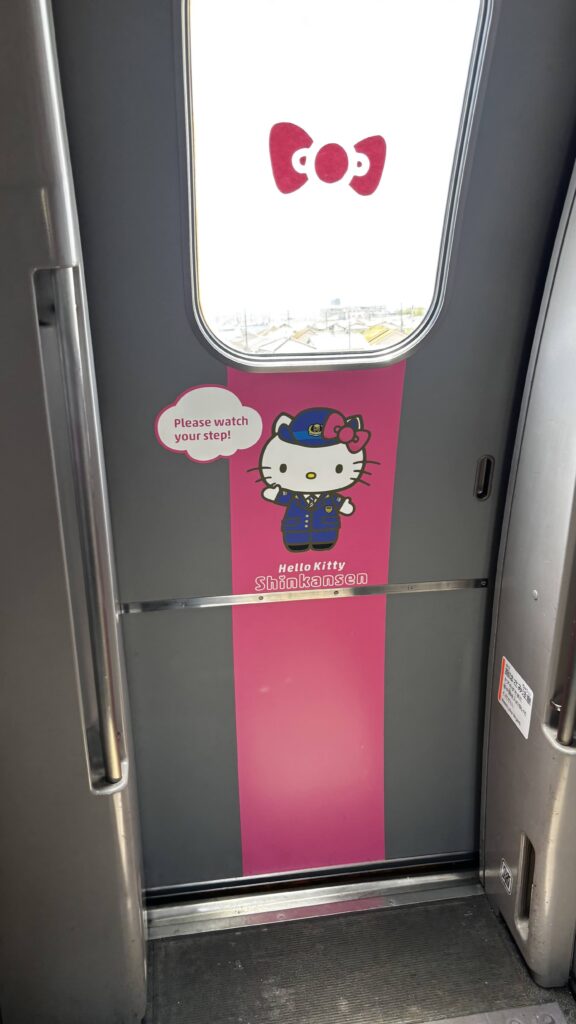
A door on the Hello Kitty Shinkansen with Hello Kitty in a conductor's uniform
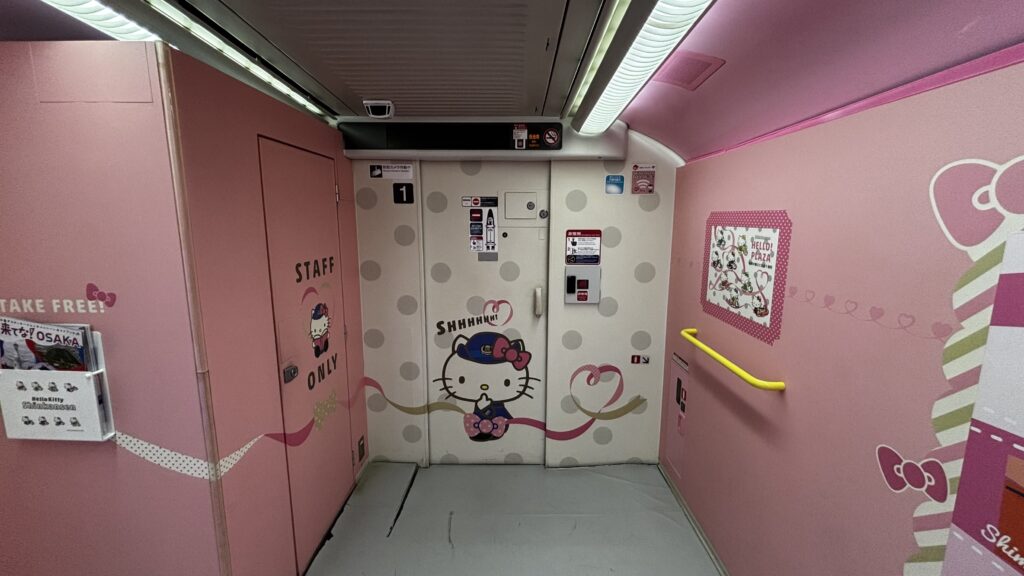
The all-pink deck of the Hello Kitty Shinkansen with the HELLO PLAZA goods area

Both trains have stopped running, but Hello Kitty Shinkansen commemorative goods can still be found through Japanese online marketplaces. If you never got the chance to ride, they are a way to keep a piece of it.

There Is a Station in Tokyo Covered in Hello Kitty

Kansai’s two Hello Kitty trains have finished, but the pairing of Sanrio and railways is alive and well in the Tokyo area.

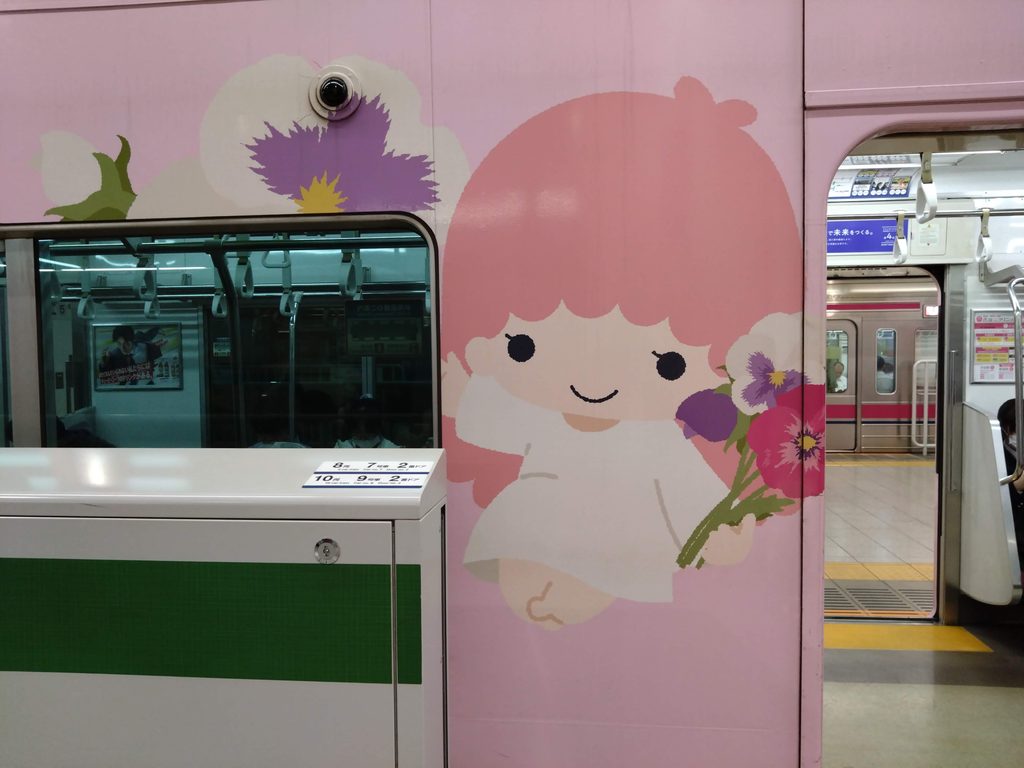
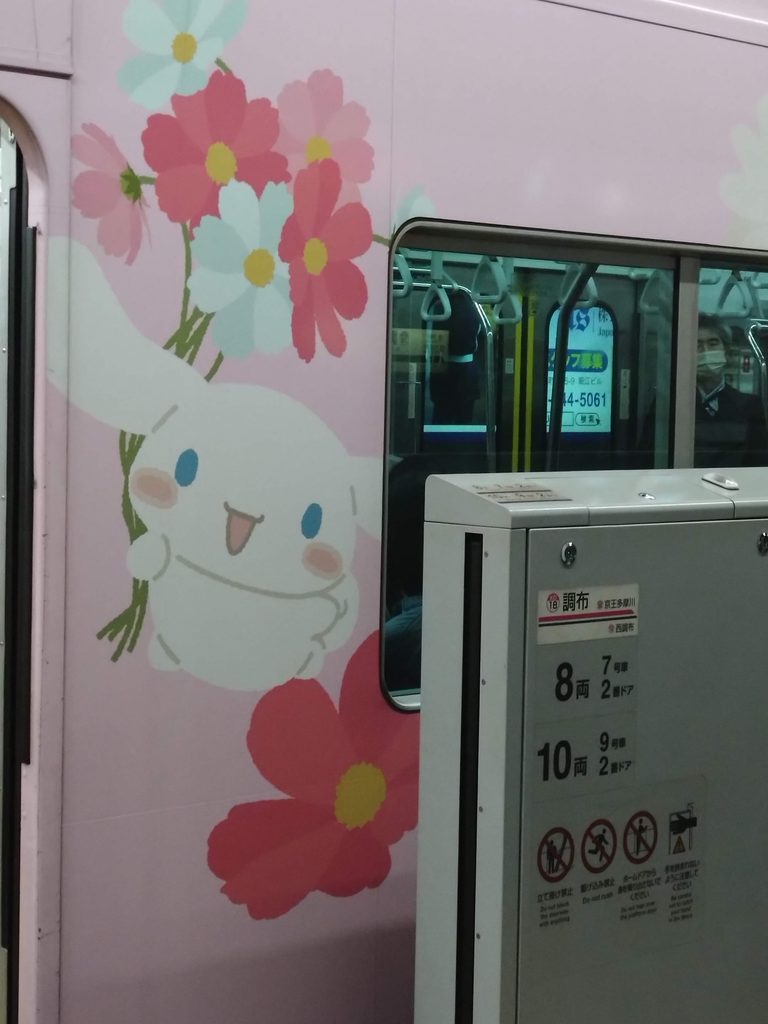
On 19 October 2023 I spent the day in the Tama area of western Tokyo. Waiting for a train at Chofu station on the Keio Line, what pulled in was a pale pink wrapped train. Beside one door, Lala was holding a bunch of pansies; on another carriage, Cinnamoroll was carrying cosmos. It reminded me of the Little Twin Stars star house I was given as a child and kept carefully for years, and I took a photograph almost without thinking.

The Sanrio wrapped train arriving at Chofu station on the Keio Line, with Lala holding a bunch of flowers
The Sanrio wrapped train seen over the platform doors at Chofu station, with Cinnamoroll holding cosmos flowers

The train was not what surprised me most that day, though. That came at Keio Tama-Center, the station for Sanrio Puroland, when I happened to look up. There were Hello Kitty characters across the ceiling, all over the place. A wrapped train is not unusual, but a station that is itself covered in Hello Kitty had never occurred to me, and I stood there looking around for a while. I had got off there knowing nothing about it, which made it all the more startling.

I learned later that Keio Tama-Center has been decorated in collaboration with Sanrio Puroland since 2016, and that Hello Kitty serves as its honorary stationmaster. Pom Pom Purin is the group leader, My Melody handles customer enquiries, Cinnamoroll looks after lost property, and the Little Twin Stars are in charge of patrolling the platform. Which means the characters I had photographed at Chofu that morning were, at Tama-Center, on duty.

What I regret is not taking a single photograph of the station. I simply stood and stared, and that was that.

One more thing worth knowing. There are two Tama-Center stations, Keio and Odakyu, standing side by side. The Odakyu one has been decorated since 2018, and in February 2026 its interior was completely redecorated, with the number of Sanrio characters on display rising from four to fourteen. I have not seen that one yet. When I do, I will write it up.

In Closing

Both trains have finished their runs. What is left is the record — the photographs, the headrest covers, the pink deck, the goods. If you rode one of them, you were there for something that no longer exists. If you did not, the 500 Series is still running, and there is still time.

The full account of the last ride on the 500 Series Hello Kitty Shinkansen is here


Summary: Two Hello Kitty Trains of Kansai

TrainRouteHello Kitty Highlights
Haruka Limited ExpressKansai Airport → KyotoHello Kitty headcovers on seats
Hello Kitty ShinkansenHakata → Shin-Osaka (1 round trip/day)Full Hello Kitty interior, exterior & exclusive merchandise

[Farewell, 500 Series Hello Kitty Shinkansen] A Journey Through Western Japan on Character Trains — Including the Anpanman Train to Tokushima!

Spring 2026 — the day has finally come. With the beloved 500 Series Hello Kitty Shinkansen heading into retirement, we set off on one last ride to bid it farewell! We also hopped aboard the Anpanman Train in Shikoku, making this a dream trip packed with character trains from start to finish.


The Pink Dream Train: Hello Kitty Shinkansen

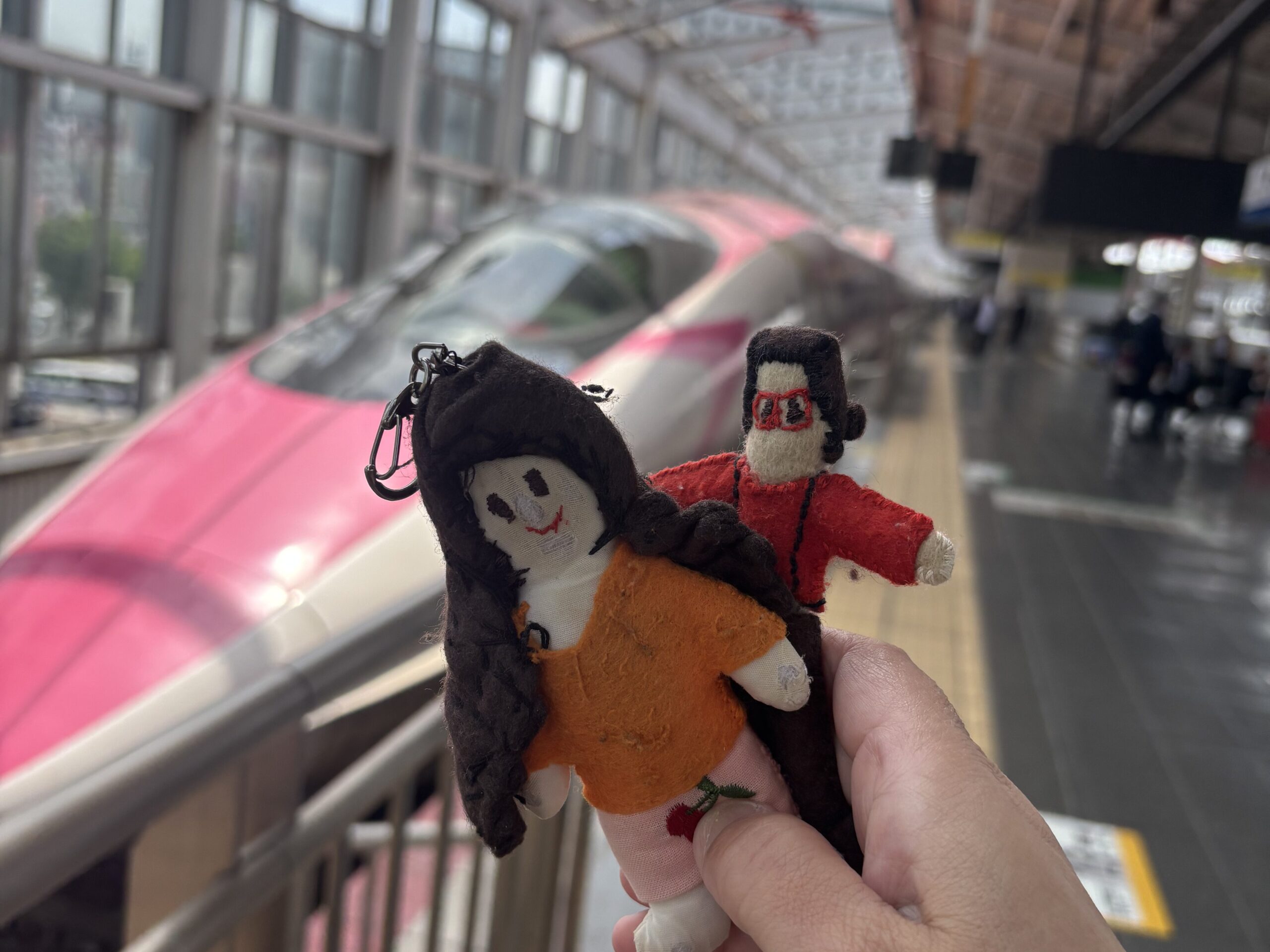
As the vivid pink 500 Series Hello Kitty Shinkansen glided into the platform at Shin-Osaka Station, our mascots let out a collective “Wow, it’s real! So cute!” — and stood completely frozen on the platform for a good while.

Since its debut in 2018, this train has captured the hearts of fans across Japan with its charming appearance. The 500 Series, with its sleek aerodynamic form, was once the fastest Shinkansen on the Nozomi route — a legendary train in its own right. Wrapped in Hello Kitty’s iconic style, it took on an entirely new kind of charm.

Stepping inside, Car 1 — the “HELLO! PLAZA” — was filled with limited-edition merchandise and photo spots. The corner where you could take commemorative photos with Hello Kitty was especially popular, given that this was one of the final rides. Even the headrest covers featured Hello Kitty designs, showing just how much attention to detail went into every corner of the train. The roughly one hour to Okayama passed like a dream, with our mascots smiling the entire way.

💡 Travel Tip: The HELLO! PLAZA in Car 1 is located in the unreserved seating area, meaning you can visit the shop and photo spots with just a regular ticket. It gets crowded quickly, so head there as soon as you board!

Tikoppi and Presley on the platform in front of the pink 500 Series Hello Kitty Shinkansen
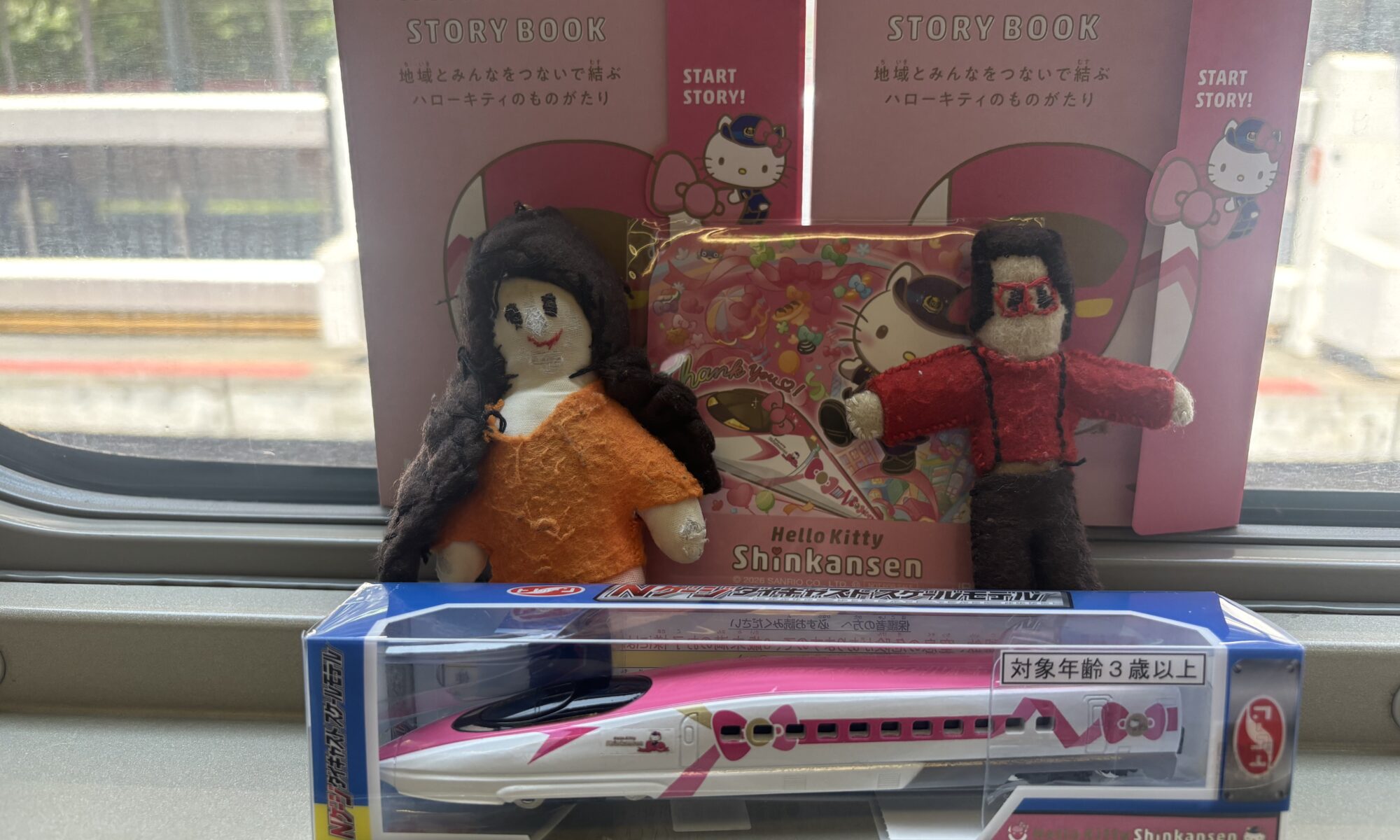
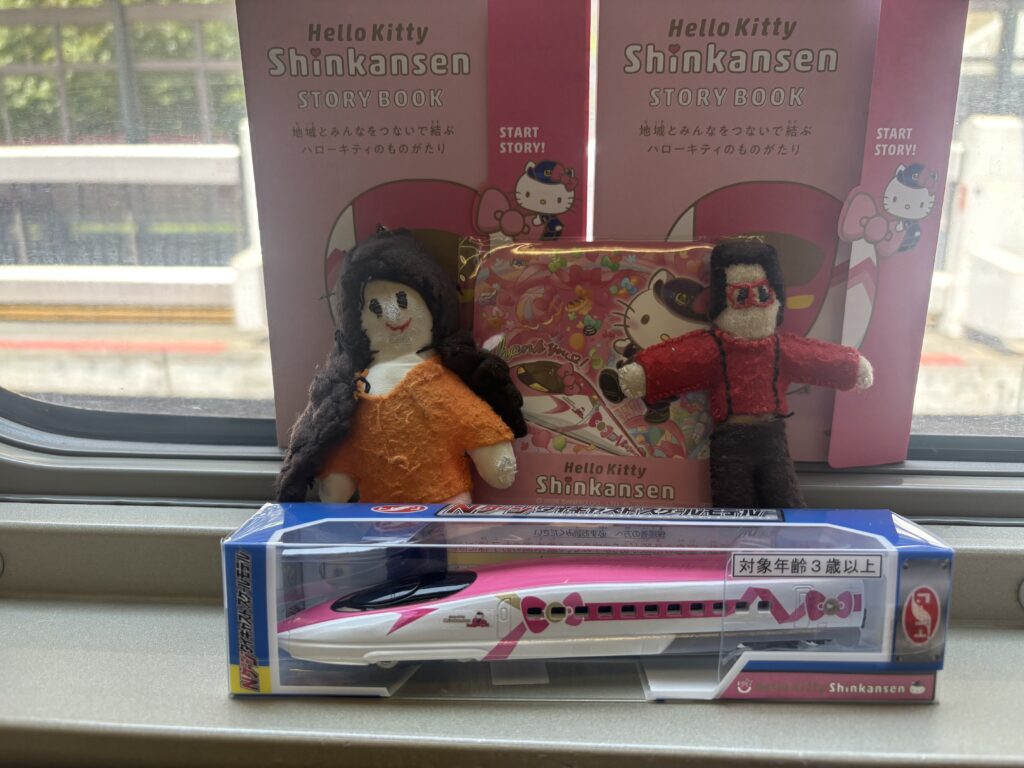
Hello Kitty Shinkansen story books and a model of the train on the window sill, with Tikoppi and Presley

Shikoku’s Beloved Icon: The Anpanman Train to Tokushima

From Okayama, we boarded the Marine Liner rapid service across to Takamatsu — and from there, our Shikoku adventure truly began. We were about to ride the Anpanman Train on the Kotoku Line, a service that launched in October 2025. Operated by JR Shikoku, the Anpanman Train runs on multiple routes centered around Kochi, the hometown of creator Takashi Yanase.

The moment our mascots spotted Anpanman and his friends painted across the entire side of the train, they burst out with “Anpanman! Baikinman is there too!” — pure joy. It’s the kind of sight that brings out the child in anyone. The interior is completely themed around the world of Anpanman, creating a space that puts smiles on the faces of families with children and adults alike. There were also unique characters like “Udon-chan” and “Udon-kun,” a charming nod to the region’s famous Sanuki udon — just one of many delightful surprises waiting inside the train.

💡 Travel Tip: The Anpanman Train operates on specific dates and routes. Be sure to check the official JR Shikoku website for the current schedule before making your plans.


What Makes Character Trains So Special

Both the Hello Kitty Shinkansen and the Anpanman Train are more than just a way to get from A to B — they are destinations in themselves. Character trains give children something to dream about, while offering adults a sense of nostalgia and warmth. Gazing out the window, surrounded by beloved characters, turns an ordinary journey into something truly memorable.

Saying goodbye to the 500 Series Hello Kitty Shinkansen is bittersweet — but the memories from this trip will stay with us forever. If you ever get the chance, hop aboard one of Japan’s many character trains and experience the magic for yourself!


Trip Summary

TrainRouteHighlights
500 Series Hello Kitty ShinkansenShin-Osaka → OkayamaHELLO! PLAZA in Car 1, limited-edition merchandise
Marine LinerOkayama → TakamatsuScenic Seto Inland Sea crossing
Anpanman Train (Kotoku Line)Takamatsu → TokushimaLaunched October 2025, Udon-chan & Udon-kun characters

📝 500 Series Hello Kitty Shinkansen — Basic Information

TrainRouteFeatures
500 Series Hello Kitty ShinkansenShin-Osaka~HakataCar 1 “HELLO! PLAZA,” limited merchandise
Anpanman TrainOkayama~ShikokuYuuyuu Anpanman Car, playroom onboard

📝 500 Series Hello Kitty Shinkansen — Key Facts

・Route: Shin-Osaka to Hakata
・Travel time: Approx. 2.5 hours (compared to Nozomi)
・Operation period: 2018 – May 17, 2026 (service ended)
・Features: Car 1 “HELLO! PLAZA” with Kitty-themed interior
・Reservations: JR tickets, e5489, or Midori-no-madoguchi

💡 For Those Considering a Ride
The 500 Series Hello Kitty Shinkansen concluded its service on May 17, 2026. For information on successor character trains, please visit the JR West official website.

Kansai had a second Hello Kitty train. The Haruka, the limited express that runs from Kansai International Airport, carried its own Hello Kitty livery, and I rode both before they finished. You can read how Kansai’s two Hello Kitty trains compared in a separate article.

Kansai’s two Hello Kitty trains, ridden and compared

The Kotoku Line that carries the Anpanman train also carries the Uzushio, the limited express for the Otsuka Museum of Art.

A Chance Encounter with the E8 Series “Tsubasa” at Utsunomiya Station – But We Couldn’t Ride It

A rare business trip to Utsunomiya, and an unexpected encounter on the way home. Along with a good deal of regret.

Heading Home After Work

When we book the Shinkansen home from a business trip, we almost always choose whatever leaves soonest after the work finishes. Meetings can overrun, or wrap up early, so the priority is simply “the first train we can catch.”

This trip was no different. We gave no thought at all to which train it would be.

Our usual line is the Tokaido Shinkansen; we rarely have reason to use the Tohoku Shinkansen. It had been a long time since we’d even been to Utsunomiya.

A Streak of Purple on the Platform

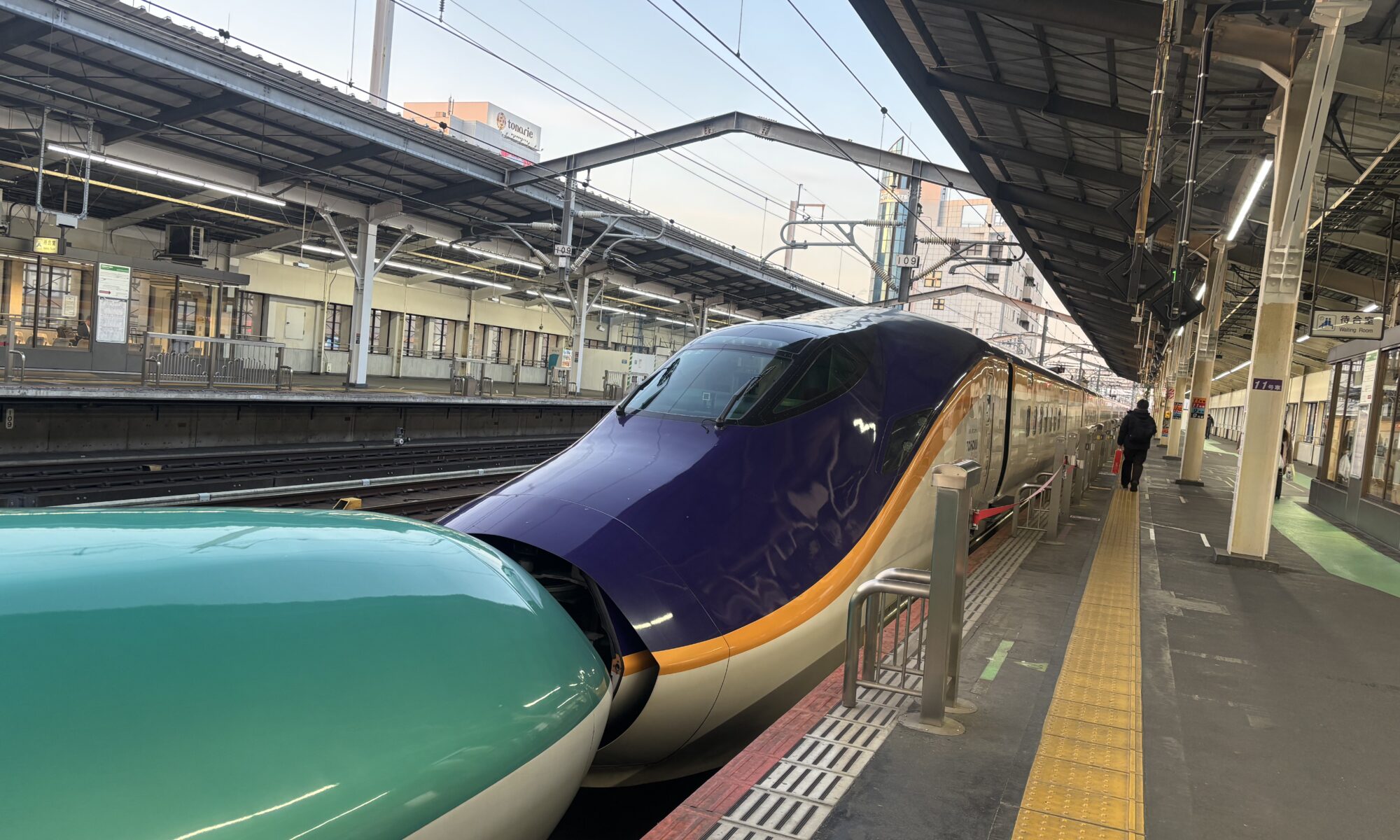
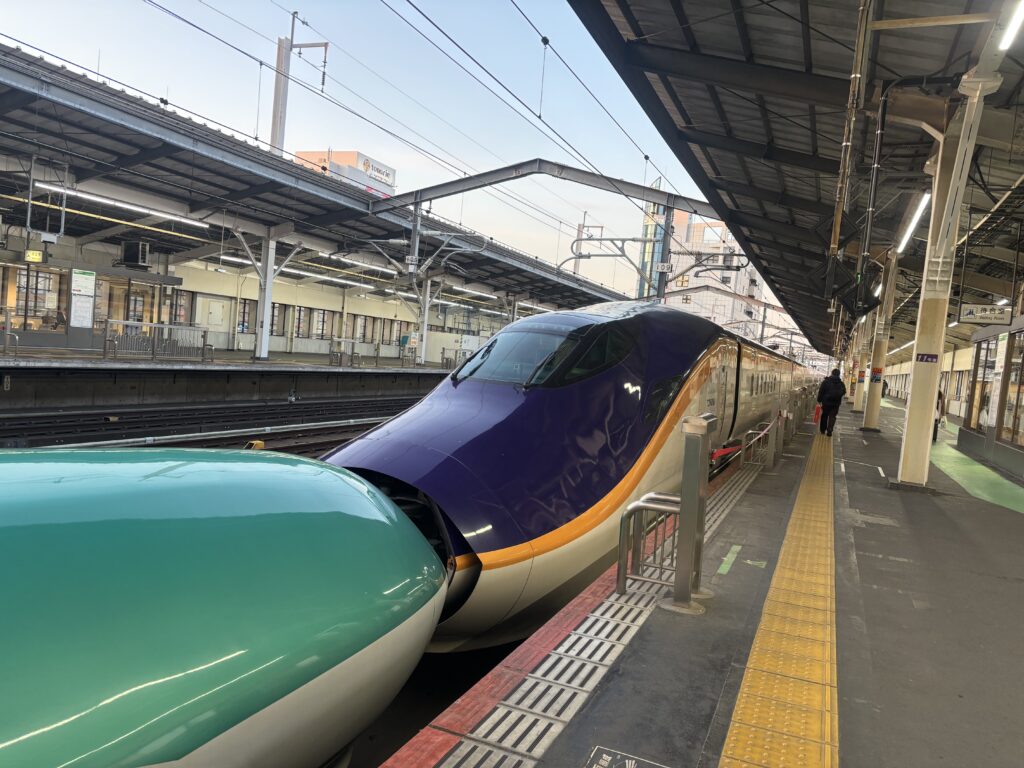
The E8 Series Tsubasa coupled to an E5 Series at the platform in Utsunomiya

Glancing idly at a phone on the platform, we caught an unfamiliar colour sliding in at the edge of our vision, and looked up.

Sliding quietly in was an E8 Series Shinkansen “Tsubasa” in deep purple. The body colour is called Oshidori Purple, set against the white of Zao Bianco and a band of Benibana Yellow that reads almost as gold. A restrained combination, and yet it dominates the platform.

The sharp nose of the lead car against that glossy purple is a genuinely striking combination. Other passengers on the platform were reaching for their cameras too. We shot away, thoroughly taken with it.

We were determined to film it while it was moving, and remember concentrating hard on doing exactly that.

The E8 Series entered service in 2024 on the Yamagata Shinkansen. Its three colours – Oshidori Purple, Zao Bianco and Benibana Yellow – are all inherited from the E3 Series it replaced. The safflower, Yamagata’s prefectural flower, gives its name to the yellow band rather than to the body. The design was overseen by Ken Okuyama, an industrial designer from Yamagata. Between Tokyo and Fukushima it runs coupled to a Tohoku Shinkansen “Yamabiko,” separating at Fukushima to continue toward Yamagata. Utsunomiya lies within the coupled section.

And Our Train Was the Next One

Here is the part that still stings.

The Tsubasa arrived as the service immediately before the one we had booked.

That purple ran past us. We got the shots we wanted. What we didn’t get was a ride. Had we booked one train earlier, we would have been on it.

Watching it pull away from the platform, the regret set in slowly.

We Should Have Researched a Line We Never Use

Thinking about it calmly, the cause is obvious.

We had forgotten that a new train, the E8 Series, was running there at all.

Because we so rarely take the Tohoku Shinkansen, we had never looked into what runs on it. We booked purely on “the first train after work finishes,” and the question of rolling stock never entered our heads.

Which is faintly absurd. On the Tokaido Shinkansen we’re particular enough to specify seat E in order to see Mount Fuji. On a line we know, we care about the seat number. On a line we don’t, we checked nothing whatsoever.

If you’re planning to take the Tohoku or Yamagata Shinkansen When you book, take a moment to check which type of train operates that particular service. JR East’s site and the Ekinet booking service both show the rolling stock for individual trains. Shifting your booking by one service can change what you get to ride. The less familiar the line, the more this small step is worth.

Looking It Up Afterwards: You Can Still Board a Full Train

Smarting from the whole thing, we went and read up on the Tsubasa when we got home. Which is how we learned something we hadn’t known.

The Tsubasa is entirely reserved-seating, year round. There are no unreserved cars. However, when the reserved seats sell out, a “standing limited express ticket” (立席特急券 / tachiseki tokkyūken) is released.

  • It costs ¥330–¥930 less than an ordinary reserved seat
  • You are, in principle, expected to stand — the ticket itself states that it does not entitle you to a seat
  • In practice, if a seat happens to be free, sitting in it is not a problem

The catch is how you buy it. These tickets are not sold through Ekinet. You have to buy one at a reserved-seat ticket machine in a station, on the day of travel or the day before. If you’re searching online from overseas you simply won’t find it, so plan on doing this at a station.

Standing all the way home after a day’s work isn’t much of a plan. But knowing there’s an option other than giving up when everything is sold out felt like something worth having. For a leisure trip, we’d take it.

Please note: this is information we looked up after the fact rather than something we’ve used ourselves. Check JR East’s official guidance for the current terms.

For everyday travel, “whatever gets me home fastest” is a perfectly reasonable rule. But on a line you’ll only ride once in a long while, it’s worth spending a few minutes before you book — a lesson this trip delivered rather firmly.

In Summary: We Saw It, and We Missed It

Those few minutes on the platform at Utsunomiya were genuinely memorable. Precisely because we weren’t expecting it, the shock of that purple appearing in front of us was considerable.

Honestly, though, the frustration of not riding it has stayed with us more strongly.

Next time we head north, we’ll check the timetable and the rolling stock before booking. Booking the Tsubasa on purpose — that’s the homework now.

The trip home from a business trip pulls you toward “whichever train leaves first.” There’s nothing wrong with that. But apply it on a line you’ll rarely see again and this is the sort of thing you’re left with. Next time, we’ll be a little greedier.

A note added later: when we first wrote this, we were convinced the train we had seen was the one known as the “Kabuki Color.” Looking it up afterwards, we found that the name belonged to the livery carried by the E3 Series 2000 subseries from December 2008, and that it disappeared when the exterior design was revised from April 2014 onwards. The E3 Series “Tsubasa” itself ended regular service in December 2025. In other words, we had been looking for a livery that had been gone for more than a decade – which lands us right back at the point of this article: we should have checked first. The relevant passages have been corrected.


How particular the same writer gets on a line they do know well is covered here.

→ Riding the Tokaido Shinkansen N700S for Work | How to See Mount Fuji from Your Seat

One Hour at Shin-Osaka Station: What a Local Actually Does

An hour at Shin-Osaka before your next train? Here is what someone who lives nearby actually does with it: when to buy 551 Horai’s pork buns without queueing, which shops the current renovation has closed, and what is worth skipping.

What this article covers:

・Whether you actually need to spend that hour waiting at all

・When you can buy 551 Horai’s pork buns without queueing

・Which shops the current renovation has closed, and which remain (as of August 2026)

・What locals actually buy as souvenirs, and what I hesitate to recommend

Do You Really Have to Wait That Hour?

Let me start with something unhelpful: if you are changing between Shinkansen trains, you often do not need to wait an hour at all.

With a non-reserved seat you simply board the next train that comes. A reserved seat can usually be changed. A great deal of the time, an hour that has “opened up” can be closed again at the ticket counter. If you are travelling on a rail pass, ask at the ticket office before you resign yourself to waiting.

Still, real one-hour gaps do happen. You may be connecting to a local line where the next train is a while away. You may be waiting for someone, as I once did here for an hour when a friend came to visit. Or you may have a reserved seat that you have good reason not to give up.

This article is for people who genuinely have that hour. I live near Shin-Osaka and use this station regularly, so what follows is simply what I do.

Shin-Osaka Is Under Renovation Right Now

One thing to know before you plan anything: the shopping area on the local line side of the station is being renovated, and a number of shops are currently gone. This is the situation as of August 2026, and no completion date has been announced.

Many guides online still list shops that no longer exist. As you will see below, some of the places I used to rely on have disappeared too.

551 Horai Pork Buns: When You Can Actually Buy Them

Butaman, steamed pork buns, from 551 Horai are the classic Osaka souvenir. Whether you queue or not comes down entirely to timing.

I buy them about once a month, and this is my experience. On weekdays after 7:30pm the line gets dramatically shorter, and that is the window to aim for. At weekends the queue is intimidating, and if you only have an hour I would give up on it rather than gamble.

Here is something that surprises a lot of people: you can buy a single bun. Most visitors assume they only come in boxes and rule them out entirely, but the shop will happily sell you just one. Grabbing one for yourself between trains is a perfectly normal thing to do.

If you buy the chilled type rather than the hot one, it travels fine on the Shinkansen.

Takomasa’s Akashiyaki (2nd Floor)

I like this place and eat here now and then. Akashiyaki is a softer, egg-rich relative of takoyaki: octopus dumplings that you dip into dashi broth rather than coat in sauce.

I will be honest, though. It gets busier than you would expect.

Some guides say fifteen minutes is enough. Depending on the queue, that is optimistic. If you have one hour and try to fit in both a meal and souvenir shopping, you will end up rushing one of them.

If you are going to eat, give up on the shopping. That is the realistic trade-off.

Souvenirs: Honestly, This Is the One

Takopatie (2nd floor, 3rd floor, and convenience stores)

Takopatie is regularly voted the most popular souvenir at Shin-Osaka. There is a saying in Japan that famous local specialities are never actually good. This one is the exception. It is genuinely delicious.

There are three reasons I keep buying it. It is light, so it does not weigh down your bag even if you buy it at the very end of a trip. The twelve-piece box is the right size and the right count for handing out. And you can buy it almost anywhere in the station: the souvenir shops on the second and third floors, and even the convenience stores.

That last point is what matters when you only have an hour. You do not have to queue at a speciality counter, because you can pick it up at a convenience store.

Tenten’s Bite-Sized Gyoza: Not for Everyone, Honestly

This one gets recommended constantly, but I do not push it.

I have bought it as a gift. The problem is that it is difficult to cook. The dumplings are small and thin, so if you get the heat wrong they do not turn out well. As a present for someone who enjoys cooking, it is a fine choice. As a souvenir that anyone will be pleased with, I think the bar is a little high.

Kiyasu Sohonpo’s Mitarashi Dango: No More Fresh Off the Grill

I used to come here often, because you could buy the dango grilled to order in the local line shopping area. Skewers with a fragrant char, handed over the same day, made an excellent gift.

The renovation has taken that shop away. You can still buy the dango at the souvenir section near the Shinkansen gates, but buying them fresh off the grill is not something you can do at the moment.

Rikuro’s: It Has Moved

Rikuro’s is known for its freshly baked cheesecake. Its shop in Ekimarche, on the local line side, is also gone during the renovation.

There are still counters on the third floor by the Shinkansen gates and in the third-floor souvenir shop, so if you are waiting for a Shinkansen you can pick one up on your way through.

The Steam Locomotive Driving Wheels on the 1st Floor

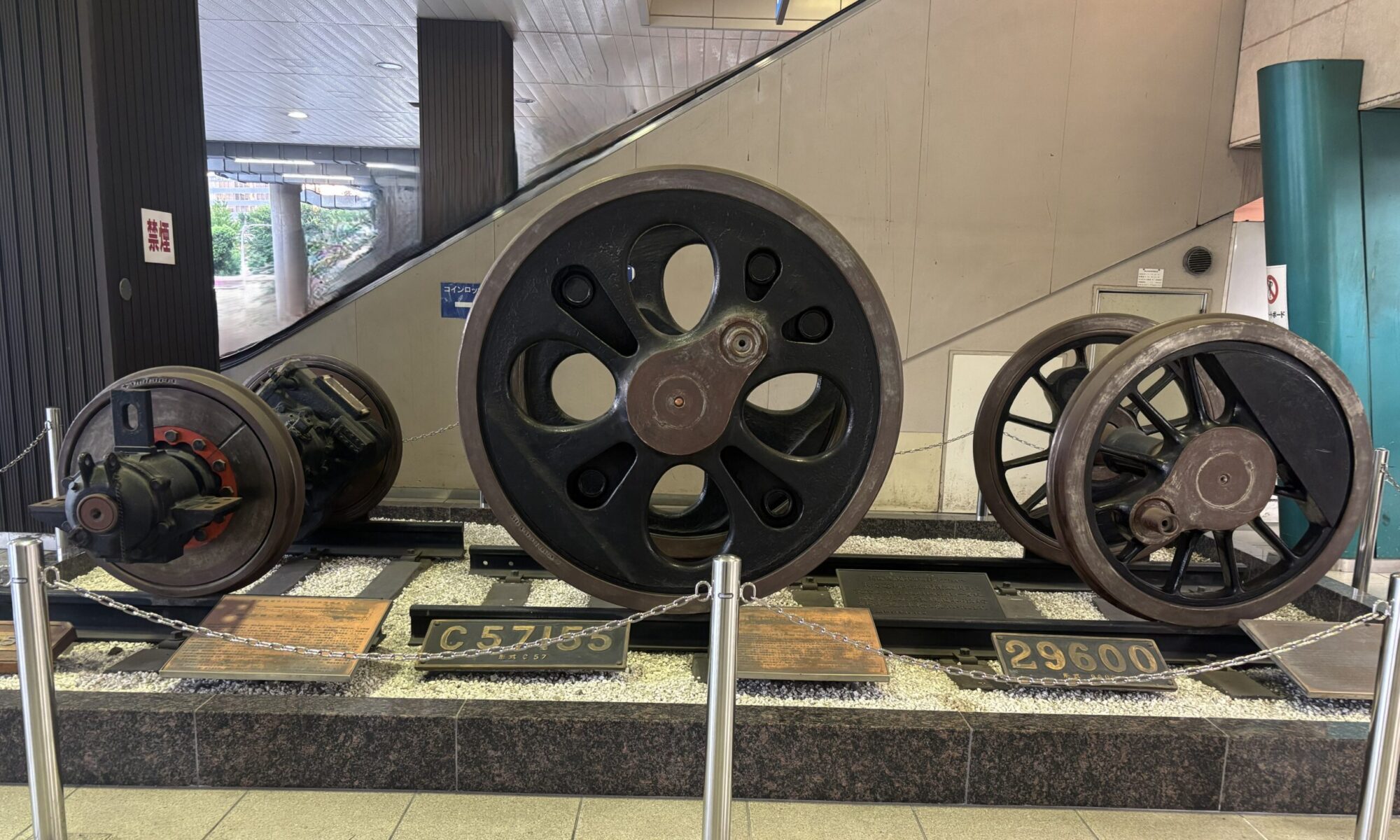
If you like trains, go down to the first floor when you get the chance. Three wheelsets are displayed beside the escalator.

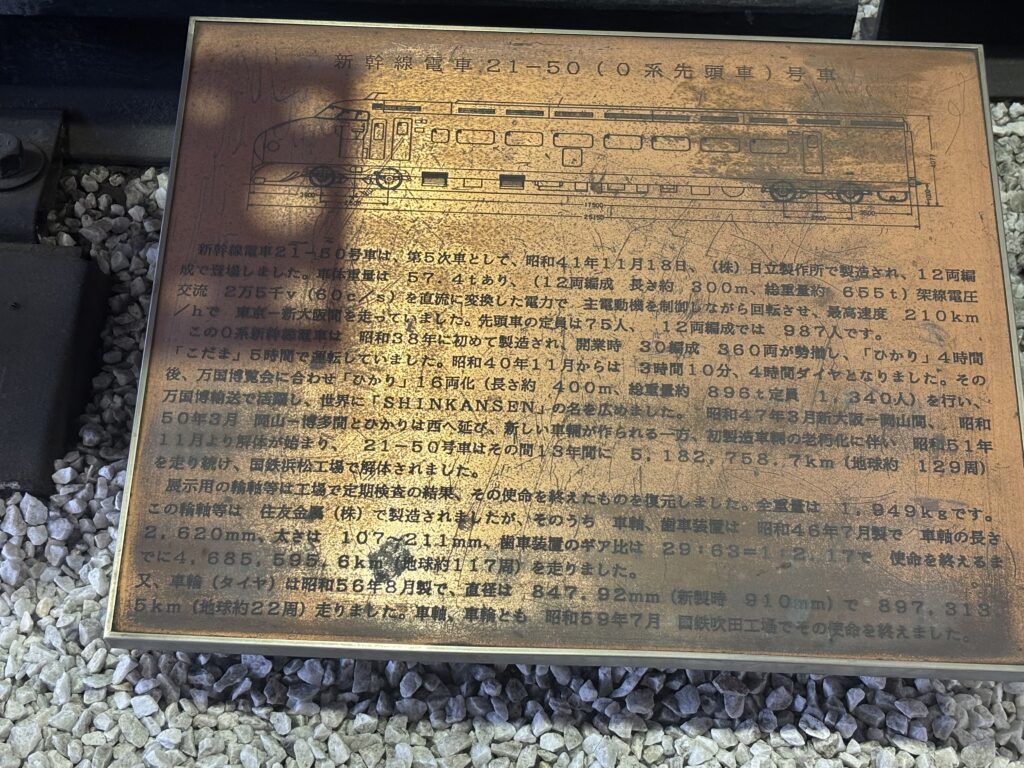
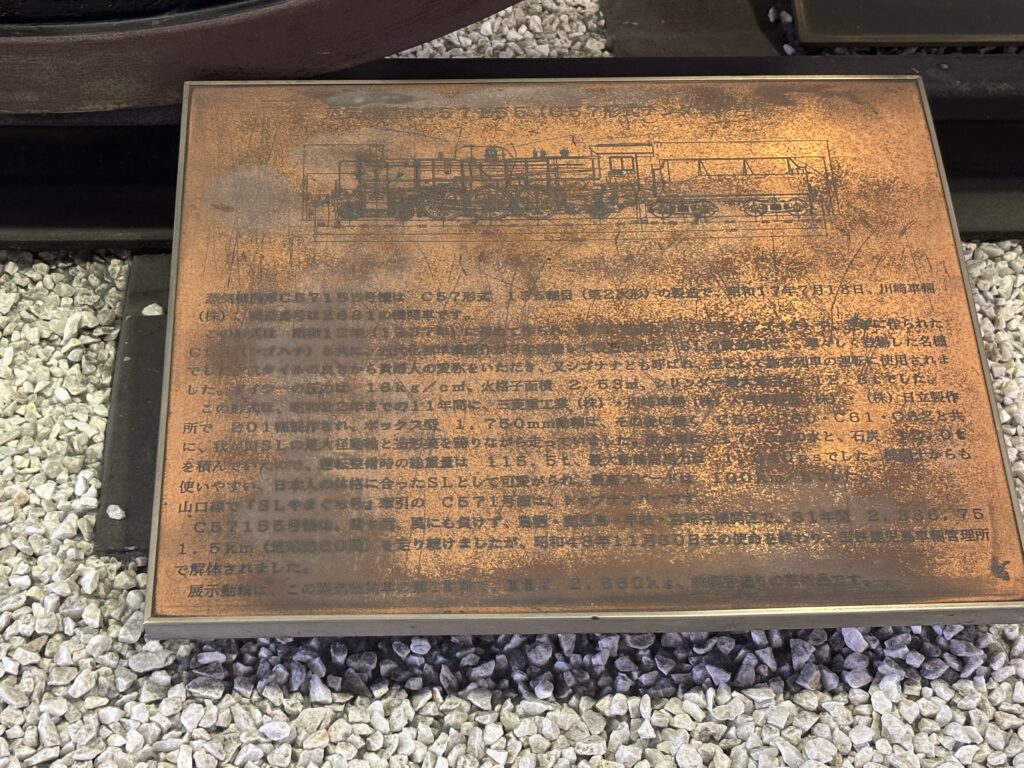
From left to right: a wheelset from car 21-50 of a 0 Series Shinkansen, a driving wheel from the C57 155 locomotive, and a driving wheel from the 29600. Each has its own brass plate, and the plates are worth stopping to read.

The 0 Series plate records that this wheelset covered 5,182,758.7 km over thirteen years, roughly 129 times around the Earth. The wheel began life 910 mm in diameter and had worn down to 847.92 mm by the time it was retired.

Information plate for the 0 Series Shinkansen car 21-50 wheelset

C57 155 was built by Kawasaki Sharyo in 1942 and ran for thirty-one years. What is on display is its second driving wheel, 1,750 mm across and weighing 2,880 kg.

Information plate for the driving wheel of locomotive C57 155

I stop and look every time I have a reason to be on the first floor. It is inside the station, so a few minutes is all you need.

Nakajima Soja Shrine: Five Minutes on Foot

If you have a little room in your schedule, Nakajima Soja is about a five-minute walk from the station.

It is a shrine with more than 1,300 years of history and almost no tourists. Locals simply call it the Nakajima shrine. I go there myself at New Year.

Allow fifteen minutes for the walk there and back plus the visit itself. If you only have an hour, you will have to cut something else to make room.

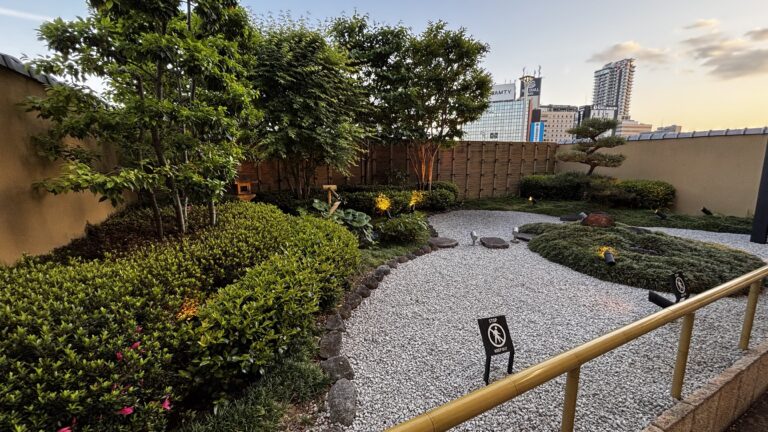
The Roof Garden at Arde Shin-Osaka

The outdoor garden on the third floor of Shin-Osaka Station

Arde Shin-Osaka, the shopping complex connected to the station, has a roof garden.

The appeal is the surprise of it: a garden, at Shin-Osaka. There are benches, so it works perfectly well as a place to sit down for a while.

One honest warning. You cannot see the Shinkansen from here. It is sometimes described as a hidden train-watching spot. It is not one. Come for the novelty of finding greenery at the station, not for the trains.

In Summary: With One Hour, Don’t Try to Do Everything

What you want to do | Realistic time | Notes

What you want to do Realistic time Notes
Akashiyaki at Takomasa Depends on the queue Do this and skip everything else
551 Horai pork buns Minutes on a weekday evening, long queue at weekends You can buy a single bun
TakopatieMinutes, convenience stores includedIf in doubt, this one
Steam locomotive wheels (1F) A few minutes Inside the station
Nakajima Soja Shrine15 minutes there and back Outside the station
Arde roof garden10 minutes No Shinkansen view

You cannot fit all of it into an hour. Choosing between a meal and shopping is the realistic approach.

And to repeat the point I opened with: if you are travelling by Shinkansen, changing your train time is also an option.

If you have half a day rather than an hour, Umeda is only a few minutes away by train.

From Hachioji to Mount Fuji on the Kaiji & Fujisan Express | Yoshida Udon, Fujisan View Express and a Fujisan-Themed Train Adventure

What You’ll Learn in This Article

  • How to get to the Mount Fuji area by train via Kaiji and Fujisan Express
  • The unique interior and headcovers of the Fujisan Express
  • All about Yoshida Udon — Fujiyoshida’s beloved local specialty
  • Information on the Fujisan View Express — next on our must-ride list!

Shin-Yokohama → Yokohama Line → Hachioji — Already Feeling the Yamanashi Vibe!

Our journey began at Shin-Yokohama Station, transferring to the Yokohama Line bound for Hachioji Station.

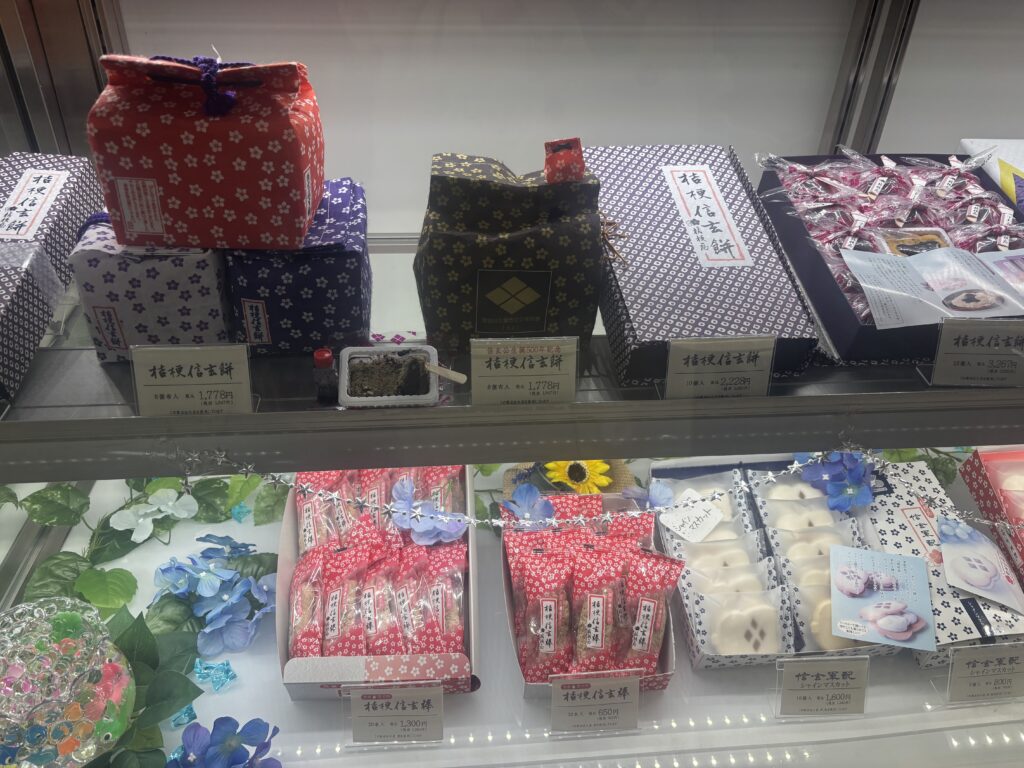
Despite still being within Tokyo, the Kiosk at Hachioji Station was already stocked with Shingen Mochi — the famous sweet from Yamanashi. And this time, a very special find caught our eye: a limited-edition Shingen Mochi in a commemorative drawstring pouch celebrating the 500th anniversary of Shingen’s birth! We made a firm mental note to pick one up on the way home, then boarded Kaiji No. 39.

Kikyo Shingen Mochi at the Hachioji Station kiosk, with the black pouch for Takeda Shingen's 500th anniversary in the centre

Limited Express Kaiji is operated by JR East between Shinjuku and Kofu / Matsumoto. It also stops at Hachioji, reaching Otsuki in approximately 30 minutes. On weekday evenings, seats are plentiful and every seat comes with a power outlet — making it perfect for working on the go.


Kaiji on a Weekday Evening — The Perfect Mobile Office

On a weekday evening, the Kaiji was noticeably uncrowded, with power outlets at every seat. Laptop open, work in progress — the 30-minute ride to Otsuki passed in no time.

Tips for Riding the Kaiji

  • Power outlets at every seat — ideal for working on the go
  • Quieter than expected on weekday evenings
  • Only about 30 minutes from Hachioji to Otsuki
  • Both reserved and unreserved seating available

Transfer at Otsuki Station to the Fujisan Express — Welcome to the Fujikyu Railway World!

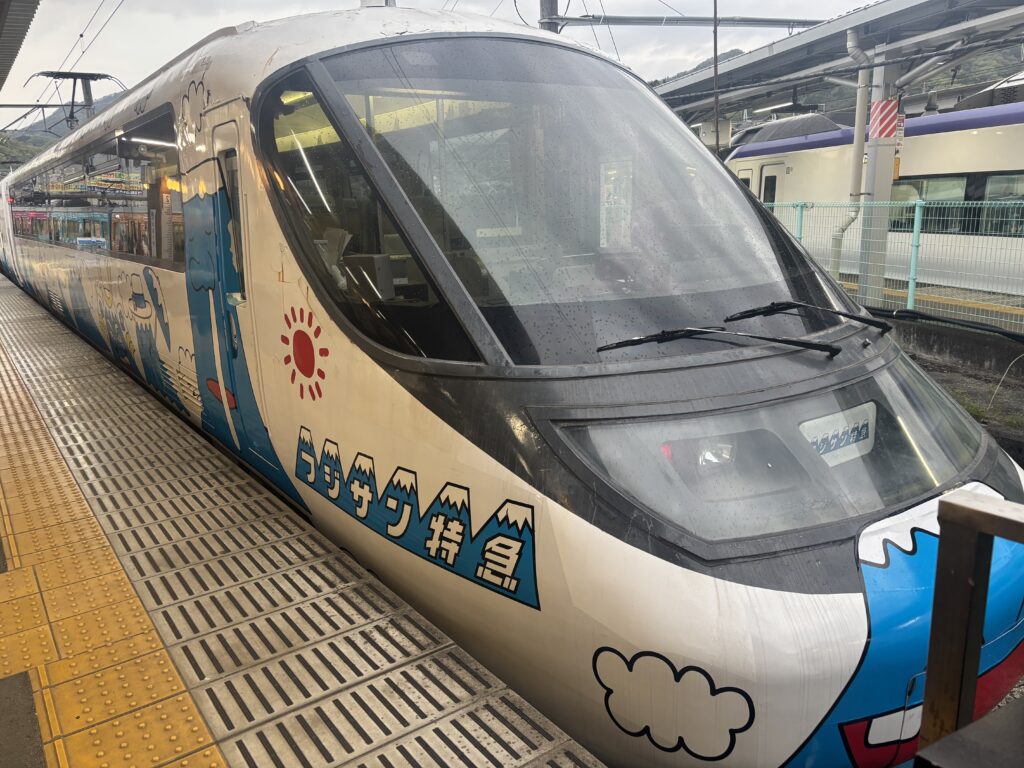
Just 30 minutes from Hachioji, we arrived at Otsuki Station and transferred to Fujisan Express No. 5.

Stepping onto the Fujikyu Railway platform, we were immediately greeted by a parade of brightly wrapped trains arriving and departing. The colorful lineup of vehicles made it instantly clear — we had arrived in Mount Fuji country.


The Fujisan Express at Otsuki Station, covered in Mount Fuji characters, with its name in Japanese

The Fujisan Express Interior Is Pure Joy! Don’t Miss the Headcovers

The Fujisan Express is covered in Mount Fuji illustrations — inside and out. The moment you step aboard, your excitement levels shoot straight up.

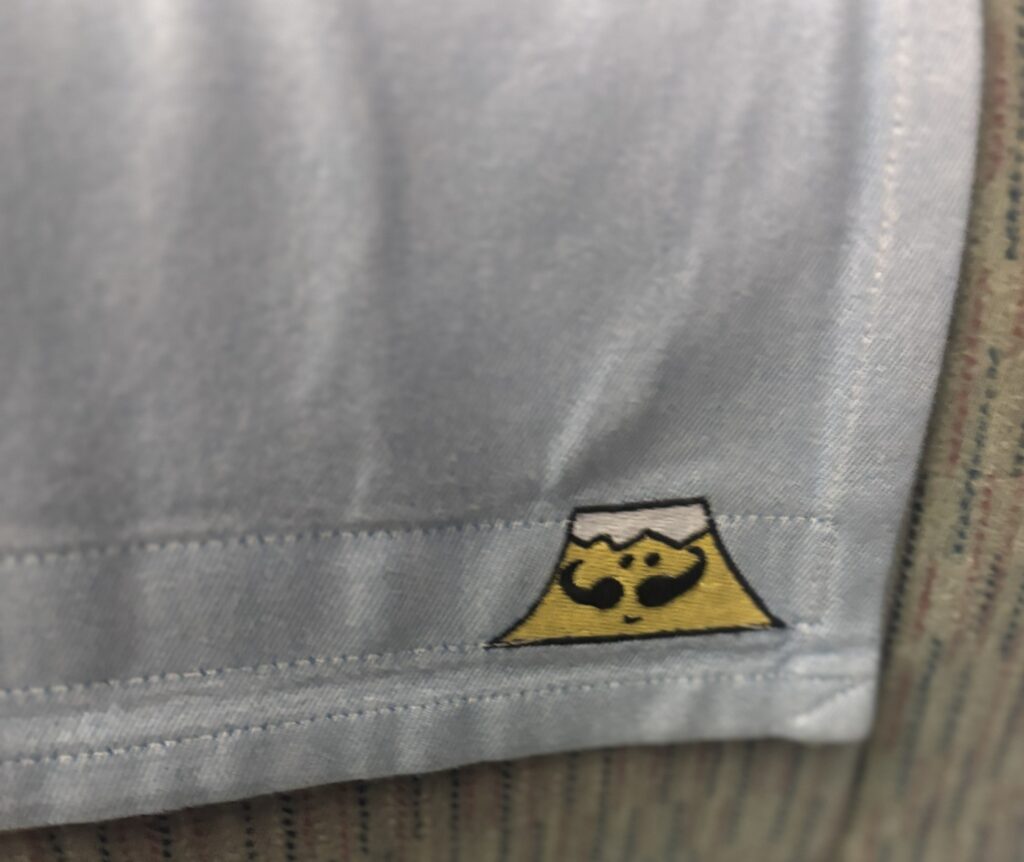
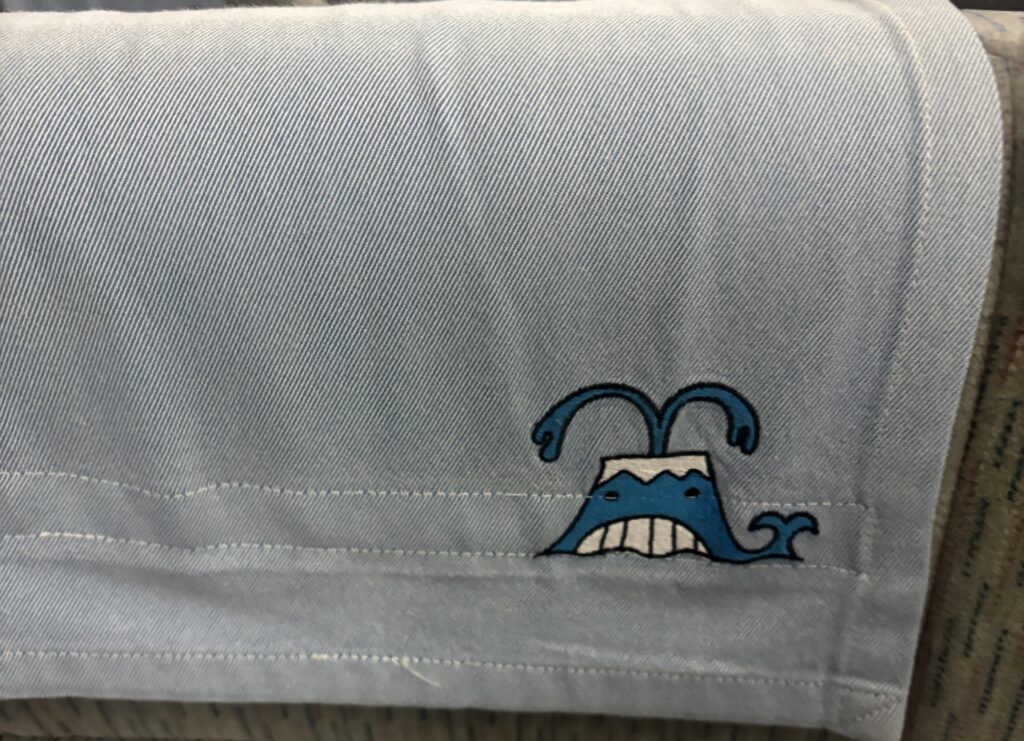
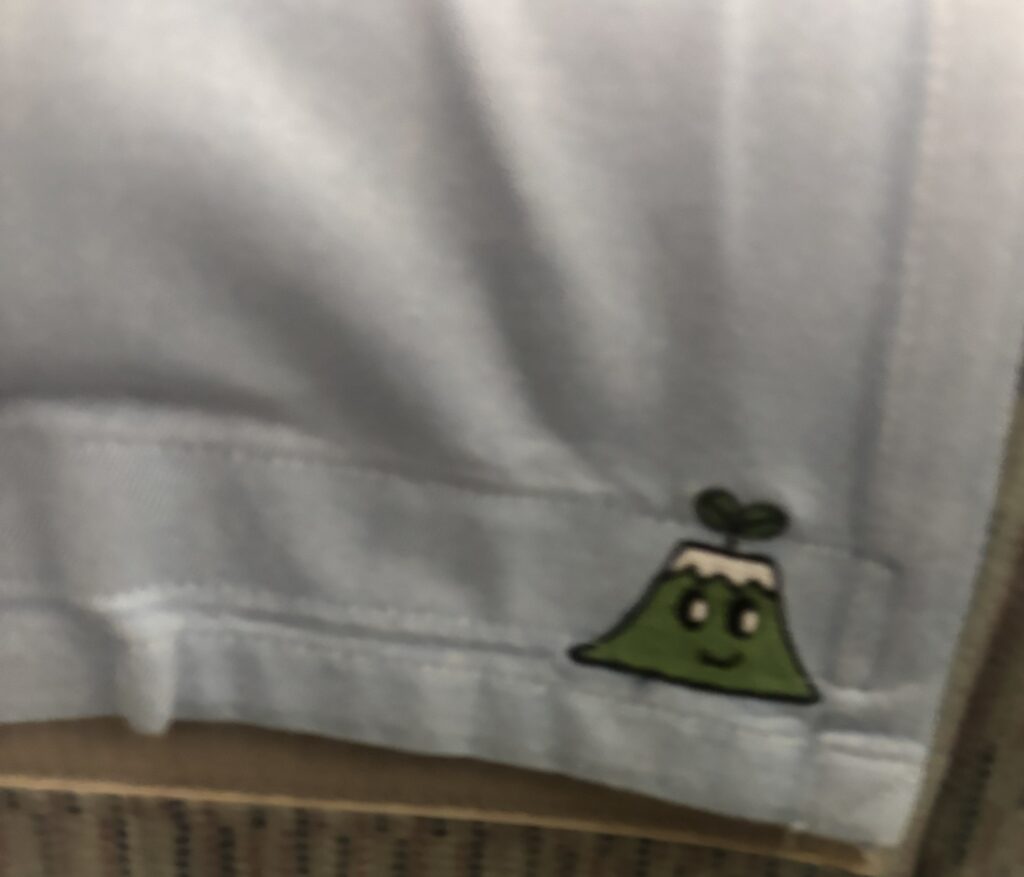
The real highlight? The headcovers on the seats, each featuring a completely different illustration of Mount Fuji. You’ll find yourself checking every single one.

A Selection of Unique Headcover Designs

  • “Whale Fuji” — a Mount Fuji that is also a whale, spouting from its summit
  • “Eco Fuji” — a green Mount Fuji with a sprout growing on top
  • “Monsieur Fuji” — a yellow Mount Fuji sporting a moustache

Hunting for your favorite headcover design is one of the great joys of riding this train!

Fujisan Express is operated by Fujikyu Railway between Otsuki and Kawaguchiko. Filled with playful Mount Fuji-themed design throughout, it is enormously popular with tourists and railway fans alike.

Trying Yoshida Udon — Fujiyoshida’s Legendary Local Noodle

No visit to the Mount Fuji area is complete without Yoshida Udon — the proud local specialty of Fujiyoshida City.

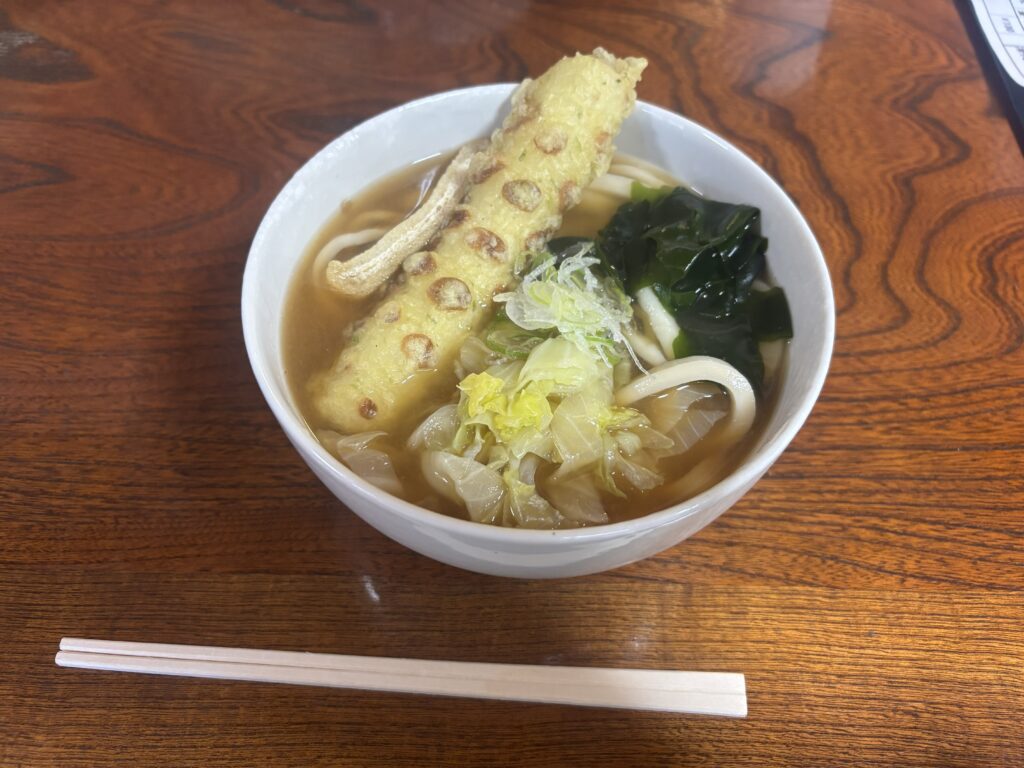
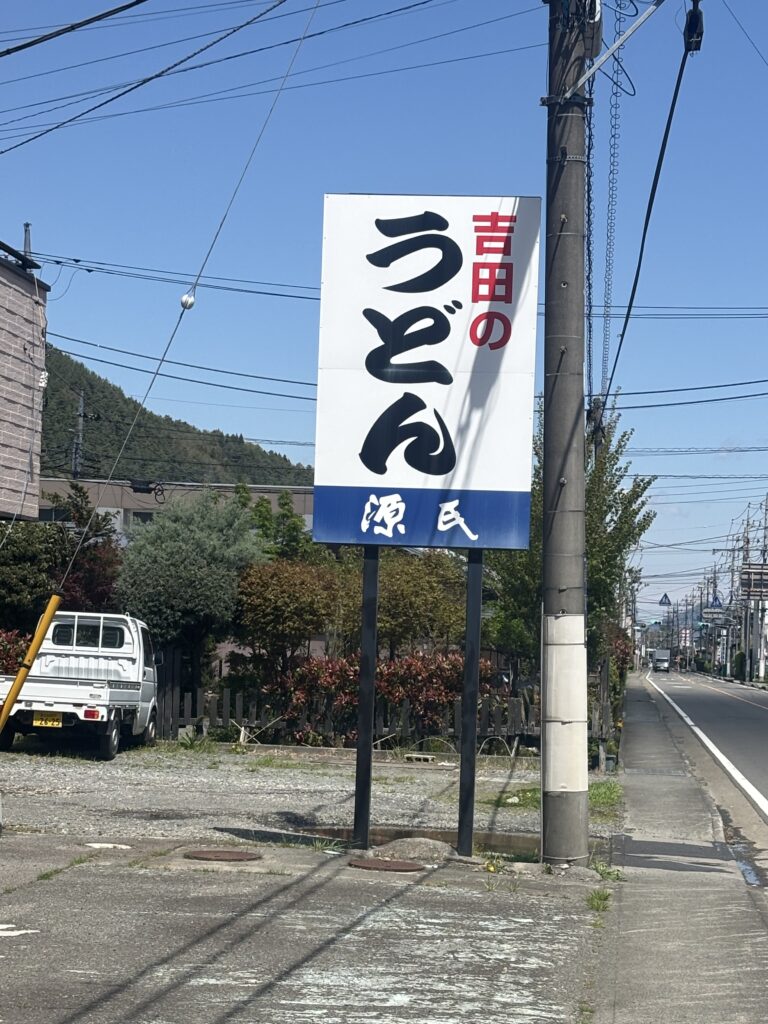
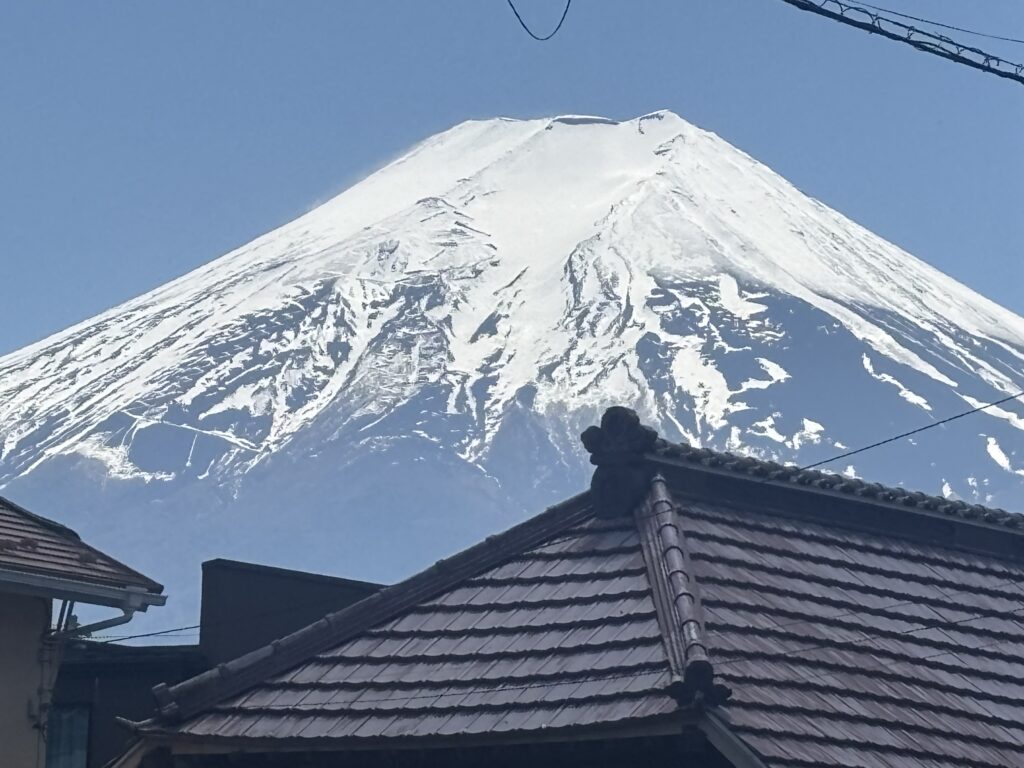
We ordered a bowl with miso broth and chikuwa tempura topping. The firm, chewy noodles paired beautifully with the miso-based soup, creating a simple but deeply satisfying flavor. Taking our seats at a restaurant called “Genji,” we looked up to find a stunning view of Mount Fuji framing the backdrop — a view that stopped us in our tracks all over again. Only in Fujiyoshida can you enjoy great food and a great view at the same time.

Yoshida udon in miso broth, with chikuwa tempura, cabbage and wakame
The sign for Yoshida no Udon Genji
Snow-capped Mount Fuji rising behind a tiled roof

Yoshida Udon is a regional specialty of Fujiyoshida City, Yamanashi Prefecture. Known for its exceptionally firm and chewy texture and its distinctive blend of miso and soy sauce broth, it offers a completely different experience from typical Japanese udon. A must-try when visiting the Mount Fuji area!


The Return Journey on the Fuji Excursion (Fuji Kaiyu) — and a Stunning Surprise on the Platform

For the return leg, we took thethe Fuji Excursion (Fuji Kaiyu) — a direct and convenient option back toward Tokyo.

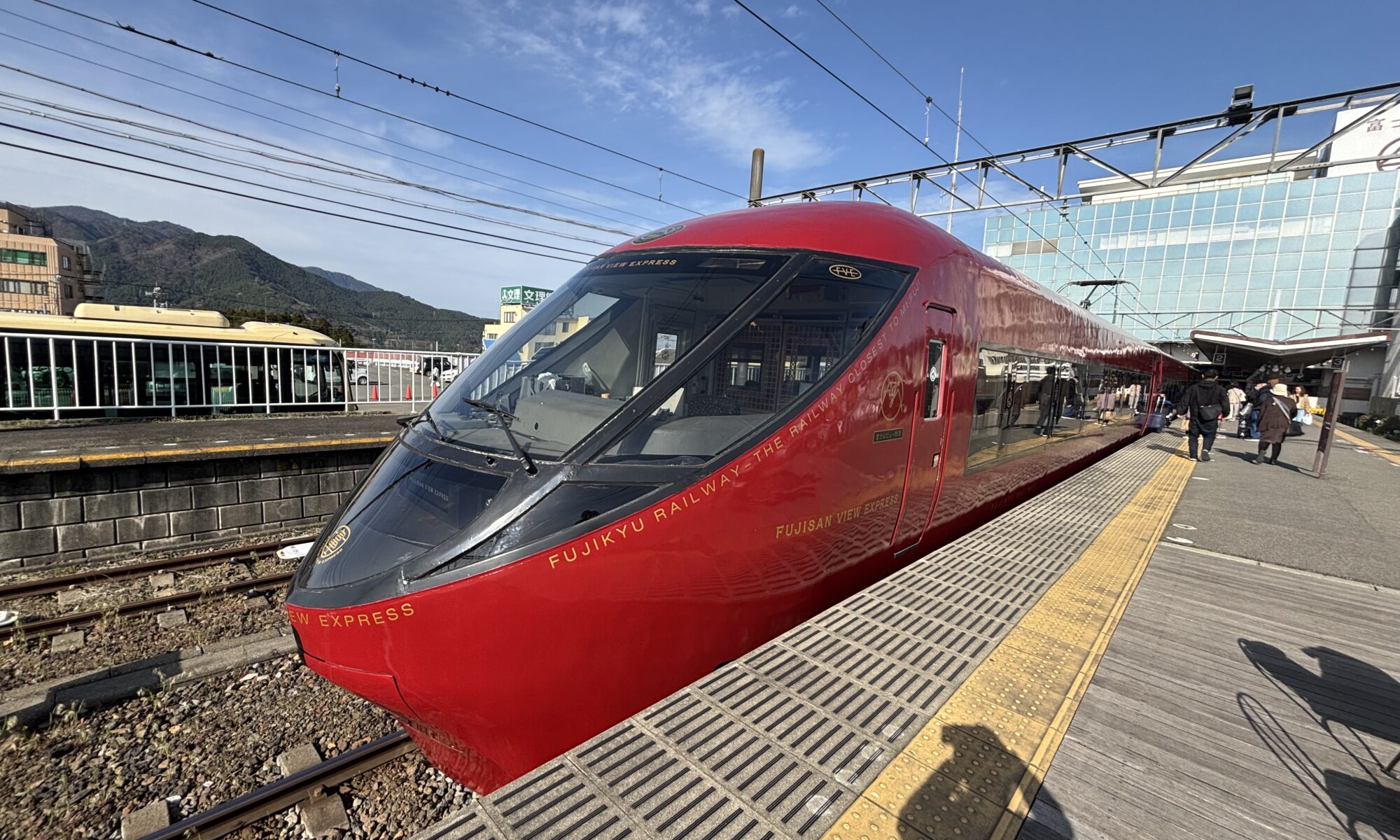
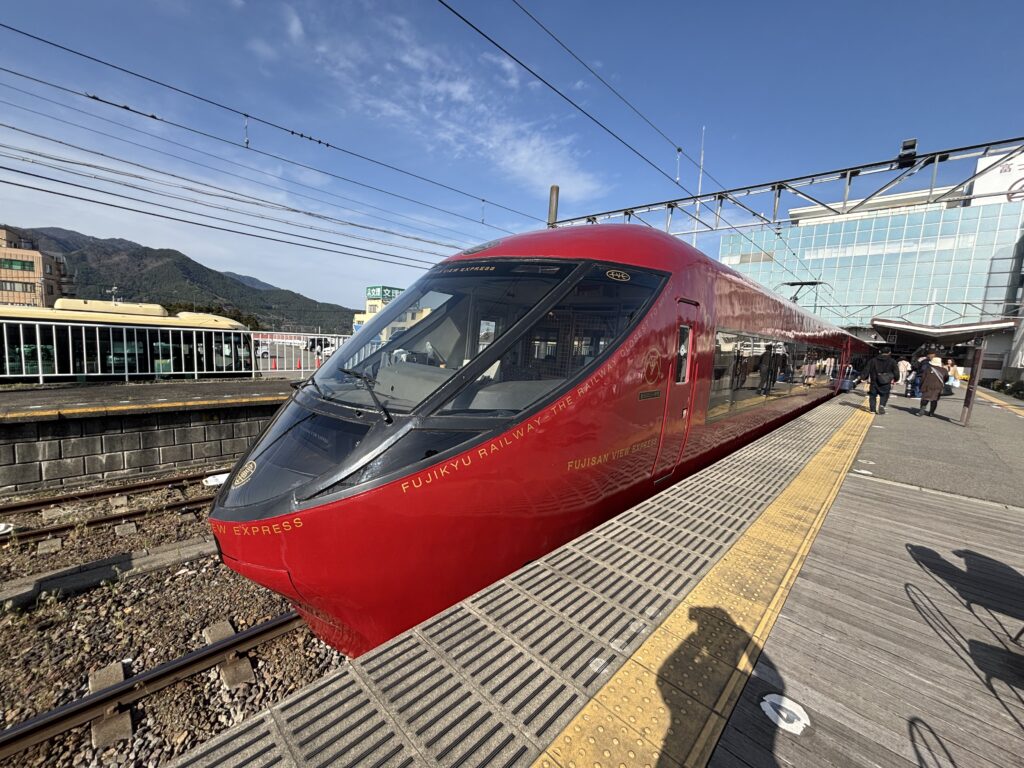
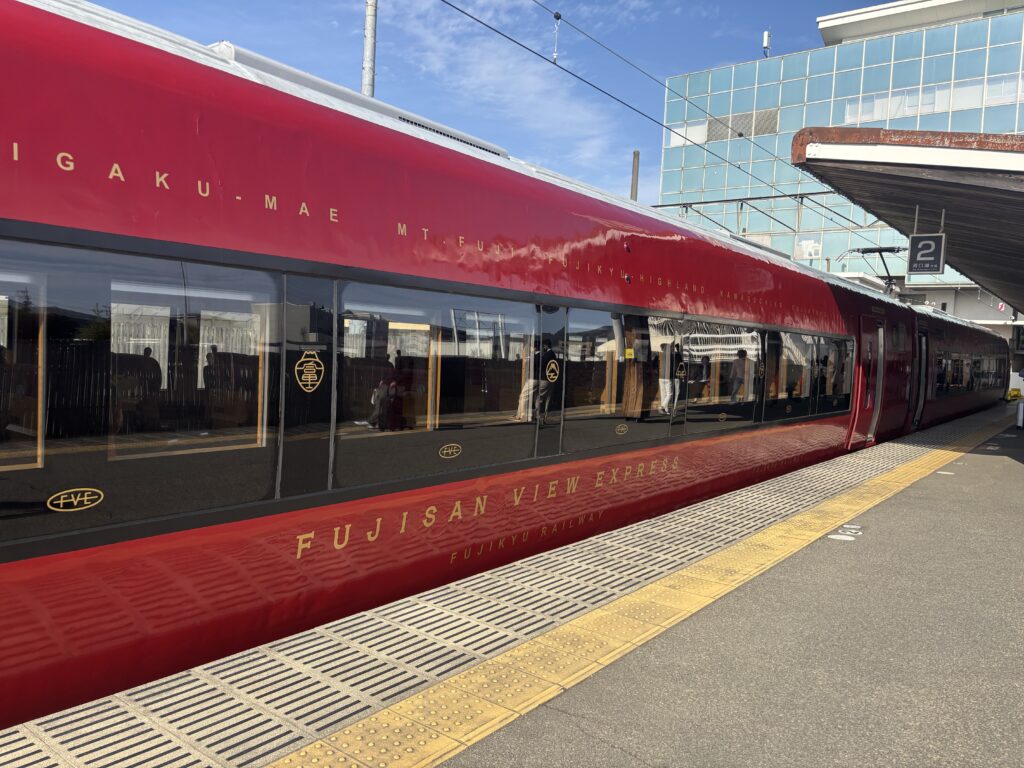
While waiting on the platform, a very special train glided in: the Fujisan View Express, designed by the industrial designer Eiji Mitooka. That striking crimson red body was absolutely breathtaking. This is officially next on our must-ride list!

Confusingly, the Fujisan Express we rode that day (8000 series) and the Fujisan View Express that pulled in (8500 series) are two different trains. Both run on the Fujikyu line, but the rolling stock and the interiors are completely different.

The crimson Fujisan View Express at the platform
The side of the Fujisan View Express, lettered "FUJISAN VIEW EXPRESS" in gold

Fujisan View Express is a sightseeing limited express operated by Fujikyu Railway. Designed by Eiji Mitooka, the designer behind the Seven Stars in Kyushu, its bold crimson exterior is instantly recognizable. All seats are reserved, so advance booking is recommended if you’d like to ride.

Don’t Forget the Souvenir — Special Shingen Mochi at Hachioji!

On the way home at Hachioji Station, we successfully picked up the special 500th anniversary commemorative pouch Shingen Mochi we had spotted in the morning. A limited-edition souvenir that made the perfect memento of the trip.

Shingen Mochi is also available online!


Access Summary | Getting to the Mount Fuji Area by Train

SectionTrainJourney Time
Shin-Yokohama → HachiojiYokohama LineApprox. 40 min
Hachioji → OtsukiLimited Express KaijiApprox. 30 min
Otsuki → KawaguchikoFujisan ExpressApprox. 50 min
Returnthe Fuji Excursion (Fuji Kaiyu)Direct & convenient

Summary | The Mount Fuji Area Offers So Much More Than Just the Mountain!

Spot / TrainHighlights
Limited Express KaijiPower outlets at every seat — work while you travel
Fujisan ExpressUnique headcovers & Mount Fuji-themed interior throughout
Yoshida UdonMiso broth, chikuwa tempura & a stunning Fuji backdrop
Fujisan View ExpressEiji Mitooka’s crimson design — next on the must-ride list!

The Mount Fuji area offers a completely different experience with each train you ride. We highly recommend combining multiple trains for a truly memorable journey!

If you want to see Mount Fuji from the Tokaido Shinkansen instead, the seat to ask for is the E seat.