
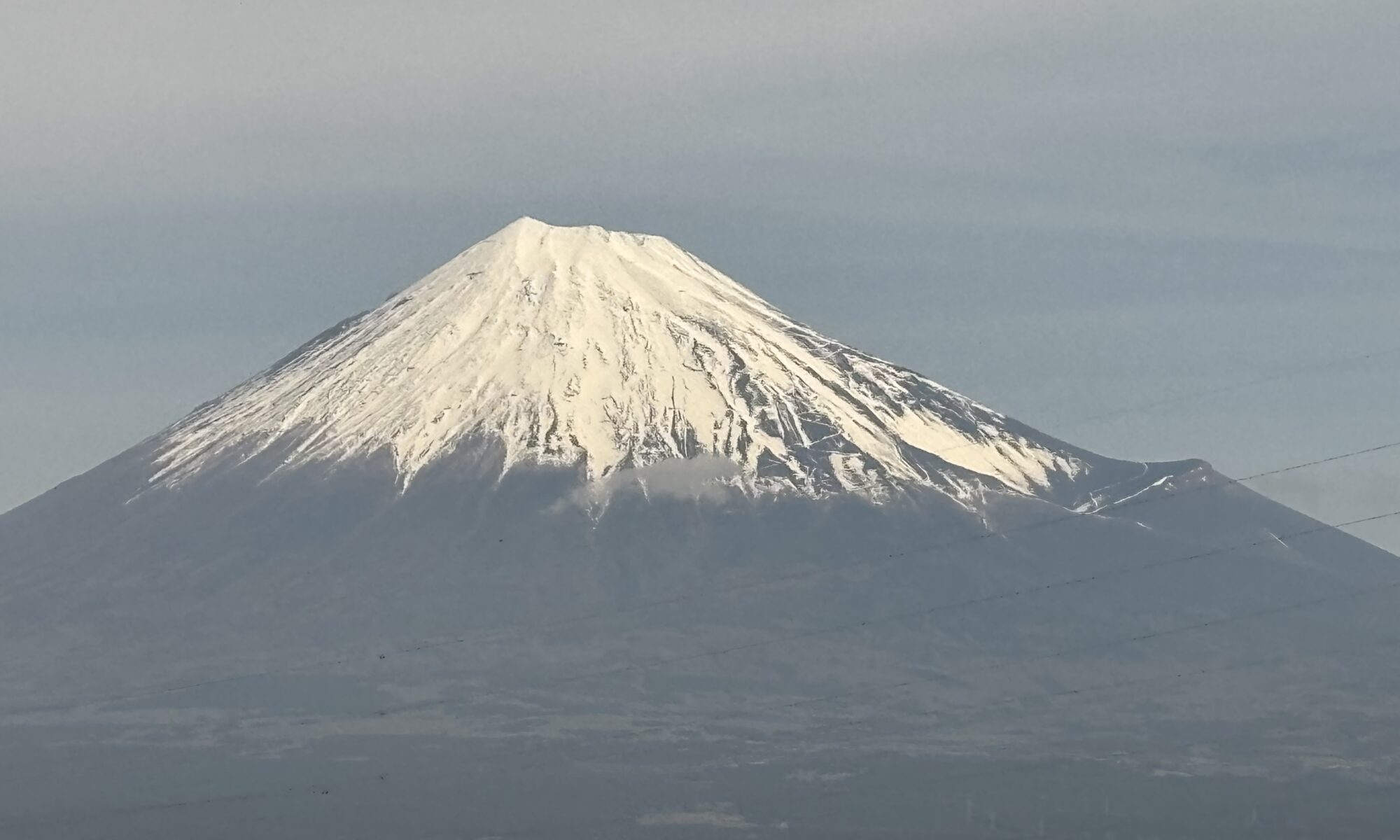
If you want to see Mount Fuji from the Tokaido Shinkansen, you want an E seat. Going west it is on the right, coming east it is on the left — either way, E is the Fuji side. Here is what I have learned riding this line for work, including why the blinds are often down in rows A to C on morning eastbound trains.
March–April: Peak Season for Shinkansen Business Travel
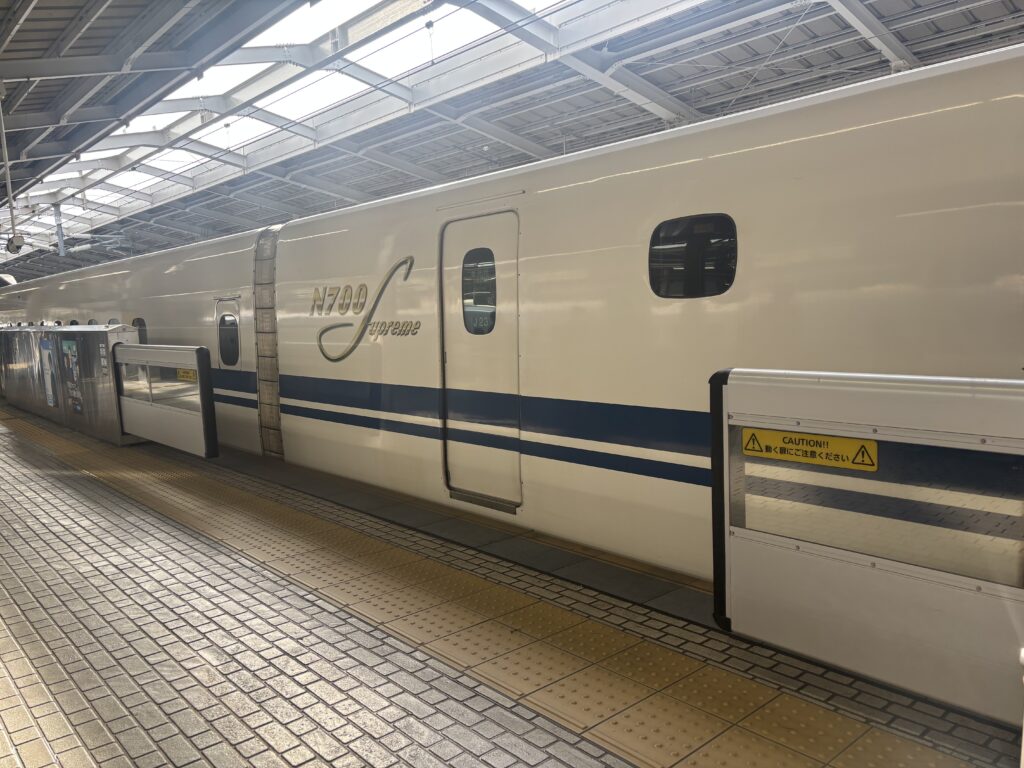
Because of the work we do, March and April bring a lot of business trips, and with them a lot of rides on the Tokaido Shinkansen N700S. We’re partial to Car 7, which tends to fill up with business travelers — but at this time of year the Shinkansen holds a quiet pleasure that only a railway fan would notice.
Want to See Mount Fuji? Go for Seat “E”!
If you want to see Mount Fuji from the Tokaido Shinkansen, your seat is everything.
Ordinary cars are split into a three-seat row (A, B, C) and a two-seat row (D, E), and that lettering doesn’t change whether you’re heading for Tokyo or for Shin-Osaka. The mountain side is always E; the sea side is always A.
Heading west (Tokyo → Shin-Osaka), Seat E is on your right. Heading east (Shin-Osaka → Tokyo), it’s on your left. But either way, Mount Fuji appears on the E side. Rather than trying to remember left or right, just remember “Seat E” — it’s the reliable rule.
The best stretch for Mount Fuji is between Shin-Fuji and Shizuoka stations. The mountain shows most clearly in winter and early spring, when the air is at its clearest. Clouds tend to gather in the afternoon, so aim for a morning departure.
On a Morning Train to Tokyo, Seat E Decides Whether You See Anything at Al
There’s one more thing worth knowing if you’re taking a morning train up to Tokyo.
Morning eastbound trains run straight into the rising sun, and the light comes in hard on the A–C side. It’s bright enough that those curtains generally stay shut for the entire run. Even on a beautifully clear day, passengers on the sea side can’t see out at all.
Seat E faces north, so the glare never reaches it and you can leave your curtain open the whole way. On a morning run to Tokyo, whether or not you’re in Seat E more or less decides whether you get a view.
A Special Announcement Interrupted Our Work!
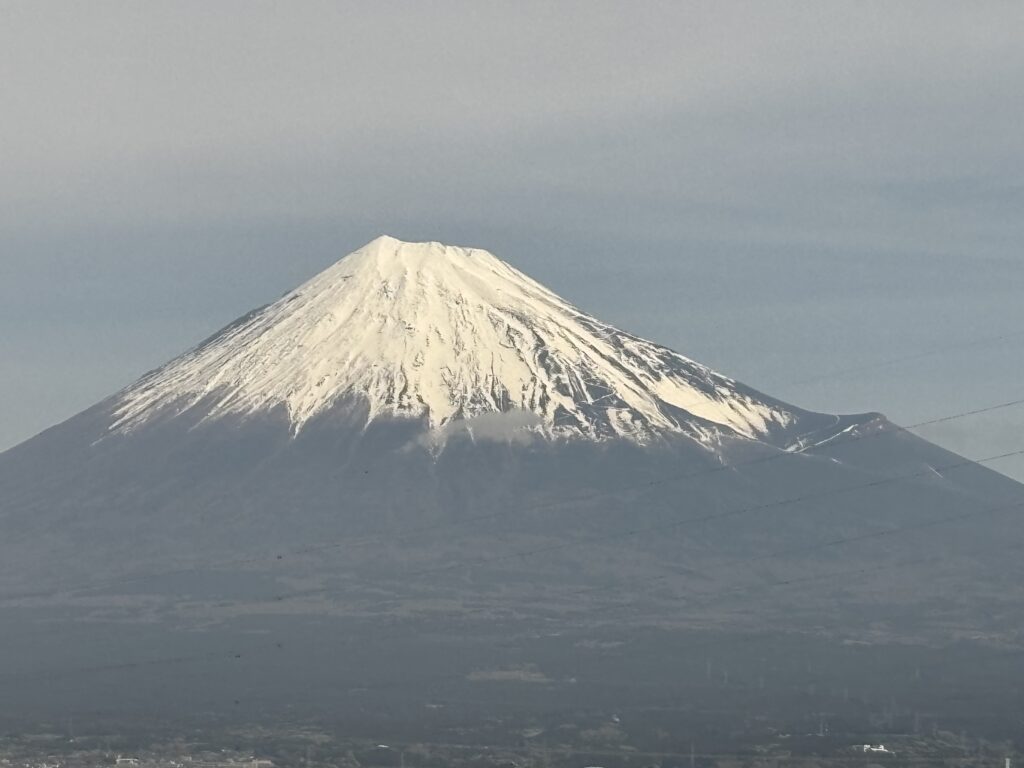
On this particular trip we were heads-down working when an announcement came over the speakers: “Mount Fuji is visible on the left-hand side of the train.”
We scrambled for the camera and got the shot. Worth putting the work down for. This announcement is only made when conditions are right, so if you hear it, point your camera and don’t hesitate.
Sitting in Seat E, we finally came face to face with Mount Fuji. The mascots pressed themselves against the window to look, and after a while one of them announced: “That mountain is wearing a hat!” They had mistaken the snow on the summit for headwear. It’s exactly the sort of thing you’d say if you weren’t used to seeing snow — and honestly, once it’s been pointed out, a snow-capped Fuji does rather look like it’s wearing a hat. Seeing the mountain through that kind of fresh perspective made it something special all over again.
Why Car 7 Is Perfect for Business Travelers
Car 7 draws a lot of business travelers, which makes for a calm atmosphere, and it’s well set up for working: power outlets throughout and a reasonably generous tray table. Book Seat E and you get Mount Fuji into the bargain — two birds with one stone.
The N700S entered service in 2020 as the newest generation on the Tokaido Shinkansen. Every seat has a power outlet, Wi-Fi is standard, and the ride quality is a clear step up, which makes long trips considerably easier.
Quick Guide: Spotting Mount Fuji from the Shinkansen
| Point | Details |
|---|---|
| Seat to book | Seat E (on your right heading west, on your left heading east — the Fuji side either way) |
| Best stretch | Between Shin-Fuji and Shizuoka stations |
| Best season | Winter through early spring, when the air is clearest |
| Best time of day | Morning — clouds build in the afternoon |
| Morning eastbound note | Curtains on the A–C side are usually closed against the sun |
| Car to choose | Car 7 — quiet, business-oriented |
Booking Seat E with Smart EX
We book our Tokaido Shinkansen travel through the Smart EX app. Registration is free, and you can pick Seat E straight from your phone. Changes are accepted up to six minutes before departure, which has saved us more than once when a business trip shifted. Link it to Mobile Suica and you can walk straight through the gates.
If Mount Fuji is the goal, secure Seat E by the day before to be safe.
It’s Not Only Mount Fuji on the E Side
.Mount Fuji isn’t the only reason to want Seat E. Lake Hamana and Mount Ibuki are both on the E side as well.
Lake Hamana (Shizuoka Prefecture) Visible as the train crosses the bridge. It isn’t really something you can sit and wait for — you glance out the window and it has already gone past.
Mount Ibuki (Shiga / Gifu Prefectures) Visible near Sekigahara, and, as it turns out, also on the E side. We’re a little embarrassed to admit we’ve never consciously looked for it. Next business trip, we intend to.
Take a look out of the window on your next trip. It makes the time pass rather more richly.
N700S Basic Information
| Item | Details |
|---|---|
| Entered service | 2020 |
| Lines | Tokaido and Sanyo Shinkansen |
| Top speed | 285 km/h (Tokaido) / 300 km/h (Sanyo) |
| What the “S” stands for | Supreme |
| Features | Power outlets at every seat, high-performance braking, improved ride quality |
Summary | Don’t Forget to Enjoy the Journey, Even on a Business Trip
Even when you’re working, simply booking Seat E means Mount Fuji might be waiting for you as a reward. Something to keep in mind next time you reserve a seat, for business or for pleasure.
The Shinkansen is not the only way to see Mount Fuji from a train window.